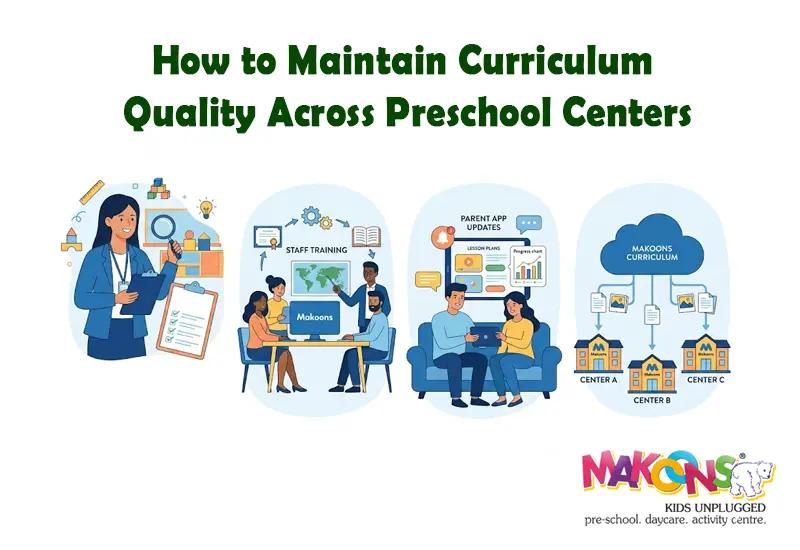
When the preschool brands are being developed in various locations, consistency is a significant challenge. The parents want to see the identical learning experience, safety measures, and the quality of teaching in all branches. This is where good quality control of the preschool curriculum proves necessary.
A curriculum document is not sufficient in multi-location operations. You require the following listed systems, training, monitoring, and continuous improvement processes that will make sure that your standardized preschool curriculum could be implemented effectively all around.
In this blog, we shall discuss effective actions that could be taken to keep the high standards of early childhood education, reinforce the work of teachers, and develop systems of effective multi center preschool management.
The Importance Of Curriculum Consistency
By sending their child to a preschool brand, parents will expect:
- Uniform learning standards
- Formal developmental milestones.
- Premeditive and conducive classroom conditions.
- Stable teacher professionalism.
- Predictable daily routines
The failure of one center has an impact on the brand image. That is why it is essential to sustain the quality of teaching in preschool centers.
1. Construct A Well-Arrived Standardized Preschool Curriculum
It must start with clarity.
In your curriculum, you should have:
- Lesson plans of the monthly plans.
- Weekly activity breakdowns
- Age group learning objectives.
- Assessment frameworks
- Mapping developmental milestones.
- Activity resource lists
Do not have imprecise curriculum outlines. Offer organised records that do not leave much to be desired.
Clarity is the first step towards consistency.
2. Develop Structured Curriculum Implementation Manuals
The finest curriculum cannot work without due implementations.
In order to have good preschool curriculum control, submit:
- Teacher handbooks
- Daily routine templates
- Guides are demonstrations of activities.
- Sample classroom schedules
- Guidelines of behavior management.
These instructions decrease differences in teaching styles in centers.
3. Invest Into Preschool Teacher Education
The drivers of the quality of curriculum lie in the teachers.
Training programs in preschool teacher training programs must include:
- Training of new employees.
- Curriculum walkthrough sessions Curriculum walkthroughs.
- Training on classroom observation.
- Child psychology basics
- Raising awareness by training in assessment and reporting.
- Parent communication seminars.
The training process should not be a single one. Conduct:
- Refresher training every quarter.
- Annual skill upgrades
- Frequent performance appraisals.
Training continuously means that all the branches have the same standards.
Related Topic: Curriculum Planning Tips for New Preschool Owners and Educators
4. Carry Out Periodic Academic Audits
Accountability is ensured by monitoring.
Introduce systematic audits like:
- Observation of classrooms unexpectedly.
- Lesson plan review checks
- Review of child progress documentation.
- Parent feedback analysis
- Education of material inspection.
Design an assessment checklist that is in line with the standards of early childhood education to objectively measure performance.
5. Apply Centralized Planning Systems
Centralized systems are used in multi center preschool management to diminish variability.
Central control can include:
- Monthly curriculum calendar that is distributed among all centers.
- Basic types of assessment centralized.
- Common reporting templates
- Shared teaching resources
- Electronic monitoring of classroom processes.
The coordination between the head office and the branches can be made easy through technology platforms.
6. Standardize Evaluation And Follower Development
There should be consistency in child testing.
Standardization must contain:
- Common observation tools
- Milestone tracking in a structured manner.
- Established reporting times.
- Regular parent progressive reports.
When they have different assessment systems in different centers, this causes confusion and destroys credibility.
7. Create An Effective Communication Loop
In the preschool, teaching quality should be maintained by open communication between:
- Academic heads
- Center coordinators
- Teachers
- Management
Encourage:
- Weekly review meetings
- Teacher discussion forums
- Sharing of best practices
- Cross-center collaboration
The ability to learn with each other enhances the general curriculum delivery.
8. Develop A Culture Of Dependability
Quality control is not a piece of paper, it is a culture.
Promote:
- Ownership among teachers
- Appreciation of well-performing centers.
- Incentives for innovation
- open performance appraisals.
When educators are responsible and appreciated, standards are by default upheld.
9. Collect Parent Feedback Systematically
Another stakeholder is the parents.
Collect feedback through:
- Quarterly surveys
- Parent-teacher meetings
- Suggestion forms
- Digital feedback tools
Compare trends across centers to establish gaps in curriculum implementation.
When several parents raise the same issues, then corrective measures should be taken immediately.
Related Topic: Nursery Program Curriculum Explained: What Children Actually Learn At Age 3–4
10. Enforce Standard Infrastructure
The quality of the curriculum is also dependent on the environment.
Ensure all centers maintain:
- Classroom furnishings that are age-related.
- Safe play areas
- Sufficient learning resources.
- Clean and organized spaces
- Standard safety protocols
Teaching can be affected by the inconsistencies in infrastructure.
11. Promote Creativity Within Organization
Standardization is not inflexibility.
Allow teachers to:
- Introduce innovative changes to actions.
- Provide culturally relevant illustrations.
- Individualize classroom interaction.
Nevertheless, it was always in the context of the uniform preschool curriculum.
Flexibility and consistency of balance.
12. Improve Through The Use Of Data
Measure indicators, which include:
- Student performance standards.
- Enrollment retention rates
- Parent satisfaction scores
- Ratings of teacher performance.
Expert based decisions enhance the quality control systems of the preschool curricula.
Frequent Multi Center Preschool Management Issues
There is a tendency to manage many centers, which may result in:
- Diversity in the quality of teaching.
- Diffusion in carrying out activities.
- Communication gaps
- Staff turnover issues
- Regional operational dissimilarities.
Solve these issues with well-executed policies and effective academic leadership.
Advantages Of Quality In Curriculum
Good consistency in the curriculum leads to:
- Improved brand credibility
- Higher parent trust
- Better word-of-mouth marketing.
- Improved child development.
- Long-term growth which is sustainable.
Equal opportunities safeguard your brand.
Quality Excellence Long Term Strategy
For lasting impact:
- Establish an educational management team.
- Undertake an annual currency upgrade.
- Compared to new standards of early childhood education.
- Implement technology-based surveillance.
- Invest in teacher retention programmes.
Quality maintenance is a continuous process, not a single undertaking.
Conclusion
With the rise in the number of preschool networks, the consistency of the curriculum becomes the foremost ingredient in brand success. A well-identity defined standardized preschool curriculum, teacher training, academic audit, centralization and continuous monitoring maintain high quality of delivery in all the locations.
It needs a level of discipline, communication, and accountability to effectively manage multi center preschools. Once the quality of curriculum is guarded, it benefits all the preschool systems, including teachers, parents, and children.
Consistency builds trust. Trust builds reputation. Reputation builds growth.
FAQs
1. Why should the quality of preschool curriculum be controlled?
It guarantees the reliability of learning outcomes, safeguarding the brand reputation, and development of parent trust in all centers.
2. What is the way standardized preschool curriculum can increase performance?
Well-defined instructions lead to minimized confusion, consistency in methods of teaching, and progressive developmental milestones.
3. Preschool teacher training programs are conducted frequently?
New employees will be required to get induction training, followed by refresher training after every quarter and skill upgrade training on an annual basis.
4. What do you think are the greatest issues in multi center preschool management?
Ensuring that teaching quality, consistency in communication and performance of staff is the same irrespective of where one works.
5. What can parents do to ensure that teaching is good?
The parent feedback will help in showing the performance in the classroom and the areas that need to be improved.
6. Is standardization in curriculum restrictions to teacher creativity?
No. Standardization offers order, but it leaves space in set learning goals to permit innovation.







 Twitter