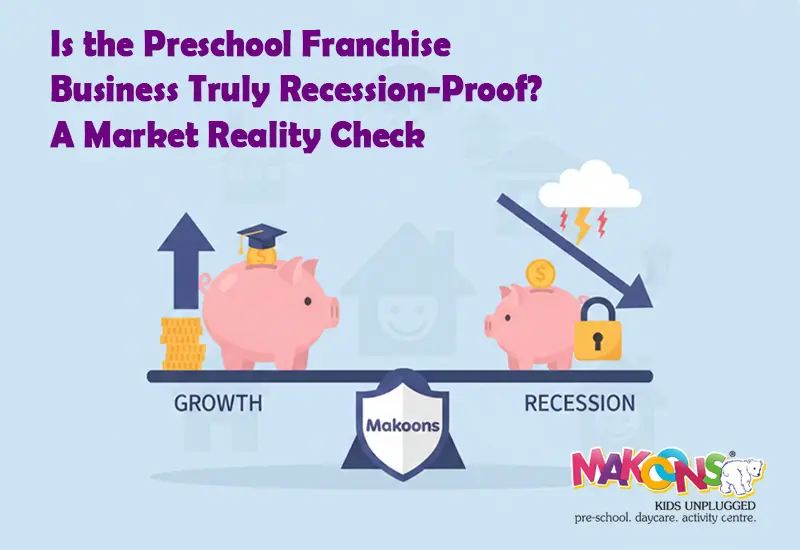
Some businesses deteriorate very quickly when economic times are hard whereas some businesses stand or even increase. One of the questions raised by many education entrepreneurs and investors is:
Is Preschool Franchise Business Recession-Proof?
In this blog we shall discuss whether it is realistic to invest in a recession proof business in India by looking at the dynamics in the preschool industry. Some of the issues that we will consider are preschool business in times of economic recession, risk of investing in preschool franchise, stability of education franchise and whether the preschool franchise ROI is worth considering this investment.
The Meaning Of Recession-Proof
A recession-proof business is an industry that is not affected easily when the economy decelerates or its effects are minimal. These are usually businesses that provide some vital services which customers will still consume in their spending even in a recession.
Traditionally resilient industries to recession are:
- Grocery and food essentials
- Healthcare services
- Utility services
- Low cost education and child care.
However is the same true of the preschool franchise business?
The Reason Preschools Are Considered To Be Recession Resistant
Preschools are relatively stable even during tough times because of several reasons:
1. Childcare Is A Necessity
In the case of most of the families and particularly those where both parents work:
- Preschool is not only education but also childcare.
- Preschool services are required by households with dual incomes.
- Continuity of learning and care is a priority of parents to young children.
Owing to this reason, the demand is usually continuous even when other costs are minimized.
2. Long Enrollment Cycles
The majority of pre-schools have an annual or termly admissions schedule. This means:
- Families commit months on months.
- Schools possess stable cash flow.
- The changes in the economy in the short-term have a lesser effect.
This structure offers stability, although this does not ensure the firm is totally stress-free in its economic positioning.
3. Early Education Is Regarded As Something Of Value
Awareness on the significance of early learning has grown in the last ten years. Most parents regard preschool as the necessity to:
- School readiness
- Social skills development
- Language and early literacy
- Formal play and intellectual development.
This attitude favors constant demand not only in big cities but also in smaller towns which are getting more and more schemes of demand.
Related Topic: How to Become a Successful Preschool Franchise Owner in India: A Step-by-Step Guide
The Truth Behind Preschool Franchise Investment Risk
There is no business which is risk free – not even in the educational sector. The following are some of the possible challenges and risks to be considered prior to investing in a preschool franchise.
When The Market Is In Recession, Fee Sensitivity Is Low
When families become cost conscious:
- The parents can change to cheaper alternatives.
- There can be an increment in the discounts and negotiations of fees.
- There are those that can postpone enrollment in preschool.
This may impact admissions and revenue.
Franchise Owners Face Cost Pressures
The cost of running a preschool would include:
- Rent for classroom space
- Utility bills
- Salaries and training of the teachers.
- Maintenance and supplies
These expenses do not fall during economic recessions – but the revenues can either remain constant or increase at a slow rate.
Competition Intensifies
Even small recessions can bring about in a saturated market:
- Promotional fee discounts
- Competitive marketing costs.
- Franchisee stress to improve facilities.
This has the potential to squeeze profit margins when not done well.
Reliance On Local Demographics
Success in preschools is usually related to:
- Young family population.
- Local employment rates
- Neighborhood income levels
Regions where the working age population is declining or whose economic activity is declining can experience decreased demand.
Related Topic: Most Trusted Preschool Franchise Under 10 – 20 Lakhs. Start Now
Franchise Stability Education: Why Is It So Strong?
The stability of education franchise businesses has several features even though it is risky:
Established Brand Support
The owners of the franchise are advantaged with:
- Recognized brand names
- Curriculum frameworks
- Operational support
- Marketing materials
This eliminates the uncertainty of start up as opposed to individual preschool establishment.
Organized Parental Involvement
Effective parent communication and engagement systems are helpful:
- Build loyalty
- Reduce churn
- Expand enrollment on a long-term basis.
This will be able to cushion revenues even during economic declines.
Efficiency-Training And Operational
Most franchisors provide:
- Initial teacher training
- Ongoing skill development
- Standard operating procedures.
This enhances uniformity and lowers chances of low quality of service which would damage admission.
Preschool Business In Economic Down Turn: Data And Trends
In analyzing past trends:
Demand Is Not Halted By Economic Downturns
When there has been a previous slowdown, preschools have tended to demonstrate:
- Minor declines in enrollment in severe recessions.
- Rapid recovery as soon as economic stability has been restored.
- The ongoing need to have affordable early learning.
Parents usually keep taking children to preschool even when the GDP is growing slowly since there is a need to have childcare as well as early learning.
Related Topic: How to Expand from One Preschool Franchise to a Chain?
Urban Vs. Semi-Urban Impact
Whereas demand in major cities can be altered by small amounts during recessions, semi-urban and smaller markets tend to be more stable due to them:
- Reduce the number of preschool choices.
- Face less competition
- Experience unswerving demand of the basic education services.
This subtle perspective assists investors to be smarter.
Preschool Franchise Roi: What To Expect
Among the most frequently used concerns of investors is return on investment (ROI).
Some of the factors that affect preschool franchise ROI are:
- Initial investment cost
- Local market demand
- Cost and charge set.
- Operational efficiency
- Quality and retention of teachers.
- Parent referrals and marketing.
A preschool franchise in good management can provide:
- Foreseeable sources of revenue.
- Long enrollment cycles
- High parent retention rates
- Effective word-of-mouth recommendations.
Nevertheless, the expectations should be fair in the sense that ROI is not only about the idea but also execution and local forces.
Frequently Asked Questions
1. Is preschool franchise a recession proof business in India?
Not completely, however, it is generally more stable than many other industries because of constant childcare and pre-school needs.
2. What are the key risks of preschool franchise investment?
The most important risks are the sensitivity of fees to recession, the operating expenses, human resource issues, and the demographic changes locally.
3. What is the performance of the preschool business in economic depressions?
Preschools tend to have small effects as compared to other businesses. During normal times the demand would be stable and the demand would recover extremely fast as the economic conditions normalize.
4. What are the strengths to the stability of the education franchise business?
Brand support, systematic curriculum, parent involvement, and operational systems help in ensuring that the brand remains stable in the long-term.
5. Is it possible to have a high preschool franchise ROI?
Yes, in case the business is operated well with good admissions, cost management, parent satisfaction and efficient business operations.
6. What are the things that investors need to think about running a preschool franchise?
These are location analysis, market demand, franchise support, teacher training systems and financial planning.
Summing up, preschool franchise business is quite resilient and attractive, although it is not completely resistant to changes in the economic environment. It can be an enriching business venture financially as well as socially with proper planning and execution.







 Twitter