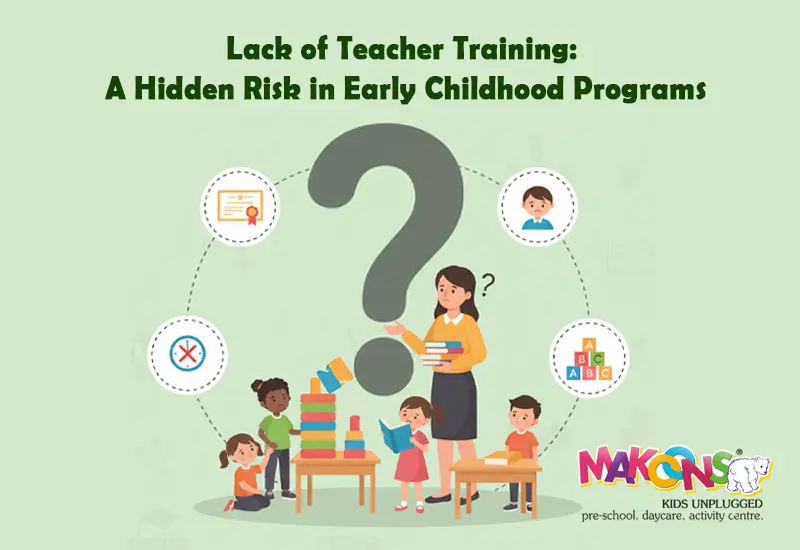
Childhood is among the most important periods in human life. Development of cognitive, emotional control and language acquisition as well as social behaviour is determined by the establishment of the foundation between the ages of 3 to 6. However, the unspoken secret behind most of the early learning programs is the absence of teacher training. Though much attention is paid to infrastructure, curriculum, and technology, the role of professional preparation of educators is usually neglected.
This covert divide is a dangerous threat to quality preschool education not only in the short-term classroom results, but also the long-term developmental trajectories.
Why Early Childhood Education Requires Special Training?
Educating the young children is not merely the case of overseeing play or learning alphabets. It needs an in-depth knowledge of child psychology, growth, behavior management, and inclusion learning.
Unless the training of a preschool teacher is done correctly, the educator may:
- Negatively perceives normal developmental delays as behavioral issues.
- Apply wrong forms of discipline.
- Do not stimulate cognitive-language development.
- Difficulty in coping with different learning requirements.
- Ignore emotional well-being.
Early childhood education issues are peculiar. Children in early childhood are not able to express their hardships. Teachers have to notice, evaluate and act with proficiency, which can be taught only to the participants of the organized process of teacher skills development.
The Real Impact Of Teacher Training Shortcoming
The untrained teachers of early learning programs cause the wave in several directions:
1. Failure To Create Consistency In The Learning Experiences
- Unstandardized training of teachers is the use of personal instincts instead of evidence-based practices.
- It makes implementation of the curriculum inconsistent.
- The results of learning in a classroom differ.
2 .Weak Classroom Management
- Children of early age need routines.
- The untrained teachers might not cope with transitions, managing attention and group dynamics.
- This causes chaotic environments which discourage learning.
3. Inadequate Cognitive Stimulation
- The guided play, storytelling, introduction to phonics, sensory activities, problem-solving exercises are all relied on to make quality preschool education.
- The lessons can turn out to be monotonous or excessive without the proper training.
- Innovativeness and inquisitiveness are harmed.
4. Poor Emotional Support
- Emotional regulation is very important in early years.
- Untrained teachers will not be able to identify the symptoms of anxiety, attachment and developmental concerns.
- Emotional deprivation in such developmental stages may be long-running.
5. Safety And Ethical Concerns
- Early learning education should be safety-related and child protection-related.
- Training is also lacking, which will put one at risk of handling sensitive situations.
Current Problems In Early Childhood Education Development Systems
Early learning programs are growing at a very high rate in most of the regions. Nonetheless, the development of infrastructure usually exceeds professional preparation. This creates a critical gap:
- The schools are more concerned with the enrollment rather than the qualification of the educator.
- The training workshops are either irregular or optional.
- The standards of certification are laxly implemented.
- There is minimal professional development of teachers.
This has led to classrooms being superficially arranged, yet not instructively.
Also read: How to Hire the Right Teachers and Staff for Your Preschool?
The Reason Preschool Teacher Training Is More Than Ever
Early childhood education has developed in the modern world. In the present day the early learning programs are focusing on:
- Play-based learning
- Social-emotional development
- Inquiry-driven exploration
- Education of various learners.
- Essentials of digital literacy.
The provision of this involves teacher skills development, in the form of:
- Knowing development psychology.
- Creating lesson plans that are age relevant.
- Positively managing behavioral issues.
- Establishing special learning needs.
- Effective communication with parents.
The lack of formal training in preschool teachers makes it possible that they are using old-fashioned or inflexible teaching methods that are not in line with recent studies in education.
The Long-Term Effects Of Being Poorly Taught In The Early Years
The effect of early education goes much deeper than a preschool age. It has always been found that quality early education leads to:
- Improved education.
- Improved social skills
- Higher graduation rates
- Less behavioral difficulties.
On the other hand, inappropriately governed early learning systems may result in:
- Low confidence in learning
- Attention difficulties
- Weak literacy foundations
- Negative school attitudes
These first years are undermined quietly because of lack of teacher training.
Indications Of Quality Pre-School Education System
In a bid to overcome education challenges in early childhood education, institutions should focus on teacher preparation. It is common to have a great system that contains:
- Compulsory certification standards.
- Organized orientation programs to new instructors.
- Constant professional growth seminars.
- Mentorship systems
- Observation and feedback processes in the classroom.
Quality preschool education does not simply consist of colorful classrooms or good marketing. It is founded on competent teachers who know the way children learn.
The Importance Of Ongoing Teacher Skills Development
Training of teachers must not conclude on certification. Continuous skills training of teachers would make sure that they are abreast with:
- Recent studies in children’s growth.
- Practices of inclusive education.
- Technology integration in the classrooms.
- Techniques of positive behavior reinforcement.
- Parent involvement measures.
The lifelong learning process makes teachers supervisors change to growth facilitators.
Policy-Level Remedies To The Deficiency Of Teacher Training
In order to reduce the latent risks of the early learning programs, there is a series of systemic changes required:
Strengthening Regulations
- Introduce minimum qualification requirements.
- Require regular renewal of training.
Investing In Professional Development
- Funded certification and training.
- Provide available online training courses.
Enhancing Teacher Compensation
- Skilled professionals are attracted using competitive salaries.
- Rewards promote constant growth.
Monitoring Quality
- Periodic classroom testing.
- Parent and staff feedback systems.
Once policymakers consider early childhood education as a professional area but not a childcare approach, the whole system becomes better.
The Role Of Parents In Determining Good Early Learning Programmes
Parents would also be helpful in closing the divide by considering:
- Undergraduate credentials and qualifications of teachers.
- Student-to-teacher ratios
- The classroom organization and participation.
- Professional development courses.
- Communication transparency
There should be a request to ask knowledgeable questions that push institutions to accountability and greater standards.
Conclusion
One risk of early childhood programs that is not visible but is very strong is the lack of teacher training. Although a building, branding, and curriculum framework may sound impressive, it is the professionalism of educators that makes early learning programs so strong.
The barriers affecting the provision of early childhood education cannot be resolved by expanding, it needs to be invested in individuals. Teacher skills development and high-quality teaching of preschool can only be achieved through intense training of the preschool teacher.
When the society actually cares about the early years, then it should start to prepare those who make them should become an aspect. Since in early childhood education the teacher is not only a teacher, he or she is the creator of the future of a child.







 Twitter