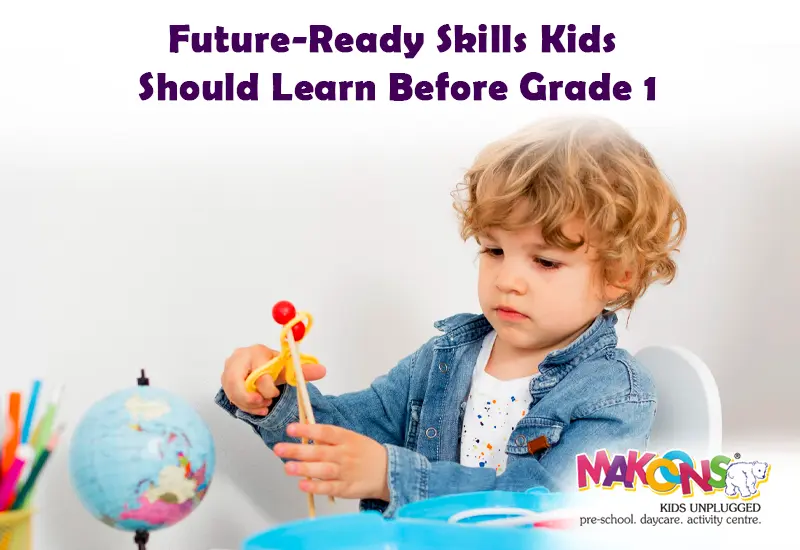
As education keeps on transforming, parents and teachers alike are giving more attention to future ready skills among kids. The first phase of life is the cornerstone of the entire lifelong learning and it is therefore important to provide the necessary skills to the kids before they enter high school. Preschool is not merely about ABCs and figures but also equipping young children with the necessary skills in early childhood education that would be able to unleash the potential to succeed in the 21st century.
This paper is about the most significant pre-grade-1 skills, why they are important, and what parents can do to ensure that kids are ready to start school in a holistic manner.
The Reason Why Future-Ready Skills Matter in Early Childhood?
In the contemporary dynamic world, education does not entail cramming of facts. Rather, creative, problem-solving, adaptability and communication have become the basis of schools. This is why early 21st century skills of children should be taught early, not just academics, but social, emotional and practical skills as well.
Preschool learning skills help to make sure that children will easily move to the 1st grade, interact with other children, and fit into formal classrooms. Such competencies also enhance self-confidence, curiosity and passion to learn- attributes that will be lifelong.
1. Communication, Language Development
One of the most important future ready skills among kids is strong communication. Prior to grade 1, children must understand how to express themselves, take direction, and have a basic conversation.
How to Encourage:
- Read stories everyday to develop vocabulary.
- Play rhyming and word games.
- Get children to answer and ask questions.
Language proficiency will aid in getting the kids prepared to attend school because they will be able to be actively involved in the classroom.
2. Literacy and Numeracy Skills.
Essential preschool learning skills include basic reading, and number recognition. Though children are not expected to be able to master academics prior to grade 1, they are expected to become acquainted with letters, sounds and numbers.
Examples:
- Identification of letters and relating them to sounds.
- Counting objects up to 20.
- Shapes and colors.
These skills have been developed before grade 1 that makes the transition to formal learning easier.
3. Social and Emotional Skills
Academic preparation is not sufficient on its own- emotional intelligence is also a part of early childhood education skills. Children are to understand how to share, take turns, control emotions and work in groups.
Benefits:
- Better classroom behavior.
- Stronger friendships.
- Less separation anxiety of parents.
Social skills are essential in the 21st century, since in future jobs the skills of collaboration and teamwork are critical.
4. Issue-Resolution and Critical Thinking
Those children who are able to think critically and solve problems on their own adjust better to challenges. These are future ready skills in kids which makes them creative and innovative at an early age.
Activities:
- Puzzles and construction blocks.
- Open questions, such as: What is it possible to do in case this toy breaks?
- Promoting trial and error over providing instant solutions.
At the core of equipping kids to school in a competitive and technology driven world is problem-solving.
5. Fine and Gross Motor Skills
Most motor development is not really given attention yet it is a vital part of early childhood education skills. Fine motor (holding pencils, using scissors) and gross motor (running, jumping) skills prepare children for activities in the classrooms and outside field.
How to Build:
- Drawing, crafts, and coloring.
- Play outside such as skipping, hopping and climbing.
- The most basic activities such as buttoning clothes or pouring water.
Good motor skills provide children with a sense of assurance and self reliance.
Related Topic: Signs Your Child is Prepared for Preschool – A Parents Guide
6. Information Technology Awareness and Digital Literacy.
In the digital age, simple technology awareness is a 21st century skill among children. Children should be taught proper and healthy usage of devices although exposure to devices should be moderated.
Suggestions:
- Infinite learning apps.
- Educating good screen behaviors.
- Basic typing or drawing on tablets.
This does not imply that we should turn the children into technology dependent but provide them with future ready skills of kids.
7. Creativity and Imagination
Innovation is fuelled by creativity. It can be storytelling, painting or pretend play, but promoting imagination is one of the key skills to be developed prior to grade 1.
Ways to Nurture Creativity:
- Give non-structured toys such as blocks and clay.
- Promote role-play (practitioner, instructor, merchant).
- Value their different ideas and drawings.
Innovative children tend to become creative thinkers thus becoming a fundamental element of the early childhood education competence.
8. Self-Help Skills/Independence
By the time of grade 1, children need to be ready to cope with simple tasks on their own. This is included in schooling kids and responsibility.
Examples:
- Packing their school bag.
- Absence of hand washing reminders.
- Eating meals independently.
These tiny steps develop trust and strength.
9. Elasticity and Strength
The transition between primary and preschool can be hectic. Flexibility is one of the future readiness skills in children that can assist them to manage unfamiliar schedules, instructors, and surroundings.
How to Foster:
- It is important to add little changes to everyday routine.
- Challenge kids to do things or eat new things.
- Congratulate efforts even though results are not ideal.
Strengthened children are in a better position to deal with both academic and social challenges.
Related Topic: How Makoons Prepares Children Through Preschool and Pre-K Programs?
10. Love of Learning/Curiosity.
Lastly, curiosity is the most useful skill prior to grade 1. A child with a passion to learn will automatically shine academically and even more.
Ways to Build Curiosity:
- Respond to their questions of why.
- Go to libraries, museums and parks.
- Do practical experiments such as seed planting.
Inquisitiveness is the basis of lifelong learning and creativity.
Related Topic: 5 Must-know Tips To Make Your Child School-ready
Conclusion
Giving kids future ready skills gives them confidence, independence, and readiness in the modern classroom. These early childhood education skills extend past the textbooks, in terms of language development and motor skill acquisition, as well as digital literacy, and emotional intelligence.
With the concern on preschool learning skills, parents and teachers will be able to guarantee that the process of entering grade 1 is all intrinsic, enjoyable and inspiring. Finally, it is not only about academic achievement, but about bringing up whole persons capable of working in the 21st century.






 Twitter