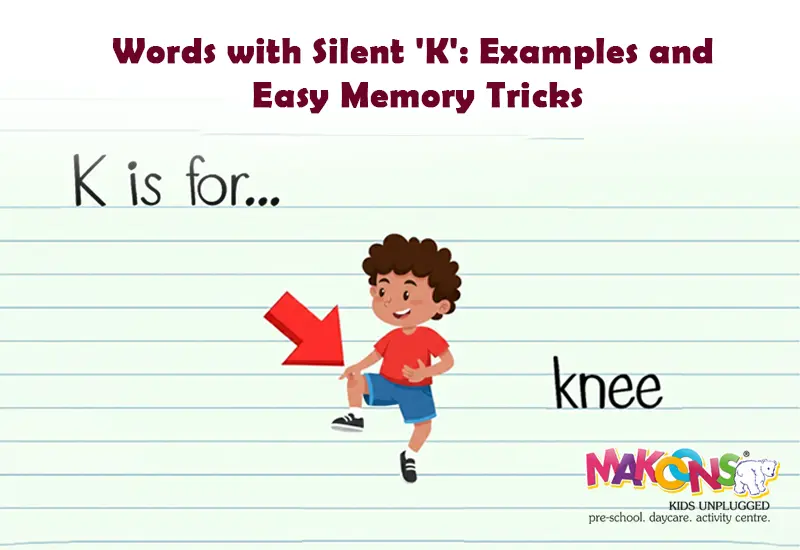
Acquiring the skills of reading and spelling in English might pose a challenge for youngsters. A contributing factor is the presence of mute letters. Silent letters are those characters we include in writing but omit in speech. A frequent example of a voiceless letter is ‘k’ situated at the start of certain words.
Within this post, we shall investigate words containing a silent k, provide illustrations, and offer straightforward techniques to aid children’s recall. This can boost foundational literacy abilities and simplify the English learning journey for kids.
What Are Silent K Words?
Words with a silent ‘k’ are those where the initial letter ‘k’ is not pronounced. Take the word “knight,” for instance; the ‘k’ there is mute. Young learners observe the ‘k’ but only articulate the remainder of the word.
Silent k words follow a common pattern. They usually start with ‘kn’. The ‘k’ is silent, and the ‘n’ is pronounced. This pattern helps kids spot silent k words more easily.
Examples of Words With Silent K:
- knee
- knife
- knock
- know
- knight
- knot
- knob
- knowledge
Why Is the ‘K’ Silent?
The silent ‘k’ comes from old English. Long ago, the ‘k’ was pronounced. Over time, people stopped saying it, but we still write it. This is why spelling rules for kids can seem confusing.
Understanding why letters are silent helps children be patient with tricky words. It also makes English learning for children less frustrating.
Common Rules for Silent K Words
Here are some simple spelling rules for kids about silent k:
‘K’ comes before ‘n’ – In almost all silent k words, the ‘k’ is followed by an ‘n’.
Examples: knock, knife, knee
The ‘k’ is never at the end – You will not see a silent k at the end of a word.
Used in both nouns and verbs – Silent k words can be objects or actions.
Nouns: knee, knob, knight
Verbs: knit, knock, know
Related Topic: 7 Days of a Week Names | Learn Days in English Easily
Easy Memory Tricks for Kids
Remembering silent k words can be easier with simple tricks. Here are a few ideas:
1. Picture Association
Draw or show pictures for words.
Knife – draw a knife.
Knee – draw a leg and point to the knee.
Kids connect the picture with the word and notice the silent k.
2. Sound Out Loud
Say the word slowly, first without the ‘k’. Then add it silently in your mind.
n + ight = night
n + ock = nock
This helps children recognize the pattern of words with silent k.
3. Word Games
Make simple games to practice silent k words.
Memory cards with pictures and words.
Matching games: word on one card, picture on another.
Games make English phonics for kids fun and improve early literacy skills.
4. Story Writing
Ask kids to write short stories using words with silent k.
Example: “The knight went to the knee of the hill. He carried a knife.”
This reinforces spelling and understanding.
5. Highlight the ‘K’
Use colored pens or markers to show the silent ‘k’.
Kids see the letter but remember it is not pronounced.
More Examples of Silent K Words
Here is a longer list of silent k words for practice:
- knack
- kneel
- knit
- knob
- knock
- know
- knowledge
- knife
- knight
- knot
- knapsack
- knead
Tips for Teaching Silent K Words
- Start Basic – Try simple terms such as knee, know, knife.
- Incorporate Visuals – Images, diagrams, and cue cards aid recall.
- Read Aloud Together – Highlight the silent ‘k’ words when reading texts.
- Promote Composition – Have youngsters create sentences incorporating these terms.
- Praise – Young learners progress quicker with positive development.
Related Topic: 5 Oceans of The World: Names & Sizes
Benefits of Learning Silent K Words
Teaching silent k words improves several areas of learning:
- Phonological Awareness – Youngsters discover that certain letters don’t have sounds.
- Orthography Skills – Aids in mastering spelling conventions for youngsters.
- Reading Assurance – Children become smoother readers once they recognize challenging words.
- Vocab Expansion – Words with unpronounced ‘k’ are frequently encountered in narratives and instruction.
Using Silent K Words in Daily Life
You can point out silent k words in everyday activities:
- Cooking: knife, knead
- Playing games: knock
- Learning: know, knowledge
- Sports: knee
Daily use helps children see practical importance and improves memory.
Related Topic: Teaching Preschoolers All Body Parts Names in English
Silent K Words for Early Learners
For early literacy skills, focus on words children see often. Examples:
- knee – “I hurt my knee.”
- knife – “Be careful with the knife.”
- know – “I know the answer.”
- knock – “Please knock before entering.”
Simple sentences help kids use the words correctly.
Practice Activities
Here are a few activities for teachers and parents:
1. Fill in the Blank
Example: “I will ___ on the door.” (Answer: knock)
2. Word Sorting
Sort words into two groups: words with silent k and words without.
3. Spelling Bee
Have a spelling contest using words with silent k.
4. Reading Aloud
Read short stories and highlight silent k words.
5. Craft Words
Use letter tiles or magnets to form words with silent k.
These activities make English learning for children interactive and fun.
Related Topic: Learn 50 Fruits and Vegetable Names in English and Hindi with Makoons Preschool
Summary
Silent k words can seem tricky at first. But with simple rules and memory tricks, children can learn them easily.
Silent k words start with ‘kn’. The ‘k’ is never pronounced.
Through visuals, interactive activities, narratives, and consistent application, facilitate their learning.
Consistent repetition enhances foundational reading abilities. Familiarity with these terms fosters self-assurance in both deciphering text and writing.
By concentrating on English phonics aimed at young learners and spelling conventions for children, youngsters can delight in the acquisition process and develop stronger reading proficiency. Grasping words featuring the silent ‘k’ represents a minor advancement that yields significant positive results in a child’s English acquisition journey.







 Twitter