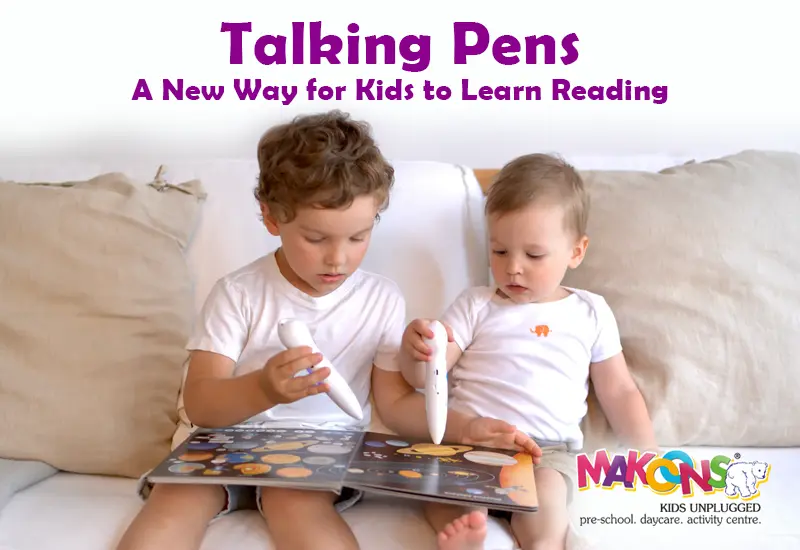
In the modern dynamic digital age, education is no longer in the realms of the classroom and the textbook. Educators and parents are also resorting to using smart learning aids, which involve making learning an enjoyable, interesting and efficient experience to children. A talking pen is one of the innovations that have become common in the global world. These media are transforming the manner in which children learn to deal with books, words and stories and early reading has become a fun journey.
In this paper, the authors discuss the benefits of the talking pen, the way teachers can use it to enhance learning tools, and reasons why it is rapidly becoming one of the most indispensable tools to teach reading to preschoolers.
What is a Talking Pen?
A talking pen, sometimes referred to as reading pen and smart pen, is a child learning technology that can help kids learn how to read. It operates on uniquely printed books or cards that have concealed codes. When the children use the pen to touch words, pictures, and sentences, it will talk and play the right pronunciation or even sound effects, or stories.
This interactive experience turns a passive reading process into a digital learning process among kids and they are able to explore, listen and repeat in a playful fun manner.
Benefits of Using Talking Pen with Children
1.Promotes Early Literacy
The greatest talking pen advantage is that it encourages early literacy devices to pre-school children. Correct pronunciation, vocabulary and structure of sentences are learned by children at a tender age and this provides them with a good base towards success in academic life.
2. Promotes Self Directed Learning
Children also depend on the parent or the teacher to read aloud. They can read stories on their own with an aid of a speaking pen. This is a self-directed learning that creates confidence and curiosity.
3. Interactive and Fun to read
The talking pen provides sound effects, songs, and games unlike traditional books, which children become bored with after some time. These interactive learning tools ensure that the children are not bored to read further.
4. Favors Multilingual Learning
A number of toddler learning pens are available with several languages. The children are able to alternate between English, Hindi or other regional languages and as such, bilingual families are more likely to facilitate language development.
5. Enhances Listening and speaking abilities
Children listen to words again and again, and as they listen, they acquire enhanced listening proficiency and learn to use proper pronunciation in words. This develops them over time in terms of speaking and communication skills.
6. Safe Digital Exposure
Child learning technology such as talking pens, unlike tablets or mobile phones which can result in excessive screen time, is an audio-based process of learning with no negative effects of blue light.
7. Talking Pen as Reading Aid in Preschool
Preschool is critical in developing cognitive, social and language development of a child. Incorporating a talking pen in the preschool reading tools will make sure that children:
- Associate words and images as well as words and sound.
- Know alphabets recognition.
- Read the stories that make one be imaginative.
- Work on phonics, rhymes and songs which enhance memory.
The teachers are able to incorporate the use of talking pens in the organized preschool programs and the parents use them at home to continue with the lessons.
8. Digital Learning Kids Why Talking pens work
The development of digital learning among children has transformed the way learning is offered. Talking pens paradoxically merge the conventional reading of books with the smart technology and thus it is the right product to be watered in the tech savvy environment.
- Interactive: Children are active and not passive consumers of information.
- Portable: As compared to laptops or tablets, learning pens are portable.
- Lasting: These pens are sturdy and are normally safe based on their design since they are utilized by toddlers.
- Cost-effective: The cost of talking pens are relatively cheap as compared to the expensive digital devices.
These attributes have seen talking pens to be among the most efficient early literacy devices in contemporary learning.
The ways Learning Pens in Toddlers Support Development
In the case of learning pens with toddlers, it is about fun, discovery and development. These pens help in:
- Cognitive Development: Children get to know problem solving and memory building tasks.
- Motor Skills: The ability to hold the pen enhances hand eye coordination.
- Social Skills: Children like reading with others, which fosters the group learning.
- Emotional Development: Fun stories and songs do encourage positive emotions and less frustration in the process of learning.
Parents have discovered that children who use talking pens become more enthusiastic to pick books and engage in reading things.
The Right Talking Pen to Your Child
In choosing a talking pen, it should be chosen with the following in mind:
- Age Suitability: Select Preschool reading materials of toddlers or young learners.
- Diversity of the content: Search to find pens with various books, rhymes and stories.
- Language Choices: Multilingualism is useful in the context of a bilingual family.
- Portability: The pen must be lightweight, strong and easy to use.
- Educational Value: Does it accommodate interactive learning tools such as quizzes, games and songs?
Child Learning Technology Future
The emergence of child learning technology depicts the fact that education is moving towards smart, interactive, and accessible solutions. Discussing pens are not all. The devices could also incorporate AI into them later on to provide a personal learning experience, adjustable levels of difficulty, and parent and teacher-tracked progress.
Talking pens help in bridging the gap between play and learning by incorporating the traditional learning and smart innovations.
Conclusion
Talking pens are more than just gadgets; they are powerful interactive learning tools that combine fun with education. By promoting independence, creativity, and literacy, they serve as one of the most effective preschool reading tools available today.
Parents seeking safe, engaging, and educational child learning technology will find that talking pens provide all the right benefits without the drawbacks of excessive screen time. As one of the leading early literacy gadgets, talking pens are indeed paving the way for smarter, more enjoyable digital learning for kids.
FAQs
Q1: What is the appropriate age of use of a talking pen?
Ans: Talking pens are the perfect learning pens amongst toddlers that normally begin between the ages of 2 to 7 years.
Q2: Are talking pens superior to mobile applications among children?
Ans: Yes. Although apps encourage exposure to the screens, talking pens offer audio-based digital learning to children without being detrimental to screen time.
Q3: Are there talking pens which work in more than one language?
Ans: Multilingual options are supported by a variety of different models, which makes them multifunctional early literacy devices.
Question 4: Can talking pens substitute teachers or parents in the teaching process?
Ans: No, they complement teaching. Talking pens are interactive learning materials which can supplement classroom instruction and home reading.
Q5: Do toddlers have long lives with talking pens?
Ans: Yes. The majority of the pens are designed as durable preschool reading instruments so that children can use them frequently.







 Twitter