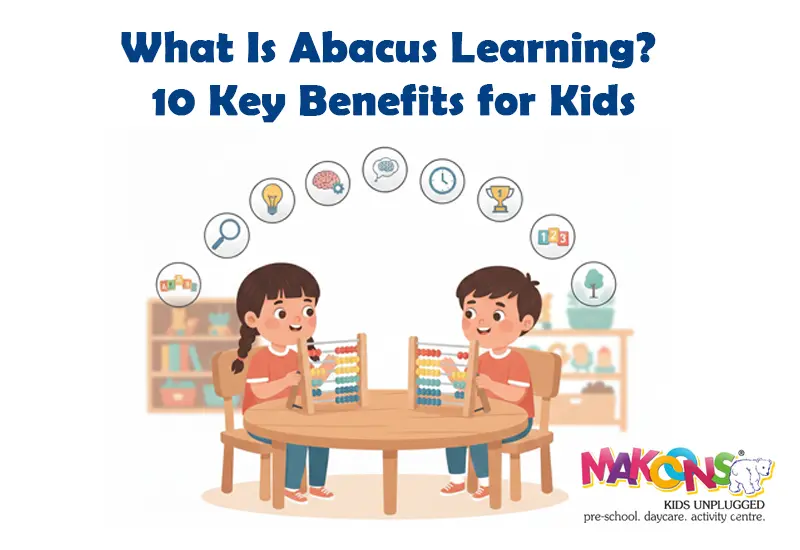
Abacus learning is an extremely effective early stage learning technique which helps children to comprehend mathematics in a convenient and interesting manner. It is based on a very simple counting instrument called an abacus. The instrument consists of beads that slide on rods and depict numbers.
Abacus learning is not merely confined to numeracy. Besides, it is also a way of nurturing strong mental skills at a very early age. A lot of parents and teachers regard abacus learning as one of the best children’s brain development activities and thus, they apply it in their everyday learning process.
In this article, we will clarify the concept of abacus learning and enumerate its key benefits for children.
What Is Abacus Learning?
Abacus learning is an incredibly efficient way of teaching math that involves a real-life abacus to train children in counting and arithmetic operations. The kids are trained to transfer the beads physically to carry out the four basic mathematical operations.
The children at the very beginning of their training use the physical abacus. Then gradually they visualize the abacus mentally. And this enhances their ability to do calculations in their minds. And this training method is referred to as mental math for kids.
Abacus learning is often considered a stepping stone to higher mathematics and mental math practice. Moreover, it not only provides a foundation of good math but also boosts kids’ concentration and memory as it engages their senses.
How Abacus Learning Works?
Abacus learning starts with hands-on practice. Children touch and move beads while solving math problems. This helps them understand numbers clearly.
As they practice more, children no longer need the physical abacus. They imagine the bead movements in their mind. This strengthens mental calculation skills.
This way utilizes the brain’s left and right hemispheres. It promotes and equally supports the development of both sides of the brain in addition to better learning results.
Related Topic: Teaching Preschoolers All Body Parts Names in English
Reasons Why Kids Should Learn Abacus?
The majority of children do not do well in math due to their reliance on memorizing rather than understanding. Learning with an abacus develops the child’s comprehension of numbers and their relations.
It slowly but surely creates confidence in kids regarding math. Kids are not afraid to do their own little experiments. As a result, math learning becomes playful rather than anxiety-inducing.
Abacus learning is considered one of the most efficient activities to develop the brain of children.
10 Key Benefits of Abacus Learning for Kids
1. Improves Mental Math Skills
One of the biggest benefits of abacus learning is strong mental math for kids. Children learn to calculate faster without using paper or calculators.
They can solve math problems in their head with accuracy. This skill stays useful throughout life.
2. Builds Strong Math Skills for Children
Abacus learning helps to enhance the very basic maths competencies of addition, subtraction, multiplication, and division.
Kids learn the functioning of numbers rather than simply retaining the answers. This creates a strong math foundation.
Good math skills for children help them perform better in school.
3. Enhances Brain Development
Abacus learning is a powerful brain development activity. It activates both sides of the brain.
The left brain handles logic and numbers. The right brain supports imagination and visualization.
Using both sides together improves overall brain growth.
4. Improves Concentration and Focus
Abacus learning requires attention and accuracy. Children must focus while moving beads and solving problems.
With regular practice, kids develop longer attention spans. This helps them concentrate better in class and during exams.
Improved focus also supports learning in other subjects.
5. Strengthens Memory Power
Children using abacus learning remember number patterns and calculations easily.
Visualizing the abacus improves photographic memory. This helps kids recall information faster.
Strong memory is an important benefit of abacus learning and supports academic success.
6. Increases Speed and Accuracy
Children who have been trained with the abacus can work out math problems in a speedy and precise manner.
Practice enhances speed and precision. It reinforces children’s self-esteem in the course of tests and competitions.
They become reliant on their cognitive skills, fearlessly.
7. Boosts Confidence and Self-Esteem
As children improve in math, their confidence grows.
They feel proud of solving problems on their own. This positive feeling encourages them to take on new challenges.
Confidence gained through abacus learning often reflects in other areas of learning.
8. Encourages Logical Thinking
Abacus learning helps children think step by step.
They learn to analyze problems before solving them. This improves logical reasoning skills.
Logical thinking is useful not only in math but also in daily decision-making.
9. Makes Learning Fun and Interactive
Abacus learning is hands-on and engaging.
Children enjoy moving beads and visualizing numbers. Learning becomes fun instead of boring.
This makes abacus learning one of the most effective early learning tools for young kids.
10. Supports Overall Academic Performance
The knowledge acquired via abacus instruction is not limited to mathematics only.
Advantages in concentration, recall, and assurance aid kids in excelling in every subject.
Abacus education aids in overall brain development and equal learning.
Related Topic: Learn 50 Fruits and Vegetable Names in English and Hindi
Who Can Learn Abacus?
Abacus learning is suitable for children between the ages of 5 and 14.
Early exposure gives better results. Young children adapt quickly and enjoy the learning process.
It is especially helpful as an early learning tool for preschool and primary school children.
Abacus Learning vs Traditional Math Learning
Traditional math focuses more on written methods and formulas.
Abacus learning focuses on understanding numbers visually and mentally.
Both methods are important. However, abacus learning strengthens mental math for kids and builds deeper number sense.
When combined with school learning, abacus learning gives excellent results.
Is Abacus Learning Useful in the Digital Age?
Yes. Even with calculators and apps, mental math skills are valuable.
Abacus learning trains the brain, not just calculation ability.
It helps children think faster, stay focused, and solve problems independently.
These skills are useful in every stage of life.
Related Topic: 20 Spices Names Kids Use Every Day At Home
Conclusion
Abacus learning isn’t just a math technique; it is a full brain development activity for kids.
The list of advantages that come with the learning of abacus consists of better mental arithmetic, memory improvement, focus increase, and confidence heightening.
It is considered to be one of the best early educational tools, which enables children to acquire excellent math skills and to be able to learn all their life.
In other words, if a child is taught abacus learning early, it can greatly influence the child’s academic and personal development.







 Twitter