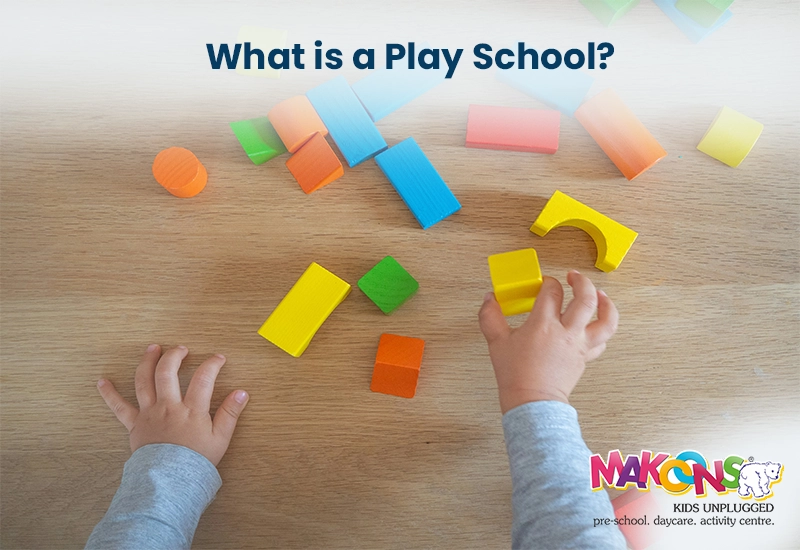
As new parents, one of the first questions you might be asking yourself is When should my child start school? After learning in a play school, and before formally beginning to education, many children, before your child begin his or her learning journey in preschool.
So, what is play school, and where have all these new play school programs come from? And, more importantly, why are so many parents choosing to enroll their child in a play school program today?
In this blog, we are going to provide you with a complete play school guide for new parents. For parents, we will explain the meaning of play school for parents, the significance of a play school, the benefits of play school education, and the difference between preschool and play school. By the end of the blog, you will know if a play school program for your child is the right fit for your child’s early years.
What is a Play School?
A play school can be defined as an early childhood learning center for children typically 18 months to 3 years of age. Unlike a school, which has a rigid format of learning, playschools take into account play, exploration and social interaction.
For parents, the definition of play school is quite simple: a safe and nurturing space for children where there is a gradual introduction to the outside world. It is not strict lessons, but the opportunity for children to explore, play, and gradually adapt to being away from home.
Play School Meaning for Parents
For many new parents, play school is the bridge between home and formal schooling. It gives children a space to:
- Learn how to be independent for a few hours.
- Interact with other children their age.
- Build confidence in a safe and loving environment.
Ultimately, the meaning of play school for parents is not academic but emotional, social and mental preparation for preschool or kindergarten.
Benefits of Play School Education
Sending your child to a play school has many advantages. Here are the most important benefits of play school education:
1. Social Development
Children learn to share, take turns, and play with others. This helps them build early friendships.
2. Emotional Growth
Time away from parents, even for a few hours of separation, allows children to begin to develop a sense of independence that eases a future transition to preschool.
3. Language Skills
Children may also learn new words, songs, and rhymes from listening and interacting with their teachers and peers.
4. Motor Skills
Play schools have various activities like the following: coloring, block building, clay, and outside games. These are all activities to develop gross motor and fine motor skills.
5. Routine and Discipline
Children learn basic structured routines like snack time, play time, and cleanup time. This aids them in adjusting later when going into preschool.
6. Early Love for Learning
The most significant benefit of play school education is that children start seeing learning as fun. Storytelling, music, art, and play encourage curiosity.
Difference Between Preschool and Play School
Many parents get confused about the differentiation between preschool and play school. They can sound the same, but both have different functions.
In short, play school is the first step, while preschool is the next stage in early education.
Why Do Parents Choose Play School?
Parents choose a play school for many reasons. Some want their child to socialize early, while others want their child to develop confidence and independence. Play schools are beneficial for:
- Children who are shy or have separation anxiety.
- Parents who want their child to experience group activities before preschool.
- Families living in nuclear setups where children don’t have many playmates.
What Happens in a Play School?
As part of this play school guide for new parents, here’s what a typical day looks like:
- Circle Time: The children will be singing songs, listening to stories, and interacting with the teachers.
- Free Play: The children will be playing with building blocks, puzzles, imaginary play, and toys to tap into their creative vein.
- Art & Craft: Colouring and painting and clay play all develop fine motor skills.
- Outdoor Play: Reseting, sliding, and simple games encourage strong bodies.
- Snack Time: Children will eat with others, learning how to share as well as table manners.
- Goodbye Time: Quick closing activity, to help the children transition back to home.
How to Choose the Right Play School?
If you’re wondering how to select a good play school, here are some tips:
- Safe Environment: Look for clean classrooms, age-appropriate toddler furniture, and staff who are “hands-on” and engaged.
- Trained Professional Teacher: Teachers should be patient, nurturing and have significant experience with toddlers.
- Play-Based Curriculum: The school should be focused on fun and not academics. If children’s interests are fostered, their learning will follow naturally.
- Child-Teacher Ratios: A low child-teacher ratio will provide children with the highest degree of quality care.
Common Myths About Play School
Many parents hesitate because of some myths. Let’s clear them:
Myth 1: Play schools are only for working parents.
Fact: They are for every child, regardless of the parents’ work schedule.
Myth 2: Play school is not necessary.
Fact: While optional, it gives children a smoother start to preschool and formal education.
Myth 3: Children learn academics in a play school.
Fact: Play schools are not about academics but about overall development.
Play School Guide for New Parents – Quick Checklist
Here’s a short checklist to help parents decide:
- Is the environment safe and child-friendly?
- Are the teachers caring and trained?
- Is the focus on Play and exploration?
- Does the school maintain good hygiene?
- Are class sizes small enough for personal attention?
Conclusion
What is a play school exactly? It is a child’s first step into the outside world and a safe, fun learning atmosphere. Play school is not about books or lessons; rather, it is a way for children to socially, emotionally, and mentally adjust themselves to learning about the world before preschool.
The advantages of play school education are apparent: improved socialization, increased self-confidence, ability to follow a routine, and the beginnings of a love for learning. And, knowing the difference between preschool and play school helps you and what you put on your child’s schedule, educational experiences, and opportunities for learning.
As new parents, put some time into finding the right school, aided by this play school guide. It may be simply the beginning, but you will be building your two-year-old’s education on a firm foundation.






 Twitter