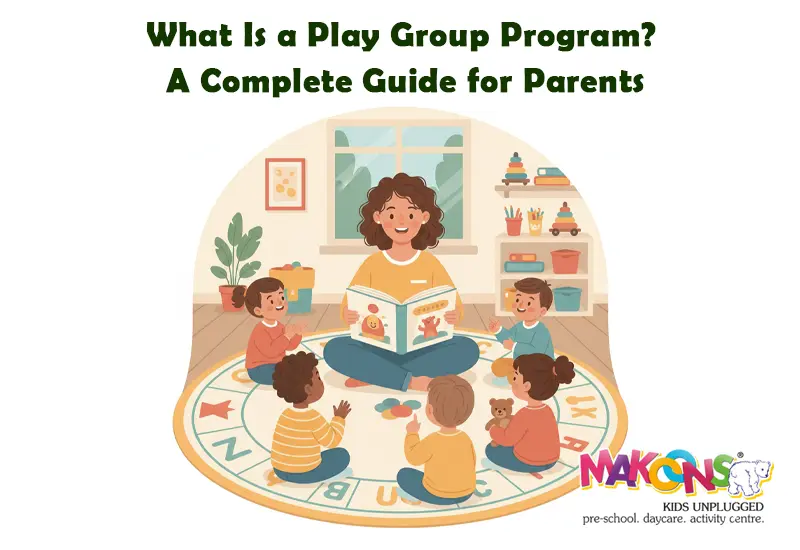
As soon as your child is two years old or just starts to discover this world as an independent person, you might start hearing about such a phenomenon as a play group program. It is the first formal experience at early education in the life of many parents, though not under the strain of school work.
The preschool play group program puts more emphasis on socialization, communication, sensory growth, and cheerful exploration as opposed to reading-writing. However, when you are not sure that it is appropriate for your child, this guide will assist you in learning all that you should know.
Just What is a Play Group Program?
A play group program is an early childhood program being targeted to very young children typically aged 18 months to 3 years. Learning occurs rather than in the form of textbooks and formal lessons, but in terms of:
- Creative play
- Music and movement
- Storytime
- Free exploration
- Hands-on activities
Simply stated children learn through playing, watching, trying, repeating and talking. This is aimed at making the toddlers feel confident, curious as well as comfortable with other children and adults.
However, unlike a typical school, toddler playgroup is not as rigid, time-consuming, and goals-oriented, and it is based on the foundation skills, including:
- Sharing and turn-taking
- Language development
- Emotional expression
- Sensory awareness
- Independence
What Is the Age Requirement of the Play Group?
All schools might be a little different, but on average, the most popular age criteria of play groups is:
Minimum: 18 months
Ideal: 2 to 3 years
At this age, toddlers:
- Begin implementation of instructions.
- Demonstrate interest in other children.
- Start investigating on your own.
- Acquire language at a young age.
They are also too young to be subjected to any organized academics, hence the purposefully light and play-based learning programs associated with early learning play groups.
What is Going on in Play Group Classes?
The first question that parents ask is what exactly children do in play group classes when they do not learn letters and numbers in them formally.
The following is what a normal day can entail:
1. Free Play and Exploration
Children select such activities as blocks, puzzles, pretend kitchen sets, cars, or soft toys. This develops decision making and independence.
2. Circle Time
Teachers sing, welcome children, discuss weather or explain some simple things.
3. Sensory and creative activities
Traditionally, these activities conveyed emotional themes, and it was only in recent years that they began to be separated into learning aspects and creative actions
4. Storytelling
Brief and interactive stories can help toddlers to build listening skills, imagination, and vocabulary.
5. Movement and Music
Action rhymes, dance and yoga with children assist in coordination and motor development.
6. Snack and Social Time
There is sharing, etiquette and routine of children taught.
All things in the play group classes are planned, age-wise, as well as geared towards whole-child development.
Advantages of Early Learning Play Group
There are strong advantages associated with a decision to have an early learning play group:
1. Social Development
Children learn to:
- Play with peers
- Share space and toys
- Cooperate and take turns
These social premises equip them with future school education.
2. Language Growth
Children can learn through songs and tales, as well as through conversations, to develop the vocabulary and expression.
3. Emotional Confidence
They are taught how to part neatly with parents and adapt to a group setting.
4. Motor Skills
Stacking, drawing, jumping, and climbing are some of the activities that build fine and gross motor skills.
5. Routine and Structure
The presence of a routine makes the toddlers have a feeling of safety and security.
This integration renders playgroups among toddlers as one of the most facilitative between life at home and school.
Play Group vs Nursery: What Do They Mean By the Difference?
Parents are usually confused between a play group and nursery. Although both of them belong to the sphere of early childhood education, their functions are dissimilar.
Play Group
- Age: 18 months-3 years
- Spotlight: Socialization, exploration, sensual play.
- No formal academics
- Short duration classes
Nursery
- Age: 3-4 years (varies by school)
- Practice: Early pre-academic skills.
- Introduction to numbers, letters, shapes, colors.
- A little longer hours and more organization.
Think of it this way:
- The play group equips children with emotional and social knowledge.
- They are prepared slowly academically at nursery.
The knowledge on play group vs nursery makes parents decide on the stage to take the child through at the right time without haste.
Is a Preschool Play Group Program Necessary?
All children are not equal, some learn better at home and others prefer an organized exposure. A play school play group program will be particularly useful to:
- Children who require increased interaction with peers.
- Social confidence Shy kids who require soft skills.
- Active kids that require direction.
- Children with problems with routines and transitions.
It is not competition or gung ho on academics. Rather, it is a soft introduction of children to:
- New environments
- Group learning
- Listening to teachers
- Adhering to easy protocols.
With play in the middle the whole time.
What Parents Need to Know in a Play Group Program?
This is because it depends on the type of play group program that is chosen. Consider these factors:
1. Healthy, Child-Safe Workplace.
There must be clean floors, soft playing, toys that are age safe, child proofing, and hygiene.
2. Warm, Trained Teachers
Educationalists ought to be understanding, kind and they must be educated in early childhood education and not simply that of academics.
3. Small Class Size
With smaller groups, there is more attention and care.
4. Play-Based Curriculum
Identify Programs that Focus On:
- Sensory play
- Social interaction
- Storytelling
- Music and movement
- instead of work sheets and memorizing.
5. Parent Involvement
Good schools update parents on the progress and provide tips often.
What is the Length of Play group Classes?
The majority of the play group classes are short:
- 1.5 to 2 hours a day
- 3 to 5 days a week
This exposure is gentle and it does not overpower toddler attention.
Tips before enrolment for Parents
To ease the process, it would be best to:
- Make a visit to the school in advance with your child.
- Advertise school at home.
- Allow gradual settling-in
- Send a play thing of your choice, should it be possible.
- Maintain goodbyes without being emotional.
Constant reinforcement makes the children feel secure and encouraged.
Final Thoughts
It is not a play group program where children are forced to get into the academic arena. Rather it provides a supportive environment where toddlers get to play, socialize and gain confidence.
Children acquire knowledge in a natural way (they are not pressured) with the help of the proper playgroup with toddlers. Knowledge of the age related requirements of the play group, play group vs nursery, and what actually occurs within a preschool play group program will enable parents to have a suitable, sensitive beginning to the education of their child.







 Twitter