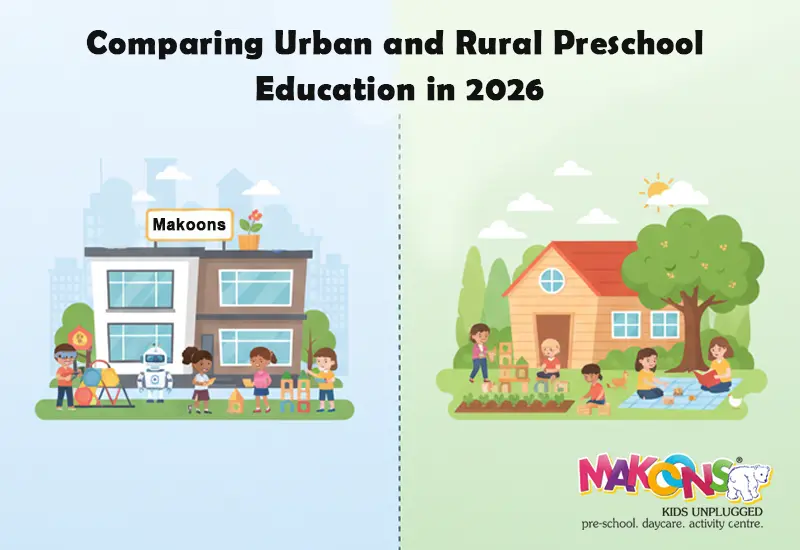
Preschool education forms the basis of future learning and development of a child. With the pace of India in the direction of 2026, the debate on early education is getting serious and participative. Nevertheless, there is one fact that is evident and that is that there is a distinct difference between the urban and rural preschool experience.
This blog discusses the differences between the urban and rural preschool education in India and how the location influences the access, quality and learning outcomes. The comparison of preschool learning between India and the US will help educators and policymakers to reduce inequality in education in India.
The Role Of Preschool Education In India
The preschool is not just a place where children hang around and waste their time. It is in which they start learning social skills, communication, emotional control and early thinking skills. In recent years, preschool education in India has received an interest because of its contribution to the development of lifelong learning habits.
The trend will be to move towards as we approach early childhood education in 2026:
- Holistic development
- Play-based learning
- Emotional and social growth
- School readiness
However, not all places have access to high-quality preschool education.
Knowledge About Urban Preschool Education
This is because urban preschools are usually located in urban areas and metropolises. These schools can be privately run and serve those families that have more resources.
Critical Characteristics Of City Preschool Centres
The typical items offered in urban preschools include:
- Well-equipped classrooms
- Professional and competent teachers.
- Structured and play based curriculum.
- Tools of technology-based learning.
These urban preschools usually adhere to contemporary methods of teaching and global education systems of early learning.
Strong Points Of Urban Preschools
1. Better Infrastructure
Urban preschools tend to be better equipped with regards to the buildings, safety, learning materials and play equipment.
2. Training And Exposure Of Teachers
One of the teachers in the city is normally provided with frequent training and exposure to new teaching methods.
3. Parental Awareness
Parents living in the city are usually better-educated about early learning, and they are actively engaged in the education of their children.
Preschool Problems In Urban Schools
Even though urban preschools have their positive sides, there are challenges associated with them:
- High fees that limit access
- Pressure to succeed at a tender age.
- Crowded classes in mainstream schools.
- Less emphasis on local culture and community.
These problems influence the educational process and may become a stressor among children.
The Rural Preschool Education
India supports rural preschool education through programmes like anganwadi centres which are substantially government-sponsored. These are centers, which are concerned with nutrition, care, and basic learning.
These Are The Major Characteristics Of Rural Preschools
Rural preschools tend to offer:
- Locally-based learning settings.
- Basic Early education.
- Concentrate on health and nutrition.
- Free or low-cost access
They are very important in enhancing preschool education in India particularly in the underserved regions.
Rural Preschool Challenges
Although rural preschools are very important, they are limited in a number of ways. Rural preschool problems are some of the major challenges such as:
1. Limited Infrastructure
Most of the rural centers use small or shared space with little learning materials.
2.Teacher Shortage
A single teacher is likely to have numerous roles, which influences the quality of teaching.
3. Limited Awareness
Parents can also focus on short term livelihood requirements at the expense of early schooling resulting in disorganized school attendance.
4. Lack Of Training
Teachers might not get access to the ongoing professional development.
Preschool Urban vs Rural: Learning Comparison
An evident preschool education contrast is used to bring to light the differences between rural and urban environments.
Learning Approach
Urban Preschool: Play based and structured curriculum.
Rural Preschool: Simple learning and activities.
Access To Resources
Urban Preschool: means of modernity, books, toys.
Rural Preschool: Little resources.
Teacher Support
Preschool in the city: Professionals and licensed workers.
Rural Preschool: Part time teachers with low qualifications.
Cost And Accessibility
Urban Preschool: Pricey and well equipped.
Rural Preschool: No-or-lowly funded but underdeveloped.
The comparison of urban and rural preschools in India reinforces the fact that there is a high level of education inequality in this country.
Effects Of Education Inequality India
The disparity in early development is experienced by children even before they are introduced to primary school. Unequal preschool experiences may result in:
- Language acquisition disparities
- Uneven school readiness
- Lower confidence levels
- Long-term academic gaps
Early intervention on these inequalities is extremely important in the establishment of an equitable education system.
Steps Toward Improvement in 2026
With the future of early childhood education in 2026, there are initiatives taking place to reduce the gap between the urban and rural population.
Government Initiatives
- Rural development of infrastructure
- Teacher training programs
- Curriculum standardization
Private And NGO Support
- Mobile preschools
- Digital learning tools
- Community awareness activities.
Parental Engagement
Parents should also be encouraged to learn the importance of early learning and this will greatly enhance attendance and performance.
The Role Of Technology
Technology is gradually contributing to the narrowing of differences. Rural teachers are getting access to digital media, teacher training programs and remote learning tools which is enhancing the quality of teaching.
Nevertheless, there is unequal access to devices and internet connectivity.
What Parents Should Know
The parents must aim at quality and not necessarily location. Good preschool-urban or rural should:
- Provide a safe environment
- Promote interaction and play.
- Facilitate emotional and social growth.
- Have respect for the pace of child learning.
Knowing these fundamentals assists parents to make good decisions.
Conclusion
The analysis of urban and rural preschool education in 2026 shows improvements and the commonest problems. Although urban preschools have an advantage in the resources and facilities, rural preschools are crucial in making sure access and inclusivity.
The best approach to curbing the level of inequality in education in India has been to work towards improving rural preschool school systems, educating teachers, as well as creating awareness. A comprehensive and non-discriminatory attitude towards preschool education in India can guarantee all children no matter where they are, a good start in life.
Childhood education is not a privilege; it is a platform that every child should have.







 Twitter