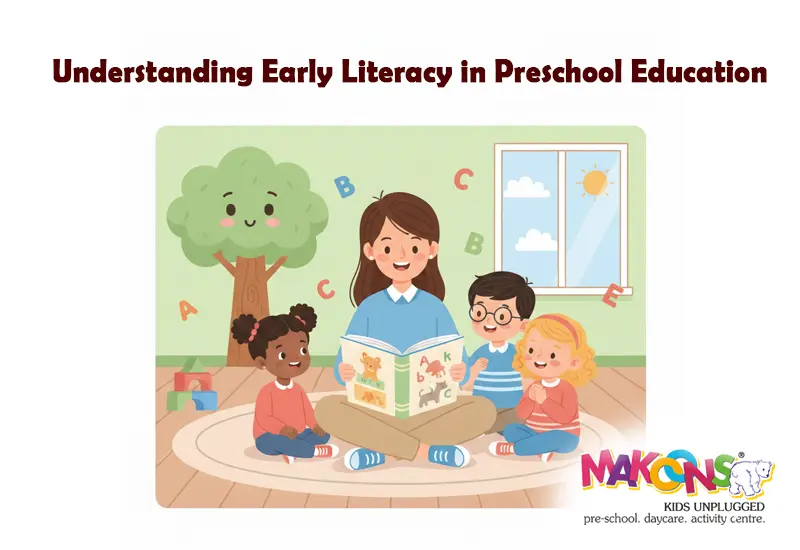
The early childhood stage is very important in laying the baseline of life long learning. Literacy is one of the major development spheres of these years. Early literacy in preschool does not include enforcing children to read or write language at a tender age, instead, it is all about fostering skills that enable children to comprehend language, communicate and love to learn. Early literacy facilitates cognitive, social, and emotional development when done in a proper way.
This paper discusses the definition, relevance, and practice of preschool literacy development and how early reading abilities, communication, and play-based experiences can help in ensuring that children develop their languages well.
What Does Early Literacy Mean in Preschool?
Early literacy in preschool is that knowledge and skills that children acquire prior to the introduction of formal reading and writing skills. Such skills make children ready to be assertive readers and communicators as they grow up.
Early literacy includes:
- Listening and speaking abilities.
- Vocabulary development
- Story comprehension
- Understanding sounds and letters
- Interest in books and print
These skills are developed automatically when children are subjected to rich language and meaning interaction.
Related Topic: Learn 50 Fruits and Vegetable Names in English and Hindi with Makoons Preschool
Significance of Preschool Literacy Development
Literacy acquisition in preschool is an important aspect in the academic life of a child. Studies have always indicated that early children who end up having good literacy backgrounds excel in education and become more confident in the educational process.
Some key benefits include:
- Development of better attention and memory.
- Better communication abilities.
- Better social interaction
- Higher problem-solving competencies.
Literacy does not just exist in academics, but it also affects the expression of emotions, posing of questions, and comprehension of the surrounding world by the children.
Joining Early Reading Skills: More Than Reading Words
Most parents think that when a child starts reading sentences, he or she has entered the world of literacy. As a matter of fact, reading abilities are developed way before that age.
These skills include:
- The ability to identify rhymes and patterns of words.
- Letters and sounds recognition.
- Realizing print is not meaningless.
- Predicting story outcomes
Such activities as listening to stories, singing rhymes and discussing pictures in books develop early reading skills without any stress and pressure.
The Role of Language Development in Children
Language development among children is highly associated with strong literacy. Language skills assist children to articulate, comprehend direction, and have communication with each other.
During preschool age, it is possible to develop:
- Vocabulary and construction of sentences.
- Listening comprehension
- Receptive language, expressive language.
- Narrative and story-telling ability.
The ability to speak and ask questions as well as experience enables the children to develop language skills naturally and facilitates success in literacy in future.
Related Topic: 5 Oceans of The World: Names & Sizes
Learning Literacy Among Children Through their Daily Experiences
Children do not need to study literacy through formal lessons and worksheets. As a matter of fact, children are best learners by the way of day to day activities and play.
Examples of natural literacy experiences are:
- Telling storybooks.
- Naming things both at home and in the classrooms.
- Playing word and sound games
- Drawing and scribbling
- Singing and recitation of poems.
These games enable the activities to make literacy fun and significant so that children can relate learning to fun and inquisitiveness.
Education Basics and Literacy Preschool
Basic knowledge in preschool education is important in assisting parents and educators in promoting early literacy. Preschool education does not emphasize academic pressure but it is holistic development.
Key principles include:
- Play-based learning
- Child-centered approaches
- Exploration as a learning process.
- Emotional and social development.
Preschool literacy should be based on these principles, and children need to acquire skills and learn at their own pace.
The Role of Educators in Promoting Early Literacy
Early literacy in preschool involves the role of teachers. An effective learning environment fosters the child to play with language in many folds.
Strategies that are effective are:
- Reading aloud daily
- Developing print-rich classrooms.
- Promoting narratives and role-playing.
- Asking open-ended questions
- Setting proper language usage as an example.
Children are assured and encouraged to participate in literacy when teachers give them positive reinforcement.
Parental involvement in Literacy in Preschool
The initial teachers of a child are parents. Home literacy can be used to support preschool literacy development, thus, reinforcing preschool literacy.
Parents can help by:
- Reading with children on a regular basis.
- Discussion of life experiences.
- Promoting enquiries and doubts.
- Restricting overuse of screens.
- Development of a schedule on books and stories.
Such easy routines are very beneficial in developing the language among children and in developing a long time interest in reading.
Popular Myths of Early Literacy
Early literacy has a number of myths that lead to undue pressure.
Some common myths include:
- Before kindergarten, children have to read.
- Literacy learning requires the use of worksheets.
- Literacy is equal to memorization.
- Intelligence increases with the speed of learning.
Literacy learning in kids is based on the ability to understand, communicate, and enjoy it as opposed to being fast and quick.
Related Topic: Teaching Preschoolers All Body Parts Names in English
Long-term Effect of Early Literacy Skills
Children that build good early literacy bases are likely to:
- Perform academically higher.
- Communicate effectively
- Build strong relationships
- Learn to think critically.
Through the emphasis on early reading competencies and language exposure in preschool years, teachers and parents provide children with a long-term successful result.
Conclusion
Early literacy in preschool is one of the basic elements of early childhood education. It helps in the development of preschool literacy, enhances language development among children, develops the necessary early reading skills, which prepares children in the course of future learning. Children get confidence and curiosity when literacy is introduced in the form of play, conversation and meaningful experiences.
The fundamentals of preschool education enable adults to establish supportive conditions in which literacy acquisition in children becomes intuitive and fun. With the collaboration of parents and educators, children will be able to attend formal education in a well-equipped position to learn, communicate and prosper.
There is no hurry in early literacy – it is a matter of an excellent, happy base in a lifetime of learning.






 Twitter