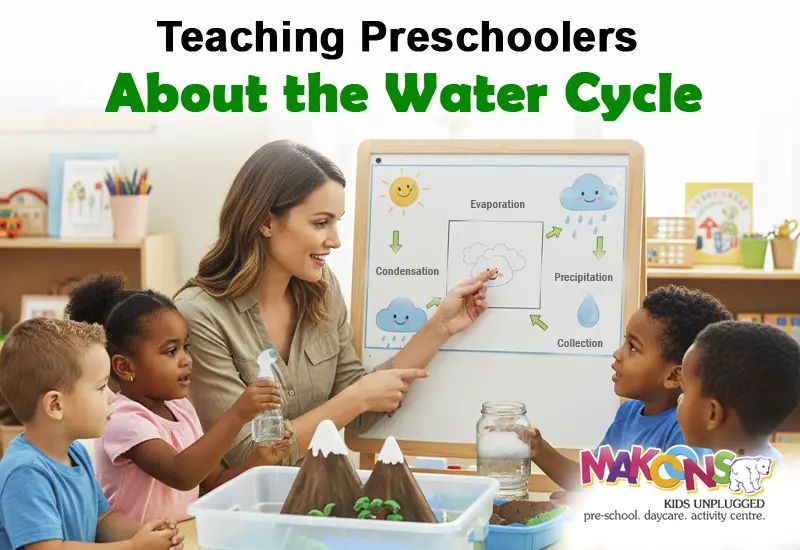
Water is everywhere: it rains, it flows in the river, it is even in the air! How does it get up and down, however, between clouds and earth? To young children, the water cycle may appear to be magic. Educating them on this in early years does not only arouse curiosity, but also makes them learn how nature functions.
The water cycle is a wonderful teaching method involving a combination of science, imagination, and play to introduce water cycle to preschoolers. By undertaking a couple of practical activities and entertaining experiments, the teachers can simplify complicated concepts, make them exciting and memorable.
The Importance of Teaching the Water Cycle in Preschool
Preschoolers are curious individuals. They adore watching clouds, playing in the puddles and posing endless questions regarding rain. These occasions are ideal times to present the early knowledge on nature and weather.
The benefits of teaching children about the water cycle are:
- Learn the characteristics of the flowing of water.
- Valuable to realize the value of water in everyday life.
- Learn to be curious and observant.
- Develop vocabulary and science.
- Create environmental and conservation awareness.
Teachers can make learning a visual and interactive experience and transform a boring concept in science into an adventure.
Related Topic: Learn 50 Fruits and Vegetable Names in English and Hindi with Makoons Preschool
Breaking the Water Cycle- Preschoolers
In explaining to children about the water cycle, it is important to make explanations to be concise, visual and narrative. The four main stages can be explained in a simple manner as follows:
- Evaporation – The sun rays make the water of lakes, rivers, oceans hot, and transform it into invisible water that drifts into the air.
- Condensation – On ascending, the vapor cools and forms clouds, as does the fog on the window.
- Precipitation – When clouds are heavy they release the water, which is in the form of rain, snow or hail.
- Collection – Rains are collected again into rivers, lakes and oceans – and the process repeats itself!
Repetition and play are necessary to give children a chance to learn, and going through these stages in a different form, such as songs, images, or games, will ensure children remember.
Water Cycle Easy Lesson with Children
Any basic lesson about a water cycle taught to children needs to be a mix of narration, illustrations, and amusement. The following are the step-by-step instructions that can be used by the teachers in the classroom:
Start with a Story:
Start with a pleasant story such as Raindrop-Big Adventure, on which a tiny raindrop goes on an expedition into the clouds, rivers, and the oceans.
This provides a personal association to the cycle to children.
Make it interesting with the help of puppets, pictures or props.
Show Visuals:
Poster colorfully or use a short video animation of the mechanism of movement of water in the cycle.
Hands-On Discussion:
Ask simple questions like:
I am asking where do you think rain comes from?
What will happen when the sun is shining on water?
Ask kids to tell their personal stories such as how they can see puddles dry after a sunny day.
Related Topic: Teaching Preschoolers All Body Parts Names in English
Summarize with Actions:
Make every step of it a motion:
- Evaporation – rise up on toes
- Condensation – hold hands in order to make a cloud.
- Precipitation– sound of raindrops.
- Collection – fake to be like a river.
Physical movement makes children recall concepts by playing.
Activities of Fun Water Cycle Preschool
Play and discovery is the best method of teaching science to young learners. Some of the imaginative activities of the preschool children involving water cycle are given here:
Experiment on the Bag (Mini Water Cycle in a Bag)
This is among the most famous fun science experiments for preschoolers.
You will require; a ziplock bag, water, blue food color, and a marker.
Steps:
- Put the sun and the clouds on the bag.
- and fill it with some colored water and close it.
- Tape it to a sunny window.
In some few hours or days, children will observe such processes as evaporation (the changing of water into vapor), condensation (the appearance of drops within the bag).
What they know: This basic illustration demonstrates to them the process of the water cycle occurring in the right before their eyes!
Cloud in a Jar
An interesting experiment to demonstrate the formation of clouds.
You will require: a glass container, hot water, ice cubes and hairspray.
Steps:
- Add some hot water in the jar.
- Spray the interior with a little hairspray.
- Add ice cubes on the lid.
Conclusion: The vapor in the interior cools down and transforms itself into small water-grains – as in a real cloud.
Outcome: Learn to condense something scientifically in an amusing, realistic manner.
Water Cycle Art Craft
Allow children to make their own water cycle posters with cotton balls (the clouds), blue paper (the water), arrows of the direction of the cycle.
This craft is used to support such words as rain, clouds, sun and evaporation.
Rain Dance Game
Dynamize science. Play happy songs, and make children dance like falling rain.
When the teacher mentions the word Sun, they stretch on their backs to demonstrate the evaporation process; when the cloud is mentioned they are huddled!
It is an imaginative and rhythmic play, a mixture of science.
Sensory Water Table
A small tub with cups, spoons and spray bottles would show how water transforms into different forms – liquid or vapor back and forth.
Freezing and melting of ice cubes.
This sense of touch is useful in assisting the children in their early investigation of nature and weather via sensory play.
Preschooler Science Ideas Fun
Children are fond of trying things and getting the results immediately. The following are some additional science activities involving preschoolers and examples of activities that correlate with the water cycle:
- Rain in a Cup– Spray some shaving cream on the water in a cup, in cloudy form. Pour water of different colors with a pipette and observe the rain going through the clouds.
- Evaporation Observation – Prepare a cup of water and place in the sun and a cup of water in a shade. Ask children why one of them dries faster and why.
- Melt the Ice Race – Provide the children with an ice cube and watch how they can melt this cube with the help of their hands, breath, or solar heat.
All these mini-experiments assist children in observing the work of nature, creating an interest and abilities of observation.
Related Topic: 5 Oceans of The World: Names & Sizes
Relationships between the Water Cycle and the Real World
Due to the significance of lessons, it is important to relate the water cycle to the pre-existing knowledge of children.
Ask questions like:
- Now then whither waneth rain to fall?
- Knowing why puddles disappeared after a sunny Day.
- What becomes of clothes when we put them out in the open air to dry them?
- These are comparable instances that will make children aware that the water cycle is occurring in their immediate surroundings daily.
It is also possible to go outside and make a little nature walk after it rains and watch puddles, wet leaves, or even clouds in the sky – this makes the surrounding a real classroom!
Hack to Teachers: Fun and Simple Science.
The following are some preschool teaching ideas on the explanation of concepts in science such as the water cycle:
- Repeat words: Repeat such words as condensation and evaporation by use of songs and games.
- Brief lessons: Preschoolers do not have long attention spans and therefore should be combined with brief talks and practical activities.
- Foster inquisitiveness: All children should be free to ask questions, even when they may seem unusual and unrelated.
- Combine creativity and narration: Science does not need to be dull and without creativity, it becomes even more memorable.
- Share observations: Each observation however small should be celebrated.
Conclusion
The issue of teaching the water cycle to preschoolers is not merely a science but a way of showing the children the beauty of nature. Preschoolers start learning about the functioning of the surrounding world when teachers playfully teach, make use of images and amusing experiments related to science.
Teachers can foster interest in weather, water and the environment through elementary water cycle classes that foster life long inquisitiveness in kids.Above all, children learn that even such invisible processes as evaporation belong to the great never-ending history of our planet.
There is a story behind every drop of rain, there is a story to be told, and when we tell the story in a manner that is inspirational and innovative, the preschoolers will be attentive, curious and investigative!







 Twitter