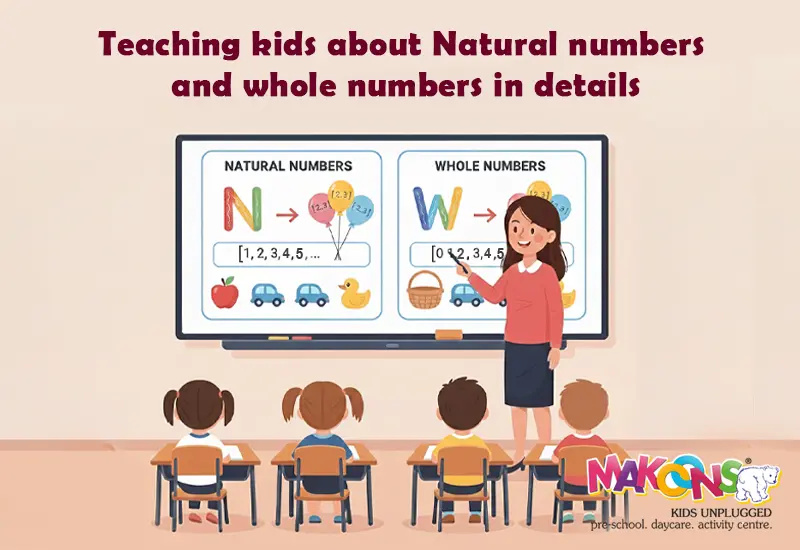
One of the most essential things of early education is teaching children numbers. Mathematics is based on numbers and allows children to make sense of the surrounding environment. Since counting all the toys to see numbers, early number learning determines the logical thinking process and problem-solving ability of a child. This paper describes both natural and whole numbers in children and outlines simple concepts of number, counting numbers in children and the best strategies of learning numbers in beginners. These concepts are key early math concepts to kids, and these will make learning fun and meaningful and long-lasting.
Beginning at the Basics of Numbers in a Kid
Children must learn some concepts on numbers before formal mathematics is introduced to them. They are the ability to recognize the numbers, the ability to understand the quantity and the ability to relate numbers with a real object. Indicatively, when a child counts apples, toys or steps, he/she starts to realize that numbers are real things.
Basic number concepts teach children:
- Recognize numbers
- Understand “more” and “less”
- Compare quantities
- Boost the confidence in math learning
These are pre-skills that equip children with higher subjects such as addition, subtraction, and problem solving.
Natural Numbers for Kids What Are Natural Numbers?
Children learn the first numbers in the form of natural numbers. These numbers are used for the counting, and they begin from 1.
Definition of Natural Numbers Natural Numbers are numbers that are defined mathematically.
Natural numbers are: 1, 2, 3, 4, 5, 6, 7, 8, 9, 10.
They do not come up with zero or negative numbers. Natural numbers are also referred to as counting numbers among the children since they are the numbers used by children to count items around them.
Applications of Natural Numbers in Everyday life
The use of natural numbers in everyday life by children includes:
- Counting crayons (1, 2, 3…)
- Counting friends in class
- Walking, counting the steps.
- Counting fruits in a basket
Natural numbers are easily understood and remembered by using real-life examples.
The significance of Natural Numbers in Early Learning
The concept of teaching natural numbers to children builds confidence in math at an early age. These numbers:
- Build number recognition
- Improve counting skills
- Teach children some sense of order (first, second, third)
- Teach children addition and subtraction.
Children who have mastered natural numbers become comfortable with numbers and like to learn math.
Effective Counting Numbers Instruction to Children
Children should be taught counting numbers in an interactive manner. Play and repetition are the best ways of learning in children.
Easy Methods to Teach Counting:
- Counting toys while playing
- Reciting number rhymes and songs.
- Counting fingers and toes
- Numbers: Working with picture books.
- Step counting when going up the stairs.
The activities assist in number learning among beginners and enjoy counting.
Related Topic: Learn 50 Fruits and Vegetable Names in English and Hindi with Makoons Preschool
What Are Whole Numbers for Kids?
Then after learning natural numbers, the kids are introduced to whole numbers.
Definition of Whole Numbers
Whole numbers include: 0, 1, 2, 3, 4, 5, 6, 7, 8, 9, 10…
The major distinction in the case of natural numbers and whole numbers is the zero (0).
Knowledge of Zero to Children.
Zero is nothingness or nothing in objects.
Examples:
- Zero apples on the table
- Zero toys in the box
- Zero pencils in the bag
Learning zero enables the children to know the idea of absence and prepares them to further concepts of math.
Related Topic: Teaching Preschoolers All Body Parts Names in English
Distinction Between Natural Numbers and Whole Numbers
| Natural number | Whole number |
| Start from 1 | Start from 0 |
| Used for counting | Used for counting and representing 0 |
| Do not include 0 | Include 0 |
The concept of this difference is an important element of the basic number concepts and assists children to gain sharpness in mathematics.
Whole Numbers are the Importance of Whole Numbers
Whole numbers among children enhance their knowledge of numbers as whole numbers. Whole numbers help children:
- Understand zero
- Learn number order
- Establish a base of addition and subtraction.
- Develop logical thinking
The whole numbers form a critical component of early math concepts among the kids, and are utilized in school life.
Number Learning Beginners: Step-By-Step
To learn numbers easily when one is a beginner, teaching must be gradual and interesting.
Step 1: Number Recognition
The first thing that children should learn is to identify the numbers based on their shape and name.
Step 2: Counting Objects
The utilization of objects assists the children to relate numbers and quantities.
Step 3: Understanding Order
Number sense is built up through teaching the sequence of number before and after.
Step 4: Introducing Zero
After it is clear in counting, the concept of zero can be introduced as a whole number.
This process is a gradual method of creating confidence and avoiding confusion.
Related Topic: 5 Oceans of The World: Names & Sizes
Easy Games that Teach Early Math Concepts to kids
Math fun makes the children learn without fear.
Activity Ideas:
- Number matching games
- Counting blocks or beads
- Number puzzles
- Drawing numbers in sand
- Sorting objects by quantity
The activities enable children to practice early mathematics and to learn in an engaging way.
Parents and Teachers’ Role in Teaching Numbers
The children have a crucial role to play in the instruction of natural numbers by parents and whole numbers by teachers.
Tips for Parents:
- Talk about numbers daily
- Prompt counting in the normal activities.
- Compliment as opposed to perfection.
Tips for Teachers:
- Use visual aids
- Add games and group activities.
- Instruction at the age-oriented speed.
Confidence in math and interest are created because of positive reinforcement.
Related Topic: 7 Days of a Week Names | Learn Days in English Easily
What They Can Do to Commonly Mistake in Teaching Number
1. Teaching too fast
- Not paying attention to practical work.
- Working with books only as opposed to actual objects.
2. Not revising regularly
These errors can be avoided and the number learning of the beginners can be enhanced and good foundation skills maintained.
3. Installing an Early Math Foundation
Good knowledge of basic number concepts, natural numbers among children and whole numbers among children will equip children with future topics in math. There is an enhancement in early experiences with numbers:
- Logical thinking
- Problem-solving skills
- Academic confidence
Young children that learn to like math have higher chances of doing well in school.
Conclusion
Educating children on natural numbers, whole numbers of kids is a critical aspect of early education. Parents and teachers can design a good foundation to math success by teaching simple concepts of numbers, counting numbers in children, and interactive number learning which is taught to beginners. Early math concepts among kids should be fun and easy to understand through the use of real-life examples, fun activities, and simple explanations. Children can be given a lifetime love affair with numbers and learning with the proper approach.







 Twitter