All the parents desire to make the right decision with regard to early education of the child. The preschool setting is the first phase where students may get to learn outside the home and the strategies employed there may influence the way they think, feel, and learn long into their future. Nowadays, many parents are left to make a comparison between STEAM and traditional preschool education and ask themselves which option makes children better prepared for the future.
No such thing as a black-and-white answer. Both approaches have value. However, how the children will live, work, and solve the problems in future makes this conversation more important than ever before.
Learning About Traditional Preschool
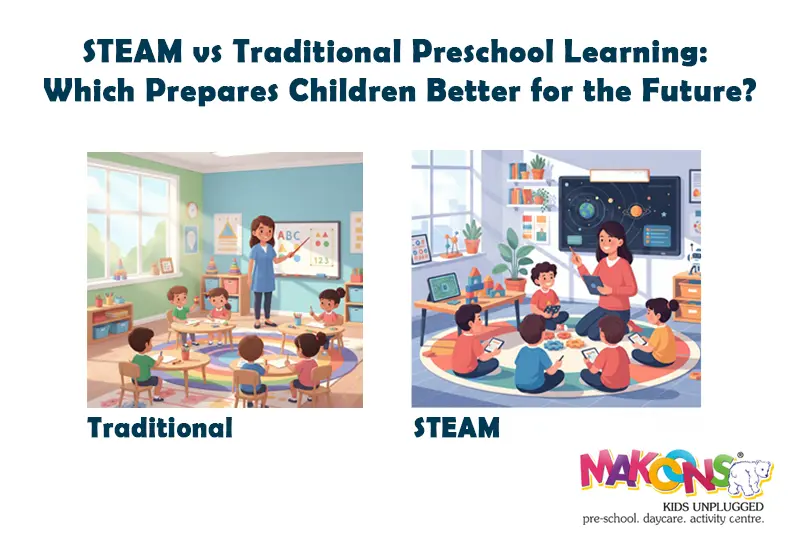
Classical preschool education is well known amongst the parents. It is usually structure-oriented, routine-oriented, and repetitive. Worksheets, memorizing, and instruction on letters, numbers, colors, and shapes may take place among the children.
This strategy appreciates discipline, listening and obeying orders. Learning through tradition may be comfortable and predictable to some children, particularly those who like routine and a sense of direction.
Traditional ways however tend to individualize towards rote learning where the kids learn by repetition without knowing the reasons or how it works. This distinction is particularly evident in the early years of learning, in the process of play-based learning versus rote learning.
A Picture Of STEAM Learning In Pre-school
STEAM learning during preschool is extremely not similar to formal studies. It is based on Sciences, Technology, Engineering, Art, and math based on play, exploration, and curiosity.
A classroom that is based on STEAM lets children build, question, ask, and experiment. There are no wrong or right answers, no second chances. Such learning is conducive to creativity, problem solving and flexible thinking.
The advantages of STEAM learning among young children will be the ability to learn how things work instead of memorising things.
Rote Learning vs Play-Based Learning
Young children will be taught better when they are engaged. Play based learning enables the child to act in accordance with natural senses, physical movements and thought processes.
Rote learning, however, requires children to sit in one place and listen to what they are being taught. This may assist with short-term memory, but this may hamper curiosity and creative thinking.
In a comparison of the play based learning vs rote learning, it can be seen that play based approaches tend to promote deeper learning and more long term knowledge-particularly in preschool age children.
Related Topic: Why STEAM Is Not A Subject But A Mindset In Preschool Education
Getting Ready For A Changing World
Skills that extend beyond memorization are the ones required in the future. Children will be required to think, learn fast, communicate effectively, and be creative with problem solving.
These are termed as future-ready skills of preschoolers and they can be acquired in the form of hands-on experiences instead of the passive learning.
STEAM classrooms are inherently supportive of:
- curiosity and questioning
- optimizing a problem by trial and error.
- teamwork and communication
- creative thinking
The traditional class rooms might also be able to provide order and discipline, yet they might not provide sufficient space to explore and innovate.
The Teacher Role In The Two Approaches
Traditional environments traditionally involve a teacher as an instructor, who provides information. Children will be required to listen, repeat and follow directions.
In the classroom setting of STEAM, teachers become more of a guide. They monitor, ask open questions and assist children as they ask questions. This style is very compatible with the modern preschool approach, when learning is child-centered instead of a teacher-centered process.
Both of these roles are valuable, and when teachers think about giving answers rather than providing them, the young children tend to be more benefited.
Social And Emotional Learning Counts
Preschool is not entirely about academics. It also concerns learning to be sharing, emotional, and collaborative.
STEAM learning usually presupposes working in groups, and children should be able to negotiate, collaborate, and learn together. This is conducive to emotional and social intelligence.
The traditional classes might provide less opportunities of cooperation, emphasizing the individual performance. Social interaction is one of the aspects to be considered when we are comparing the traditional and progressive preschool learning.
Which Of The Two Approaches Is Better?
Most teachers do not want to take one side of the coin, but instead, an amalgamation of both structure and exploration seems to be the most valuable learning style in preschool children.
Kids require order and structure, but they must be allowed to play and experiment. A balanced pre-school setting may consist of:
- clear daily routines
- time for guided instruction
- enough practical, play-based STEAM activities.
Such a combination allows children to feel safe and at the same time promotes innovation and curiosity.
What Parents Should Look For
Rather than putting the labels on the children, parents can observe the way children learn. Ask questions like:
- Do children feel free to ask questions?
- Does playful learning engage?
- Are teachers in favour of curiosity and creativity?
- Do children enjoy and feel secure?
Such signs are more important than whether a school is called traditional or STEAM-based.
Final Thoughts
The problem of STEAM vs traditional preschool education is not a battle of the two sides. It is about knowing what children really require during their tender age.
The conventional education is structured and known. STEAM learning provides adaptability, curiosity and creativity. Children are the ultimate beneficiaries of the ever-changing world that enables them to think, explore, and develop with confidence.
Preschools can equip children not only to go to school- but life by emphasizing on the aspects of curiosity, play, and meaningful experiences. And that is what the future-ready education is all about.






 Twitter