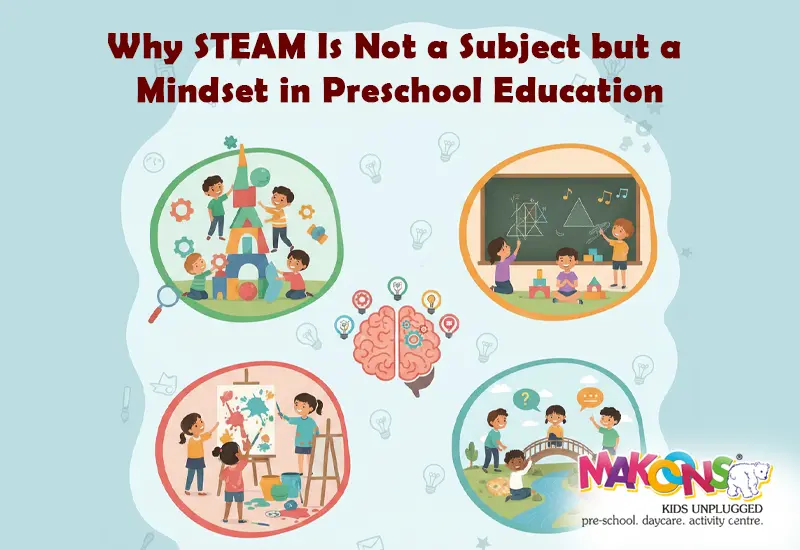
When individuals are talked about STEAM, most individuals tend to think of science experiments, robots, or sophisticated technology. In a pre-school classroom, however, STEAM has a completely different appearance- and is much easier. It is not an independent lesson on the schedule, a topic that the children are seated to learn. During early age, STEM is a method of thinking, discovering and cognizing the world.
That is why STEM education in preschool is most effective when this approach is considered as an attitude, not as a subject. It exists in the daily games, doubts, errors, and findings that children come across by nature.
What STEAM Really Means For Preschoolers?
STEAM is an acronym of Science, Technology, Engineering, Art and Mathematics. These areas are not clearly in boxes to young children. When a child constructs a tower, paints a picture, or wants to know why something falls, he/she is already experimenting with a number of STEAM concepts simultaneously.
In the early childhood STEAM education, learning occurs in the form of curiosity, rather than teaching. Children do not have to memorize facts. They need time, space, and support to speculate, experiment and remarry.
The STEAM Starts With Curiosity, Not Content
Preschoolers are born in inquisitive stages. They pose questions continuously- they can ask a question repeatedly. That inquisitiveness is the core of the STEAM approach to early education.
Where teachers answer with the phrase, let’s find out, rather than the phrase, here is the answer, children learn how to think, and not what to think. A puddle following a downpour is a science laboratory. It becomes an engineering project of a cardboard box. Crayons and blocks would be problem-solving instruments.
Here, it is the best of play based STEAM learning.
Play The Natural Immersion Of STEAM
During preschool, playing is not a pause in the learning process, but rather a learning process. Children explore, experiment, compare and imagine when they play. These are core STEAM skills.
When a child combines colors in the process of painting, he or she is experimenting with science and art. A group of children who are constructing a bridge using blocks are engineering and doing math. The sorting into similar size or color is a kind of early mathematical thought.
This is the reason why STEAM learning methodology in preschool should remain playful. The natural process of learning is usually interrupted by structured worksheets or strict instructions.
Educators As Directors, Not As Teachers
With a STEAM-oriented preschool classroom, the teachers do not stand at the front of the classroom presenting lessons. They see, hear, and instruct mildly instead.
A teacher might ask:
- What do you suppose will be the result of putting another block?
- “Why do you think it fell down?”
- “How could we make it stronger?”
These are some of the simple questions that stimulate more thinking. They advocate preschool innovation learning by enabling children to vent out ideas without having to be afraid of being mistaken.
Mistakes are not fixed instantly, they are argued about. It is there that the actual learning takes place.
Art Is Not An Extra–It Is Necessary
In STEAM, art is occasionally confused. In preschool, art does not imply creating something perfect. It is a question of expression, of being creative and experimental.
Drawing, painting, or creating are all experiments in which children are trying things out and making sense of the world. Art assists the children to express themselves, where they are yet to find words to express themselves.
The inclusion of art makes sure that there is holistic learning in preschool where emotional, cognitive and creative growth go hand in hand.
STEAM Favors Whole Child Development
STEAM at preschool does not simply develop academic skills. It promotes both social and emotional development.
Children learn to:
- work together
- share ideas
- listen to others
- handle frustration
- try again after failure
These skills in life are as valuable as counting or building. The kind of thinking that goes in STEAM at a young age does not only equip children with the necessary school mindset but also the life mindset.
STEAM Moments Are Everyday Moments
STEAM learning does not require any advanced tools or technology. The day-to-day classroom regimes provide infinite possibilities.
Measurement is taught by pouring water into cups. Toy cleaning consists of sorting and categorizing. During cooking procedures, texture, temperature and quantity change.
By teachers being aware of these instances, STEAM education at the preschool level is no longer considered a special activity, but a lifestyle.
The Importance Of No Labels To Pre-Schoolers
Preschoolers do not have to be aware of the fact that they are doing STEAM. They simply require entertaining experiences. When schooling is overrated, it may be made dull.
When learning is a natural experience, children are able to succeed. Teachers are more likely to promote true knowledge and interest when they pay attention to the experience rather than the outcomes.
That is why STEAM is best applied as an attitude, something incorporated subtly into all activities.
Building Confident Thinkers, Not Just Smart Kids
The actual aim of STEAM education in early days is not to produce engineers and scientists of tomorrow. It is to train confident minds, which are not fearful to ask questions or pursue new ideas.
Children become resilient and creative when they grow up knowing that it is okay to experiment, fail and do it again. Lifelong learning is based on these qualities.
Final Thoughts
In preschool, STEAM does not concern subjects, schedule, or results. It is about developing an interest, imagination, and belief. Each approach to early childhood STEAM education will make it happy, significant, and impactful when considered as a mindset.
Children are taught how to think and not what to learn through play, exploration and gentle direction. And that is what a STEAM mindset can do in early education. When we quit posing the question, How do we teach STEAM? and begin to inquire, the best way that children learn? the answer becomes clear.
Why is STEAM important for preschool children?
STEAM helps preschoolers develop critical thinking, creativity, and problem-solving skills at an early age. It also encourages curiosity and exploration.
What does STEAM stand for in early education?
STEAM stands for Science, Technology, Engineering, Arts, and Mathematics, which are integrated to support inquiry-based learning and discovery.
How is STEAM learning introduced in preschool classrooms?
In preschool, STEAM is usually taught through play-based activities like building blocks, painting, exploring nature, and simple experiments.
What skills do children develop through STEAM education?
Children develop skills such as creativity, collaboration, problem-solving, communication, and confidence through STEAM activities.







 Twitter