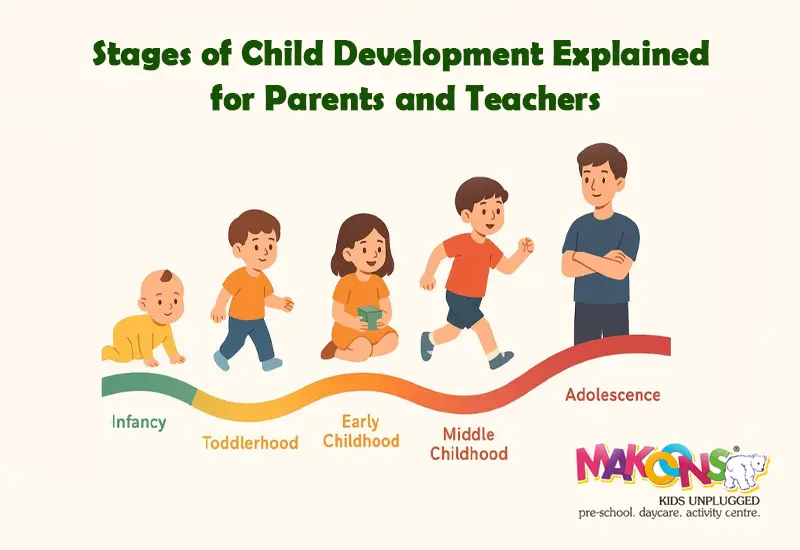
Knowledge of the child development stages enables the parent and the teacher to assist the kid in the best manner they can. During infancy to early school years, children develop at a very fast rate in terms of physical, cognitive, emotional, and social aspects. The stages that one goes through are cumulative and have the potential to establish a lifelong learning and well-being basis.
It is a resourceful guide to child growth and development that spells out what one should expect at various ages and how the adults can react accordingly. Both at home and in a classroom, being informed of the child development stages that a parent and a teacher should have will ensure that children are given the appropriate support at the right time.
The Importance of Knowing Child Development
The children do not develop at the same rate yet they tend to exhibit some predictable trends. Age wise Child development can help adults to recognize:
- Set realistic expectations
- Early detection of developmental delay.
- Attract age-related activities.
- Promote emotional and social needs.
As we discuss child development in the form of an explanation to the teachers, we stress on observing, guiding and adjusting the teaching so that it fits the developmental readiness.
1. Infancy ( 0-2 Years): The Foundation Stage
The initial two years of life play a key role during the stage of early childhood development. Brain development in this stage is of an unparalleled pace.
Physical Development
- Sudden increase in height and weight.
- Learning how to roll, sit, crawl, walk.
- Fine motor skills such as grasping development.
Cognitive Development
- The ability to detect voices and faces.
- Starting to develop the sense of cause and effect.
- The exploration of objects by senses.
Emotional and social development
- Forming secure attachments
- Reaction to smiling and expressions.
- Showing such feelings as happiness and anger.
Responsive care giving is required in this phase of the stages of child development. Parents are advised to communicate, sing and communicate with each other to engage brain development. Daycare teachers should ensure that sensory experiences are safe so as to encourage exploration.
2. Toddlerhood (2-3 Years): Freedom and Discovery
It is inbuilt in toddlers to be curious. The growing independence is usually a characteristic of this stage in the child development stages of parents.
Physical Growth
- Better ambulation and running.
- Beginning to climb and jump
- Better hand coordination
Cognitive Skills
- The development of vocabulary is quick.
- Adhering to basic directions.
- Engaging in pretend play
Social and Emotional Alterations
- Saying “no” frequently
- Demonstrating affection towards adults one knows.
- Beginning parallel play
Patience is important in this stage of age wise child development. The toddlers push limits because children are learning to be independent. The routines should be given by teachers and safe exploration should be promoted by parents.
Related Topic: What Are the 10 Main Areas of Child Development – Know Here
Preschool Years (3-5 Years): Quick Learning and Social Development
Preschool is among the earliest years of development of life. Children start to think in a better way and express themselves better.
Physical Development
- Improved trade off and coordination.
- Skills in drawing simple shapes.
- Knowing how to dress up by yourself.
Cognitive Development
- Asking many “why” questions
- Identifying colors, shapes and numbers.
- Developing imagination
Student Development: Social and Emotional
- Playing cooperatively
- Learning to share
- Word expression of feelings.
To the teachers, child development described to teachers at this stage implies employing play-based learning. Group games, music, art and storytelling are activities that facilitate holistic development.
At home learning should be reinforced by parents through reading, conversations and directed play. This phase establishes a good academic and emotional background.
Early School Age (6-8 Years): Academic Development
When children start attending primary school, the priorities change to organized learning. Nonetheless, social and emotional development is also significant.
Physical Growth
- Increased stamina
- Better handwriting disability.
- Involvement in structured sporting activities.
Cognitive Skills
- Acquisition of rational thinking.
- Literacy and simple mathematics.
- Learning regulations and order.
Social and Emotional Growth
- Forming friendships
- Understanding fairness
- Developing self-esteem
During this period of the child development stages, encouragement is important. Children become more conscious of comparisons with others. Confidence is built by positive reinforcement by teachers and parents.
At this age wise child development underpins that the expectations of children in academics are realistic and enabling.
Essential Developmental Areas of Observation
Four main areas of child growth and development guide are based on the complete child growth and development guide:
- Physical Development
- Cognitive Development
- Social Development
- Emotional Development
Both domains interact with each other. Indicatively, cognitive learning is improved when there is emotional security. Language competence is enhanced through social interaction.
Observation is essential when it comes to child development as explained to the teachers. Behavior patterns, communication skills, and peer interaction patterns should be observed to help teachers adjust the instruction.
Related Topic: Why Preschool Is Important for a Child’s Overall Development
The Parental and Teacher Roles
The initial learning environment is given by the parents. That is the foundation that teachers build on. The two should work together to facilitate the early childhood development stages.
For Parents
- Offer regular schedules.
- Promote free flow of information.
- Model positive behavior
For Teachers
- Apply teaching techniques that are age-related.
- Make classrooms very accommodating.
- Provide positive criticism.
Familiarity with the child development stages of a child offers the parent real expectations and eliminates unjustifiable tension.
Understanding Personal Differences
Although this child growth and development guide summarizes the overall trends, each child is unique in the way he or she develops. Others might talk early and speak late. Some people might be good in society yet they do not perform well in school.
Age wise child development monitoring assists adults in differentiating normal variation of development and possible developmental issues. Preliminary intervention can be helpful in enhancing the outcome in the long-term.
Related Topic: How the Brain Grows Fast in Early Years: What Parents Should Know
Investing in Healthy Development
In order to facilitate healthy development in children throughout the child developmental stages, adults are expected to:
- Promote healthy eating habits.
- Ensure adequate sleep
- Offer physical exercises.
- Foster emotional security
- Encourage the process of creativity.
These are mere techniques that empower every stage of the early childhood development stages and equip children to achieve success in the future.
Conclusion
The knowledge of child development phases will enable parents and teachers to raise children well. However, at the infancy stage, the early school years, and older years, every stage contributes tremendously to personality, intelligence and emotional strength.
The given child growth and development guide shows that the processes of development are interconnected and multi-dimensional. By understanding the age wise child development, the adults are able to provide favourable conditions that acknowledge their developmental pattern.
Eventually, when the explanation of child development to teachers and parents coincides with a feasible assistance, children perform well in school, socially, and emotionally.
FAQs
Q1.Which are the key developmental stages of children?
Child development is divided into the main stages, which are infancy, toddlerhood, preschool years, and early school age, and are concerned with physical, cognitive, emotional, and social development.
Q2. What is the importance of knowing child development stages by parents?
Knowledge of child development stages among parents allows them to make real expectations, as well as ensure that children are provided with age-related assistance.
Q3. How does age wise child development vary among children?
Age wise child development follows general patterns, but individual differences are normal. Some children may develop certain skills earlier or later than peers.
Q4. Why are early childhood development stages critical?
Early childhood development stages are critical because brain development is rapid, and early experiences shape lifelong learning and behavior.
Q5. How can teachers apply child development explained for teachers in classrooms?
Teachers can observe developmental milestones, adapt teaching strategies, and create supportive learning environments aligned with each child’s growth stage.







 Twitter