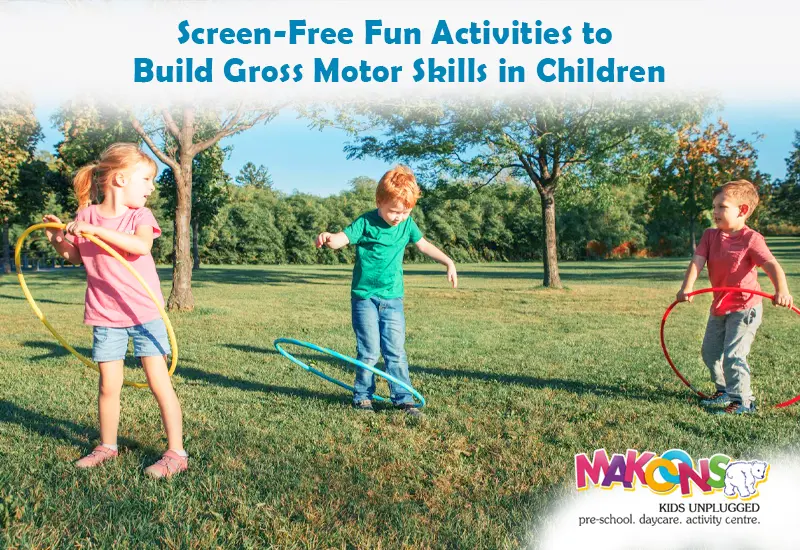
In the contemporary digitalized world, screens have silently become the daily aspect of childhood. As much as technology is desirable, children also require time to move, jump, climb and explore their bodies. Screen-free activities are not only necessary to reduce screen time, but they also enable the promotion of healthy movement, confidence, and coordination. Development of gross motor skills is one of the most significant aspects that they endorse.
Gross motor skills are those activities that use large muscles on the arms, legs, and the core. These abilities assist children to move (run), balance, toss, climb, and engage in daily physical activities. Good gross motor development preconditions comprehensive physical well-being, emotional control and even school preparation.
A Case Of Gross Motor Skills In Childhood
Gross motor skills are significant to the general development of a child. They help in maintaining posture, balance, coordination, and strength. Children also learn the attributes of space and control of the bodies when they move freely. Confidence and independence are closely related to the physical development of kids.
Such children tend to be more focused, have stronger muscles, and develop a better social level due to frequent movement-accompanied play. They also feel freer to venture in new environments and challenges.
The Worthiness Of Screen-Free Activities
Activities without screens promote creativity, imagination, and the physical world. Children do not need screens to focus on to be more conscious of the bodies and the world around them. They are more natural at creating games, solving problems and communicating.
Activities without the use of a screen also assist in overstimulation and sleep patterns. More to the point, they enable children to work on their gross motor skills that is very crucial by engaging in natural movement.
Outdoor Play: An Intuitive Means Of Getting Strong
The natural surroundings outside encourage movement. Running in open places, climbing playground devices or engaging in simple chasing games assist children to utilize their whole body. Outdoor games make the muscles stronger and enhance stamina.
Games such as cycling, skipping, and ball games are one of the best kid exercises games that help in maintaining balance and coordination. Similar activities like walking on an uneven floor or stepping over puddles increase the awareness of the physical body.
Related Topic: 30+ Fun & Educational Activities for Preschoolers
Playground Fun Providing Physical Activity
The activities can be supported by indoor activities when it is impossible to play outside. Obstacle courses made with cushions, chairs and tunnels enable the children to crawl, climb and balance. Another fun way of enhancing coordination and rhythm is dancing to music.
Both outdoor and indoor play are significant in the day to day life of a child. The trick is to move around as opposed to spending much time sitting down.
Fun Like Movement Games
Children tend to remain active when they feel that movement is a game and not a form of exercise. Games like simulation games, animal walks, or imaginary adventures will ensure that the children are always active and at the same time, they build large muscles.
The games involved by these kids also enhance listening and body control. Children who mimic movements and instructions learn to co-ordinate stress free and without stress.
Developing Gross Motor Skills In Daily Life
Special equipment is not necessary in gross motor development. Even very simple family chores such as carrying light items, watering plants, or assisting in picking up the toys include lifting, walking, and bending.
Vocational training through promotion of children to assist in everyday chores assists the children to learn actively as well as being responsible and independent. These instinctive movements make muscles strong and enhance coordination without being structured.
Related Topic: 20 Fun & Easy Craft Activities for Preschoolers
Physical Development And The Role Of Free Play
Free play will enable the children to experiment with movement at their own speed. They decide on the speed at which they are going to run, the height they are going to jump and even when they are to rest. This is a self-directed exercise that helps control emotions and physical self-confidence.
Creativity is also promoted by free play. Children create their own games, and by doing it, they engage their body, and imagination which facilitates the holistic physical development of kids.
Movement-Based Play: Social Benefits
Children learn to collaborate, take turns and communicate when they actively play with other people. Group activities enhance social interaction and also enhance gross motor skills.
Working jointly, throwing a ball, or playing team games fosters unity and emotional learning. These common experiences are a significant aspect of active learning among the children.
The Way Parents Can Promote Screen-Free Movement
Healthy motion can be supported by parents establishing an everyday routine, which incorporates playing. Minimizing screen time and providing activities that are appealing to children will help them interact with nature. The basic motivation and involvement are sufficient.
It is possible to make outdoor and indoor play safe to ensure that children feel comfortable exploring movement. Adults who practice active behavior are likely to be followed by children.
Striking A Balance Between Structure And Freedom
Although formal games are useful, children should have time to move freely, too. Guided activities and free play should have a balance to ensure a well-rounded growth.
Creativity and expression of feelings are facilitated using games which are structured to obtain certain skills in kids exercise, and free movement. Both are equally important.
Related Topic: Fun and Educational Pre-KG Activities to Do at Home
Lasting Advantages Of Powerful Gross Motor Skills
Children who have good gross motor skills tend to gain better posture, stamina as well as coordination as they mature. The skills enable them to be involved in sports, classroom activities, and everyday activities.
Other than physical health, movement also promotes mental health. Moving children tend to experience less stress and have better concentration, which testifies to the close relations between mind and body.
Final Thoughts
Calls to action: Screen-free fun activities do not qualify as a pause in technology, they are a vital part of a healthy childhood development. Play, movement, and exploration help children to develop good gross motor skills that are helpful in their life-long physical and emotional well-being.
Promoting screen-free activities, outdoor and indoor games, and providing happy children with games of jumping and moving, parents and educators provide them with the environment, in which children can develop, run, and live. Children should start active learning with a movement, and each jump, run, and climb is a step towards a healthier future.







 Twitter