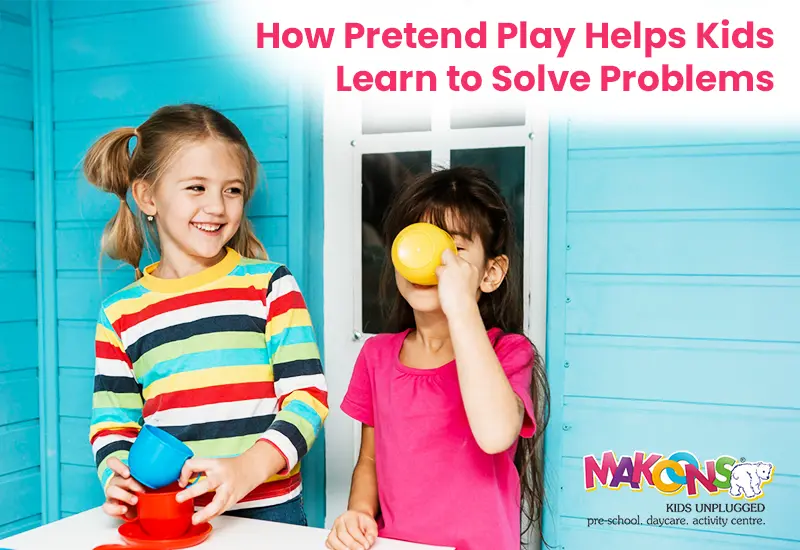
Pretend play is one of the most powerful ways for preschoolers to understand their world. Sometimes referred to as imaginative play, or role play, pretend play can take many different forms of thinking and behavior that all relate to creating imaginary situations, taking on roles and making pretend stories.
Pretend play is not “just play.” It provides an active way to support important cognitive, social and emotional learning, including the basis of problem solving in preschool, creative thinking and adaptability. In the following sections we will take a closer look at why and how pretend play in preschool is preparing the next generation to be curious problem-solvers.
What is Pretend Play?
Pretend play is when children take their emerging imaginations to create stories, develop characters and build settings- whether they are pirates, culinary chefs, merchants, parents or superheroes. Pretend play may use objects in new ways (a block is a phone), draw on scenarios from real life, or a totally made-up world. All the playful moments listed above are at the heart of both creative learning and social development for preschool children.
Benefits of Pretend Play for Problem-Solving
1. Encourages Creativity and Flexible Thinking
Pretend play has infinite open-endedness. Children create problems (“The castle is under attack!”), find solutions (“Let’s put a wall up!), and use objects in new ways (“My spoon is a magic wand”). When doing these types of imaginative play children are conditioning their brains to explore solution options with more than one answer- building the context for being creative and using “out of the box” thinking is a key component of problem-solving for preschool age children.
2. Creates Trial and Error Experiences
When the first idea does not work out just right (“No! The block tower fell down!”), children often will try again, change their plan or ask someone for help.These small failures and trials teach children to see mistakes as learning opportunities—very helpful for solving problems in preschool.
3. Increases Executive Function and Cognitive Flexibility
A child’s organization of a narrative and remembrance of roles while switching between make-believe and reality involves memory, planning, and flexible thinking. Executive functions the “front desk manager” of the brain are directly involved in pretend play. Here is where the child focuses and changes direction, or perseveres!
Role Play for Kids: Developing Social and Emotional Problem-Solving
1. Understanding multiple perspectives
Through role play, children act as a teacher, a doctor, or as a superhero. Children begin to see multiple perspectives, identify feelings in others, and adjust their responses to a different situation—this is the genesis of empathy and social negotiation.
2. Practising Social Skills and Conflict Resolution
In role play, when disagreements occur over roles (“I want to be the daddy!”), children practice negotiating, compromising, and setting out their needs. They will figure out how to resolve conflicts with peers, share, take turns, and follow shared rules—all valuable life skills.
Imaginative Play Activities to Encourage Problem-Solving
“What If” Games: create a problem—“what if the store is out of food?”, and then let the children come up with possible solutions.
Prop Boxes: Offer simple items—hats, scarfs, boxes, kitchen items, etc.—and ask the children to make a storyline.
Story Acting: After reading a book, let the children use their own ideas to act out the story or extension of the story, or change the
Community Helpers Play: Provide a pretend doctor’s office, a grocery store, or a post office – then develop mini “problem(s)” (e.g. a lost letter or sick teddy bear) for them to problem solve.
Preschool Social Skills Play: Learning Together
When children create imaginary group play, they develop preschool social skills:
- Children are going through a process that involves planning together, assigning roles, and co-creating.
- They also develop resilience and patience, which is important while they “wait their turn” and engage in a new role.
- When children work together on compounded scenarios they are developing both group learning and individual play.
Real-World problem-solving & executive function
Research supports that routine, high-quality pretend play consistently relates to the following skills during early childhood, and further travelling through school:
- More improved planning, organization, and attention skills.
- Less brain overload more ability to remember what to do and toggle or switch tasks.
- More advanced use of language, a more sophisticated use of narrative and accounting-storying—these are all vital to coming up with and conveying solutions.
Ways Adults Can Help Support Pretend Play Problem Solving
1. Join them in the play, and scaffold the play: Play with the child and provide some playful provocation (“What are we going to eat for our tea party?”) to enrich the imaginings.
2. Provide props rather than quadrants: Very simple dress-ups, different household items, and open-ended categories of play (blocks, dolls, boxes) might all contribute to pretend play. Do not script what they are to play. Let the child take the lead in the play.
3. Help children’s reflections: After play, ask the child a few questions: “How did you fix the problem with the building?” “Could you have tried something else?” or some more profound thinking a support of their metacognition (thinking about their thinking, and solutions).
4. Don’t deal with frustration: Redirect the child’s conclusions if necessary, and celebrate the safe and creative attempts they made and even the “mistakes”. Tell children the next time they are processing a problem, it is okay to explore other options.
5. Celebrate collaboration: Compliment children that can share in the working together, and will help team-mates, teamwork children, or work towards some compromise during anything that might appear to be a conflict.
The Value of Preschool Creative Learning For Life
Children who engage in pretend play routinely include:
- Odysseys with greater perseverance or resilience when they experience a new or challenging situation.
- The ability to appreciate while learning are “mistakes”-and keep attempting.
- A way to experience flexible thinking, which is critical to everything from math to becoming an entrepreneur.
- The ability to express orally and demonstrate communication which is more exhilarating along with their foundation for group problem-solving and reasons alone.
Conclusion
In conclusion, pretend play is WAY more than simply fun and games for preschoolers! Research suggests that pretend play is a major contributor to their development of many behaviors; imaginative or pretend play is a strong driver for developing their problem-solving abilities, level of social understanding, language delivery, and creative thinking. Through role play for kids, preschool social skills play, and other ways to engage in imaginative play activities children learn to become adaptive, inventive, and collaborative learners. For parents and educators keen to foster preschool creative learning and robust early childhood problem-solving, the best classroom is one that allows time, space, and freedom to pretend, explore, and invent preparing children for a world of challenges and possibilities.
Read Also : What is the Role of School in a Child Life?






 Twitter