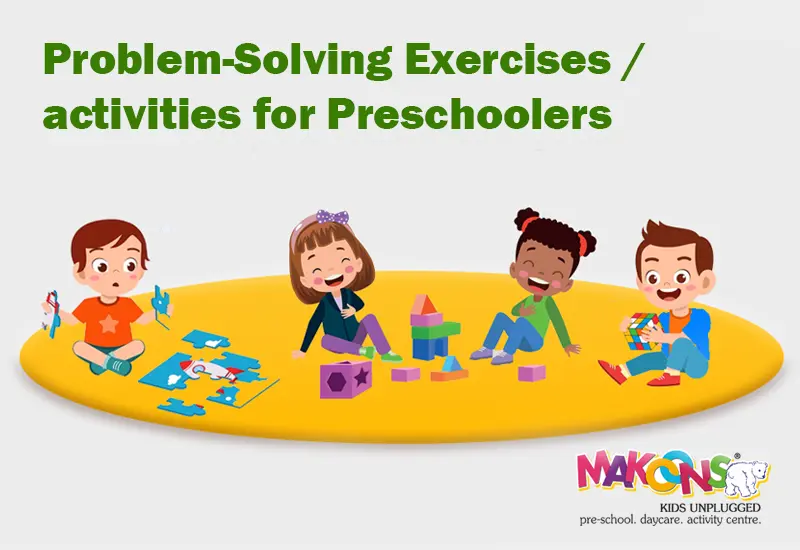
Building problem-solving skills in preschoolers is valuable because problem-solving skills are important in their cognitive, social, and emotional development. Problem-solving skills help children make sense of their world, handle challenges, and develop persistence. Problem-solving skills develop naturally in preschoolers, along with an opportunity to explore playfully and lay the foundation for critical thinking for children and lifelong learning. This overview provides a general, research-based framework – including implementable problem-solving games and activities – that can be implemented at home or preschool settings.
Read more : Top 10 Activities Every Preschool Curriculum Should Have
Why is Problem-Solving Important in Early Learning?
Problem-solving is a key focus in early learning critical thinking. According to Piaget’s research, young children construct their own knowledge through tactile exploration, trial and error, and thus real life learning experiences. Young children conceptual learning all the while improving your problem solving thinking about how to explore, ask, predict, and eventually develop strategies to overcome limits and difficulties. Problem-solving experiences provide young children:
- Persistence or tension
- Self-confidence, self-sufficiency
- Communicating or collaboration
- Reason or decision making
- Change or opportunity.
By engaging children in meaningful activities, preschoolers can accommodate activities around any ability or increase and need a surprising amount of limited resources.
Principles for Developing Problem-Solving Games with Young Children
- Keeping activities hands-on and playful
- Supporting children to make decisions and guess are they thinking and doing
- Children should work solving problems together or independently
- Children should deal with a new a new problems each question from scratch with age/ability
- Model persistence and praise effort, not just praise score or fulfillment of task or completion.
10 FUN and Engaging Problem-Solving Activities for Preschoolers
1. Build a Den
Use blankets, pillows, cardboard boxes or large sticks outside, inviteAllow them to determine the design, pick their materials, and strategize about how to build their den.
Practiced skills: Planning, foresight, teamwork, spatial reasoning.
Further Situations: Ask children what they would do to make the den sturdier or bigger, and when the fort flops or materials aren’t available, debrief together how to get it to work (especially if it fell).
2. Cooking & Baking Together
Invite children to help measure, mix, stir, etc. Talk about what went well, and what you think we could do differently/modify next time.
Practiced skills: Sequencing, mathematical reasoning, evaluating, flexible thinking.
3. Design and Complete their Obstacle Course
Invite children to design and navigate their own obstacle course inside or outside using cushions, chairs, boxes, or to use outside equipment. Encourage them to resolve challenges with movement (E.g., “How are you going to get under this/ over this / around this?”)
Practiced skills: Physical problem solving, flexibility, strategic thinking.
4. Play with Patterns & Sortings
Give children colorful items (cotton balls, buttons, building blocks, etc) and ask them to sort them by color, shape, or size. Challenge them to continue or create patterns of the items.
Practiced skills: Sorting, classification, logical reasoning, predictions.
5. Utilize Puzzles & Tangrams
Offer children with jigsaws, shape sorters, wooden puzzles, and/or tangrams that are age appropriate. Allow children to experiment with fit, angles, and trial and error.
Practiced skills: Spatial awareness, perseverance, visual reasoning.
6. Ice Rescue Experiment
Freeze some toys overnight inside a bowl of ice. Present the block of ice to children and ask them to come up with a plan to safely obtain their toys (using water, digging, tools, even their hands). Skills developed: Scientific reasoning, hypothesis testing, patience
Extension: Compare different melting methods; discuss cause and effect.
7. Treasure Hunt Adventures
Design a simple treasure hunt with clues or riddles to solve. Each clue will lead you to the next clue, creating excitement and building logic for the next clue.
Skills developed: Sequencing, memory, reading comprehension, navigation
Extension: Include teamwork or partner children to collaborate to solve the clues that are challenging.
8. “What Would You Do?” Social Situations
Consider daily dilemmas: “What would you do if you lost your shoe at school?” “How would you help your friend that was upset?” Give children the opportunity to discuss the situations, act out responses, or draw their response.
Skills developed: Decision making, emotional reasoning, empathy everyday speech
9. Building Challenges with Lego, Blocks, or Boxes
Ask children to build the tallest tower, longest bridge, or animal with set materials. While they are building, you are encouraging problem-solving (“What can we do to make this taller?” “How do we keep this from falling?”)
Skills developed: Engineering, creativity, resilience, planning edge early learning
Extension: Give time limits, particular goals, or incorporate building something together.
10. Storytelling with Objects: Pick 3 random objects and ask children to create a story that includes the 3 objects. Take turns creating the story with children, in efforts to allow for flexibility and critical thinking.Practiced skills: Imagining, adaptable thinking, constructive communication.
Building preschool problem solving skills every day
In addition to intentional games, promote opportunities for problem solving every day:
- Ask open-ended problems (“How could we make this taller?” “What do you think would happen if…?”)
- Allow children to help with authentic life tasks: setting the table, sorting laundry, preparing a group activity.
- Use books, stories and puppets to talk about dilemmas in everyday life.
- Invite children to think about a challenge, and invite them to think about change (“How did you fix this? What might work?”).
When we think about critical thinking for young children, we think about the child’s natural curiosity, trying new approaches and experience while also reflecting after action. Preschooler’s brains are built for inquiry and we must create situations to foster that thinking by:
- Creating a safe space to “mess up” and celebrating learning.
- Brainstorming many approaches to a problem, one problem could have many solutions or approaches.
- Using a visual prompt- charts, choice boards, drawing ideas.
- Talking about strategies and encouraging persistence.
- Home School Strategies to support preschool skills in problem-solving:
In Daily Life:
- Dilemmas: “We have one banana and two kids—how could we share it.?”
- Questions: “Why do you think that happened?”
- Letting them try and solve a small challenge: matching socks, toy is missing, help to cook.
Inclusion and Adaptation in Problem Solving and activities:
- Kindergarten and Problem-solving activities should accommodate the diverse range of interests and abilities children demonstrate.
- Using everyday familiar material or arranging an age-appropriate space.
- Always give an option to do the activity independently or in a pair/group.
- Adapting or modifying depending on sensory, motor or language difficulties/abilities; engagement pictures instead of words, add more time, or match children to provide conversation.
- Celebrating all different problem-solving approaches is extremely valuable and rarely is there only one “right” answer.
Building the role of failure and resilience in problem-solving
- Continuing to show and teach even at an early age, that mistakes, or “mistakes” are part of problem-solving.
- Talk about what worked or didn’t and then assist in brainstorming a different approach.
- Praising the effort over quickly fixing the problem enables character building with perseverance and esteem.
- Sharing your own stories while learning while on the journey models a growth mindset and healthy attitude towards learning.
List of Fun Games for Preschoolers to problem-solve & consider
- Tangram & wood puzzles,
- Pattern blocks, sorting and arranging games,
- Ice rescue/lab science activities,
- Karaoke Lego block or build literature, flash card games of memory and/or similar pair matching to adult games.
- A treasure hunt or riddle trail is another fun approach.
- Stupid games can be fun, as long as the children and educators engage in role play or, “What would you do?”
Having children move physically, such as an obstacle course would be more for fun and to problem solve is fine too.
Conclusion
Using play based, interactive and diverse activities adults can support strong problem solving skills for preschoolers which is what they will use to plan, try, adapt, communicate, and reflect in real life play. Educators/practitioners should celebrate all creativity, teamwork and perseverance and flexible groupings. All of these habits build the foundation of critical thinking and problem-solving for kids so they feel curious and capable for whatever you will throw their way from school and into adulthood.
Read Also : Fun Learning Activities to Do at Home with Preschoolers







 Twitter