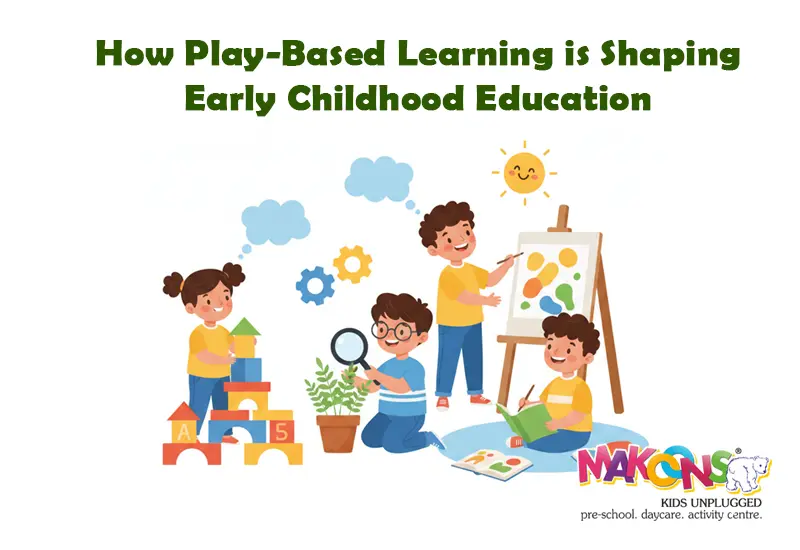
The initial language of a child is play. Before children can read or write, they make sense of the world by playing with it, touching it, pretending, building, asking and answering questions. This instinct of nature is the basis of modern education to-day. The concept of play-based learning is no longer regarded as simple play, but as one of the most effective methods of children learning during their initial years of growth.
Play based learning in preschool is being adopted by preschools across the globe as one of the main methods of teaching. This change is altering the way we consider the trends of early childhood education and redefining the image of meaningful learning.
What Is Play-Based Learning?
Play-based learning refers to a system of education in which children acquire knowledge by means of facilitated play, exploration, and physical activities as opposed to being taught.
It focuses on:
- Child-led exploration
- Real experiences as a way of learning.
- Active listening rather than passive listening.
- Informative engagements with individuals and objects.
Plays in a play based curriculum do not represent a pause of learning- they are the learning.
Why Play Is Necessary In Early Childhood?
Brains of young children are growing at a very fast rate during the initial years. Traditional teaching cannot do this development as play does.
Through play, children:
- Learn nothing to be afraid of failure.
- Problem-solving and practising decision-making.
- Show emotions and creativity.
- Develop self-confidence and confidence.
Such experiences are the pillars of life long learning.
Related Topic: Why Play-Based Learning is More Effective Than Traditional Teaching?
The Major Advantages Of Play-Based Learning
The advantages of play based learning are broader in scope than academic preparedness. It takes care of the entire child, physically, mentally, emotionally, and socially.
Cognitive Development
- Promotes inquisitiveness and questioning.
- Teaches the kids about cause and consequences.
- Enhances short term memory and attention.
- Adapts to math and language concepts early.
Social And Emotional Growth
- Learn to work together and share.
- Assists children in coping with emotions.
- Develops understanding and personal communication.
- Promotes strength and self-esteem.
Physical Development
- Enhances motor and coordination.
- Promotes muscle strength, balance and motility.
- Promotes physical exercise by playing.
Language And Communication
- Develops vocabulary using conversations.
- Promotes narration and communication.
- Enhances the listening and understanding skills.
Play Based Learning In Preschools
Play is a learning process in contemporary classrooms and it occurs in various ways.
Examples of play-based activities are:
- Fantasy and role plays.
- Playing with construction toys and blocks.
- Music, art, and artistic expression.
- Sensory sand, water and texture play.
- Dramatic plays and storytelling.
- Play in nature and outdoor adventure.
Every activity is planned well to help in achieving learning objectives without imposing on the children to be the leaders in the activities.
Teacher Role In Play-Based Learning
Within a play-based setting, the teachers become facilitators but not instructors.
Their role includes:
- Noting the likes and behaviours of children.
- Asking open-ended questions
- Bringing novel concepts at an opportune time.
- Directing play and not being controlling.
- Propping up personal learning styles.
This will be a strategy that honors the pace and personality of each child.
The Play-Based Learning Of Building School Readiness
The issue of whether play equips children to the real school is one of the most widespread anxieties of parents. Studies indicate that play-based learning creates firmer grounds compared to early learners.
Play-based learning fosters the development of children:
- Increased ability to solve problems.
- Greater attention and concentration.
- Development of emotional regulation.
- Trust in new circumstances.
- Favorable perspectives on learning.
Such abilities are necessary to the success of long-term academic achievements.
Related Topic: What Is Play School Methodology? A Complete Guide For Parents
Play Based Curriculum Vs Traditional Learning
Classical learning usually dwells upon:
- Memorisation
- Worksheets
- Teacher-led instruction
- Fixed outcomes
The play-based curriculum lays emphasis on:
- Exploration and discovery
- Hands-on experiences
- Child-led learning
- Process over results
This change is indicative of the trends in the world trends in early childhood education.
Play And Brain Development
The various parts of the brain are stimulated by play. Children will think, move, communicate and even feel, all simultaneously when they play.
This helps:
- Form powerful neural networks.
- Become more emotionally controlled.
- Support creative thinking
- Jump-start problem-solving skills.
Play literally develops the growing brain.
Related Topic: Importance of Play Groups Classes in Early Childhood Education
The Play-Based Learning At Home
Parents are also significant in continuing the play-based learning outside the classroom.
You can support learning by:
- Permitting free time to play.
- Promoting the use of imagination and creativity.
- Asking open-ended questions
- Limiting screen time
- Cooperation with no instructions.
Even ordinary daily tasks can be a strong learning experience.
Why Play-Based Learning Is The Future Of Early Education?
Contemporary education appreciates the fact that children are not blank plates that are to be stuffed with information. They are also learners in action and build meaning based on experience.
Play-based learning:
- Conforms to the natural learning principles among children.
- Favors the comprehensive growth.
- Builds a love for learning
- Trains the children in a dynamic world.
This practice is influencing the future of early childhood education in the world.
Final Thoughts
Play does not distract one of the learning, it is the main part of it. Through the adoption of play-based learning in preschool, teachers and parents will provide the children with a safe environment to learn, experiment and develop.
The real strength of the play is that it makes curious minds, brave hearts, and competent learners. With the current trends in early childhood education, play-based learning is at the centre-stage of this trend, as it respects the best thing that children can learn, which is play.







 Twitter