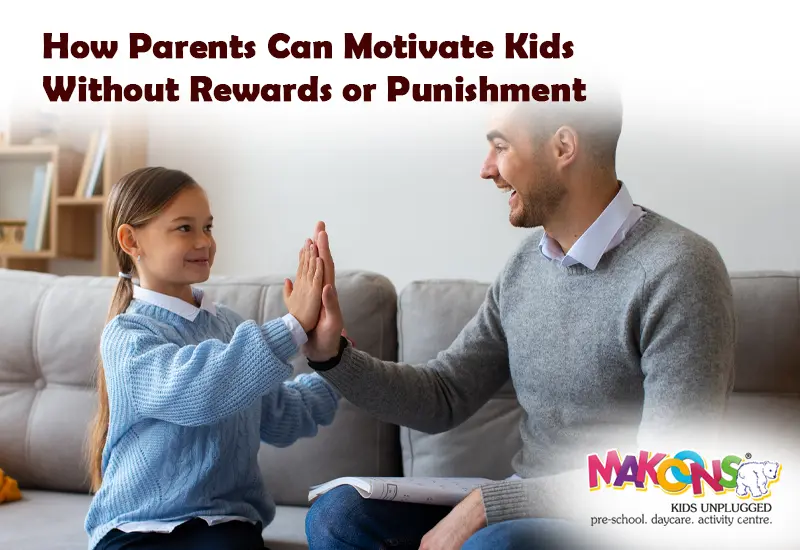
Modern day parenting can be described as a balancing act. Most parents use chocolates, screen time and even punishment to get kids to listen, study or even act well. These approaches are effective in the short term but they fail to create motivation and emotional robustness over the long term. Current studies and positive parenting strategies indicate that there is a more appropriate method- assisting children to generate intrinsic motivation.
This paper discusses effective parenting strategies and effective child motivation strategies, which can be used by parents to ensure that they can motivate children without using rewards and punishments but at the same time make them learn and grow into responsible and confident individuals.
The Flaws of Rewards and Punishment in the Long Run
External motivators are rewards and punishment. Children learn to be results-oriented and not values-oriented when they take an action only to receive a reward or to escape punishment.
Problems with rewards:
- Children demand reward on any occasion.
- In the case of rewards being stopped, motivation fades.
- The learning process becomes transactional.
Problems with punishment:
- Not understanding, but fear creates.
- Parent-child relationship Hammas parent-child relationship
- Reduces self-confidence
Motivation without rewards makes children perform because they feel like they should not because they are in need of motivation.
Knowledge of Internal Motivation in Children
Curiosity, interest, purpose, and satisfaction are sources of internal motivation. When kids feel:
- Understood
- Capable
- Respected
Their desire to collaborate, learn and better is inbuilt.
One aspect of positive parenting is that it involves leading children instead of controlling them.
1. Develop a Good Emotional Attachment
Emotional safety allows the children to listen to the conversation.
Parenting tips:
- Spend quality time on one on one basis daily.
- Listening, not interrupting.
- Affirm emotions when there is a need to correct behavior.
Example:
At the expense of telling them to stop crying or I will scold them, tell them:
“I see you’re upset. Now, that is what happened.
Children become open to instructions when they feel that they are understood. Connection on the emotional front is what can be used to encourage children.
2. Promote Hard Work, Not results
Praise of effort instead of success is one of the strongest methods of child motivation.
“You’re so smart!”
This is a good piece of work you did.
Why this works:
- Builds a growth mindset
- Reduces fear of failure
- Brings children to desire to learn.
Children are taught that it is not about the grade or the comparison but rather about the hard work.
3. Provide Weaknesses with Flexible Options
Children do not like being controlled, however, they are co-operative to autonomy.
Instead of giving an order: Do your homework!
Aggression: Do you want to begin with math or English?
This simple shift:
- Builds responsibility
- Reduces power struggles
- Promotes uncompensated motivation.
Decisions enable the children to feel appreciated and engaged.
4. Achieve Expectancy Consistency
In foreseeable surroundings motivation flourishes.
Parenting style: Positive parenting.
- Set clear rules
- Give the cause of the reason behind them.
- Be consistent, not harsh
Example:
Homework time is between 5-6 pm because it will make you relax after that.
Regularity assists children in feeling safe and competent and this instinctively encourages children to adhere to routines.
5. Be a Role Model
Parents teach children more by example rather than words.
If you want to:
- Teach children – be interested.
- Learn to wait – to be cool in reply.
- Develop discipline – be self ruling.
Such model behavior as reading, problem-solving, and emotion regulation. This is one of the most effective parenting tips, which is known as silent teaching.
6. Punishment instead of Natural Consequences
Natural consequences enable the children to experience learning.
Example:
Lost homework – clarify to the teacher.
Did not put away rattles – will not be able to play with them.
This method:
- Builds accountability
- Avoids shame
- Promotes positive parenthood.
Children get to know cause and effect without fear or threats.
7. Learn to Work on Strengths and not Weaknesses
All children possess different skills.
Give up paying attention to what your child does not have:
- Identify strengths
- Promote competence-based faith.
- Celebrate progress
When a child feels competent, he or she gets greater motivation to explore new things. One of the major methods of motivating children without pressuring them is by acknowledging their strengths.
8. Provide a Learning-Friendly Environment
Children are curious in nature.
To encourage kids to learn:
- Keep books accessible
- Ask open-ended questions
- Both exploration and error should be permitted.
Avoid over-scheduling. Creativity and self-directed learning is usually a result of boredom.
9. Communicate, Don’t Control
Punishment is substituted with good communication.
Instead of: “Because I said so!”
Try: “This rule keeps you safe. Let’s talk about it.”
Children are willing to cooperate when they know the reasons. This creates trust and supports the motivation in the absence of rewards.
11. Encourage Self-Reflection
To make children reflect on their actions.
Ask questions like:
- “How did that make you feel?”
- What would you have done differently the next time?
- What do you consider to be a good solution?
Self-reflection creates emotional intelligence and inner discipline, which is an important element of child motivation techniques.
12. Avoid Comparisons
Motivation is hurt by comparison of siblings or classmates.
“See how your cousin studies!”
I know you are doing better than you used to do.
Competition does not lead to healthy motivation but personal growth does. This is a style that closely adheres to the values of positive parenting.
13. Be Patient with the Process
Rewarding and punishing children without incentives is a slow process.
There will be:
- Resistance
- Mistakes
- Emotional moments
Nevertheless, consistency, empathy, and trust make a long-term change. When children are brought up with an internal drive, they become responsible adults who can take responsible actions even in the absence of supervision.
Final Thoughts
Understanding the way in which parents can entice children without rewards and punishment is an effective transition to thoughtful and respectful parenting. Parents can effectively encourage children to be motivated by addressing emotional bonding, independence, and consistency, and also by communicating with them.
With such parenting tips and applying the effective techniques of child motivation and positive parenting, it is possible to motivate kids to learn to enjoy the learning process and not to get rewards or to be afraid.
Authentic motivation is uncompensated and results in confidence, responsibility and curiosity throughout their lives- something that every parent would prefer his or her child to have.







 Twitter