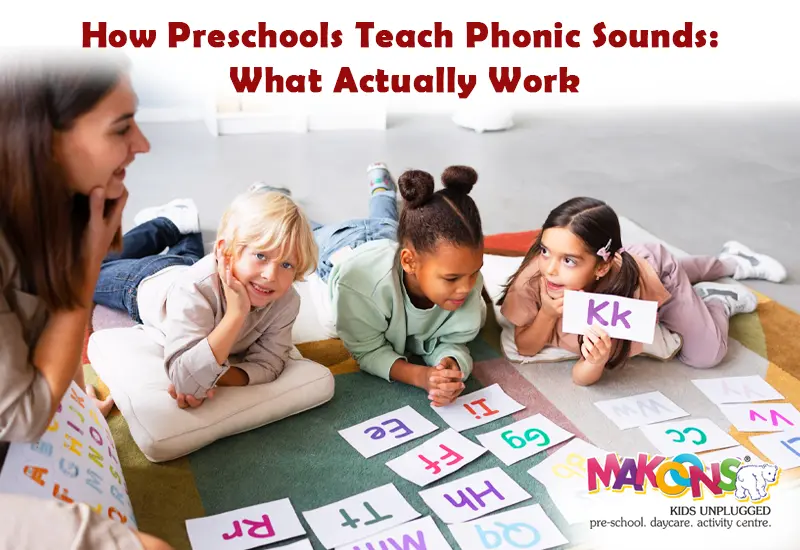
One of the most significant milestones of early childhood is learning to read. The key of this trip is phonics- the relationship between letters and sounds. Parents have heard such words as phonics-based curriculum or phonic sounds to kids yet they are not always sure what makes kids learn.
In this blog, we are going to discuss how to teach phonics in preschools, the best teaching techniques of phonics used in preschools and what really works in facilitating phonics learning in preschoolers without pressure and confusion.
The Importance Of Phonic Sounds In Preschool
Reading and writing are based on phonics. As soon as children learn that letters may be sounds, they start to decode words instead of memorizing them. This competence promotes literacy in the long run and confidence.
At early ages, phonics assists children:
- Recognize letter sounds
- Blend sounds into words
- Improve pronunciation
- Acquire the ability to read at an early age.
This is why phonics is a part of early reading skills programs in most of the modern preschools.
Also Read: 7 Days of a Week Names | Learn Days in English Easily
The Phonics Instructions For The Preschools Today
Phonics is not taught to preschools as in primary schools. No massive textbooks or extensive spelling practices. Learning occurs instead as a result of play, repetition, everyday interaction.
An effective phonics based curriculum presents the sounds in a slow but enjoyable, stress free manner.
The Phonics Learning Of Step-By-Step
1. Sounds Before Letters
The teach back sound-first-not-letter-name is one of the most effective preschool teaching methods to teach phonics.
For example:
- Children acquire the sound /b/ and not the letter B.
- Sounds are drilled in solitude then they are mixed into words.
This assists children to learn to hear sounds properly and not to be confused at a later stage.
2. Listening And Speaking
Children require good listening abilities before they read or write. That is why phonic sounds among children are initially presented by:
- Songs and rhymes
- Repetitive chants
- Sound emphasis narration.
This oral base helps in understanding and remembering.
Phonics Learning By Preschoolers With Means Of Play
Youthful children learn best through play. Playful techniques are employed in the successful preschools that do not rely on formal teaching of phonics.
Preschool Popular Phonics Activities
Certain successful phonics tasks during pre-school are:
- Sound matching games
- Sound associated picture cards.
- Phonics (jump and clap) Action-based.
- Sound hunts in the classroom using toys.
These activities make learning a pleasurable process and not a burden.
Reading With Picture Books And Stories
Stories are very strong in the development of early reading skills. When reading aloud, teachers pay attention to some sounds to give children an opportunity to relate phonics to the meaning.
For example:
- Repetition of words with a common beginning.
- Asking them to recognize familiar sounds to children.
- Promoting guessing words by children.
This is a better way of enhancing understanding and acoustics.
Also read: 5 Oceans of The World: Names & Sizes
There Are Multisensory Teaching Phonics Methods
Children have the ability to learn effectively when more than one sense is involved. Multisensory approaches are currently used in the phonics based curriculum of many preschools.
This includes:
- Following words in sand or air.
- Using clay to form letters
- Sound activities based on movement.
- Pictorial instructions such as charts and flashcards.
Such techniques aid the children in the maintenance of information.
Mostly Soft And Natural Blending
Phonics learning involves a significant aspect of blending, which must never be hurried. Preschools emphasizing phonic learning in preschoolers work in blending only after individual sounds are mastered by the child.
For example:
- /c/ /a/ /t/ becomes “cat”
- The sounds are stretched and amalgamated softly.
This will instill confidence and eliminate frustration.
What Not To Do In Teaching Phonics
It is important to know what not to do as well.
1. Too Much Too Soon
Children are puzzled by introducing excessive sounds simultaneously. Successful teaching strategies in preschool phonics involve slow development.
2. Worksheets And Rote Learning
The young children do not learn using worksheets but by moving, interacting. Early writing can make it less interesting.
3. Comparing Children
Every child studies at his or her own pace. The comparison of the reading progress leads to pressure and influences the confidence.
Related Topic: Teaching Preschoolers All Body Parts Names in English
The Role Of Teachers In Teaching Of Phonic Sounds
In the teaching of phonics in preschools, teachers are a crucial element. A skilled teacher:
- Monitors the learning rate of every child.
- Makes constant repetitions.
- Promotes involvement without coercion.
- Employs positive reinforcement.
Fancy tools are not as important as training and patience.
The Role Of Parents In Supporting Phonics
The process of phonics does not end in school. The parents can help the children with phonic sounds in simple means:
- Read aloud daily
- Attend games and music on a day-to-day basis.
- Promote the detection of sounds in children.
- Do not make too much correction–concentrate on effort.
Home support enhances classroom learning.
The Bigger Picture Phonics And Early Reading Skills
Being a phonic does not turn a child into a reader. It does best in combination with:
- Story comprehension
- Vocabulary development
- Listening skills
- Love for books
Balanced phonics based curriculum develops both technical reading and the pleasure of reading.
Conclusion
Properly applied phonics can be enjoyable and part of the learning process. The ideal preschools know that speed is not the way phonics learning should be done among preschoolers, but rather comprehension.
Phonic sounds among kids are the basis of good early reading abilities through play, repeated exercises and nurturing instructions. Patience, consistency and being child friendly, that is, where the learning process is a discovery, rather than a pressure, is what works.







 Twitter