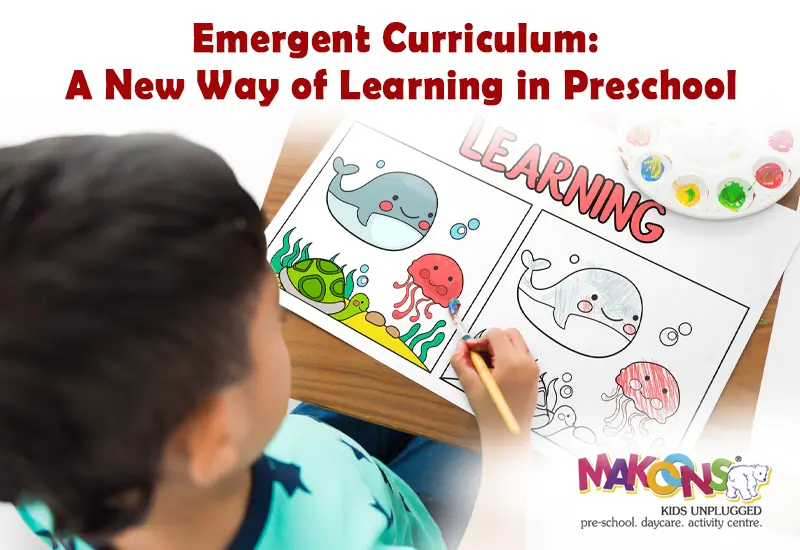
Preschool learning is changing fast. Parents and teachers now want learning that feels natural and joyful. One approach that is gaining attention is the emergent curriculum preschool model. This method focuses on children’s interests. It lets learning grow from their curiosity. It makes classrooms active, flexible, and child-friendly.
In this blog, we will understand what is emergent curriculum, how it works, and why it is becoming a popular part of preschool curriculum trends.
What Is Emergent Curriculum?
Many parents ask, what is emergent curriculum? It is a learning method where lessons are not fixed in advance. Teachers do not follow a strict daily plan. Instead, they observe children and build lessons based on what children are curious about.
If kids indicate they are interested in animals, the teacher can execute the activities that involve animals’ sounds, homes, and food. When children show curiosity about rain, their curriculum might consist of water play, reading rain-related stories, and having basic science discussions.
This makes learning feel natural. It also makes children feel heard and valued.
How Emergent Curriculum Works in Preschool?
In an emergent curriculum preschool classroom, teachers watch and listen. They take notes on what children talk about, play with, and ask questions about. These observations guide the next set of activities.
There is no pressure to finish a fixed syllabus. Learning grows day by day. Teachers guide, support, and add ideas. Children feel safe to explore.
This method supports modern preschool teaching methods. It moves away from rote learning. It supports learning through play and real-life experiences.
Related Topics: What’s Inside a Preschool Syllabus? Core Subjects and Fun Activities Explained
Child-Centered Learning in Preschool
One of the biggest strengths of this approach is child-centered learning preschool. Here, the child is not forced to follow strict instructions. The child becomes an active part of learning.
Children get to choose activities. They get time to ask questions. They get space to fail and try again. This builds confidence. It builds communication skills. It builds strong thinking habits.
It is generally the case that in the conventional classroom setup, instructors give lectures and students listen. On the other hand, in the child-centered classroom, kids discover the world and teachers direct their learning.
Why This Is a New Learning Style in Preschool?
The new learning style preschool focuses on flexibility. It understands that every child learns differently. Some children learn by touching. Some learn by seeing. Some learn by listening.
Emergent learning respects these differences. It does not compare children. It does not rush children. It allows each child to grow at their own speed.
This approach also improves emotional development. Children learn to express feelings. They learn to work in groups. They learn to share and wait for turns.
Related Topic: Preschool Curriculum: Academics, Play & Life Skills
Role of the Teacher in Emergent Learning
In innovative preschool teaching, the teacher is not a strict instructor. The teacher is a guide and observer. The teacher sets up safe spaces. The teacher provides tools, toys, books, and materials.
Teachers ask open questions like:
- What do you think will happen?
- Why do you like this?
- Can you show me how?
These questions spark thinking. They make learning deeper. This is very different from old preschool teaching methods, where children were expected to sit quietly and copy.
Activity Based Learning in Preschool
A key part of this approach is activity based learning preschool. Children do not just listen to stories. They act them out. They do role play. They use blocks, clay, water, sand, and colors.
Some common activities include:
- Building houses with blocks
- Painting with fingers
- Water play with cups and bottles
- Gardening activities
- Puppet shows
These activities build motor skills. They build language skills. They build teamwork. They make learning fun and lively.
Benefits of Emergent Curriculum in Preschool
The emergent curriculum preschool approach offers many benefits.
- First, it builds curiosity. Children learn to ask questions. They learn to explore answers.
- Second, it improves communication. Children talk more. They express ideas freely.
- Third, it supports social skills. Children learn to share, cooperate, and respect others.
- Fourth, it reduces learning fear. There are no strict right or wrong answers. Children feel safe to try.
This method also supports overall brain growth. Children learn through real life and play, not through pressure.
How Parents Can Support This Learning at Home
Parents play an important role in child centered learning preschool. You can support this method at home in simple ways.
Talk to your child about their day. Ask what they liked. Ask what they discovered. Provide simple materials like paper, crayons, empty boxes, and safe kitchen tools.
Allow your child to explore. Avoid stopping questions. Try to answer patiently. This builds a strong learning habit.
You do not need to create strict study time. Learning can happen while playing, cooking, or cleaning together.
Emergent Curriculum and Preschool Curriculum Trends
Modern preschool curriculum trends are moving towards flexible learning. Many schools are now mixing structure with freedom. Emergent curriculum fits this trend perfectly.
Schools now understand that early learning should not feel like pressure. It should feel like play. It should feel like discovery.
This approach also supports overall development. It improves thinking, feeling, social, and physical growth.
Challenges of Emergent Curriculum
Like every method, this approach also has some challenges. It needs skilled teachers who can observe well. It needs good planning behind the scenes. It also needs parent support.
Some parents worry about the lack of fixed books. But over time, they notice better confidence and creativity in their children. When done well, the results are very positive.
Why Innovative Preschool Teaching Matters?
Innovative preschool teaching is important in today’s world. Children need more than books. They need problem solving skills. They need creativity. They need communication skills.
Emergent learning helps build these skills early. It prepares children for future academic and life challenges.
This method builds happy learners. It builds confident thinkers.
Conclusion
The emergent curriculum preschool approach is changing how children learn. It focuses on curiosity, play, and real experiences. It answers the question of what is emergent curriculum in a simple way. It is learning that grows from the child.
This new learning style preschool supports natural growth. It follows modern preschool teaching methods. It promotes child centered learning preschool and activity based learning preschool. It also matches the latest preschool curriculum trends.
By using innovative preschool teaching, we can give children a strong and joyful start to learning.






 Twitter