Multiplication is a significant achievement in the mathematical life of a child. It develops the basis of division, fractions, long division and advanced mathematics. The multiplication tables are hard, boring, or confusing to many children, more often than not, at least at the beginning of memorizing numbers. This is where the use of creative teaching techniques can come in with a big difference.
This guide discusses how to teach kids about multiplication tables between 2-10 with fun and easy methods involving the use of visual tools, games, patterns and daily activities. It is aimed at enabling children to learn tables without being stressed and being able to remember and enjoy them.
The necessary keywords, teaching kids multiplication, multiplication table to kids, easy multiplication rules, fun way to learn tables, learning math as a kid, etc. are all built into the article, which is ultimately more beneficial to enhance the business in terms of SEO.
The Importance of Multiplication Tables
It is worthwhile to know the importance of multiplication tables to kids before delving into methodologies:
- Improve mental mathematical ability
- Get faster resolution of problems
- Assistance with such topics as division, HCF, LCM, fractions
- Boost confidence in school
- Make higher classes easier
Learning multiplication at an early age and in a creative manner facilitates ease in learning.
Related Topic: 7 Days of a Week Names | Learn Days in English
Begin With the Idea of Repeated Addition
Learners have to know what multiplication is. Why multiplication is just adding the same number twice and again.
Example:
2 x 3 = 2 + 2 + 2
4 x 5 = 4 + 4 + 4 + 4 + 4
One can use marbles, candies, pencils, or blocks to make the concept more understandable.
This is an effective method to use when teaching kids multiplication since they relate multiplication with things that they are already conversant with.
Use Patterns to Teach Tables
Patterns simplify math and ease its memorization. Children enjoy seeing patterns among the numbers and this can be utilized when learning the multiplication table between 2 to 10.
Patterns to show:
- Table of 2: the numbers will always have the end in 2,4, 6, 8, 0.
- Table of 5: the answers always end with 0 or 5.
- Table 9: the numbers of all results sum to 9.
- Table of 10: the end = 0.
Patterns make kids find multiplication more entertaining and not memorization.
Teach Skip Counting (Jump Counting)
One of the easiest methods of teaching multiplication is skip counting.
Teach kids to count in steps:
2, 4, 6, 8, 10… (skip counting by 2)
3, 6, 9, 12… (skip counting by 3)
Often when they learn to skip count, they learn to multiply automatically.
Example:
Skip counting by 4:
4, 8, 12, 16, 20 (this becomes the table of 4)
Rhythm and memory are also enhanced by Skip counting.
Related Topic: 5 Oceans of The World: Names & Sizes
Sing Multiplication Tissue and Rhymes
Music makes learning joyful.
Multiplication songs about children are numerous and include all the tables between 2 and 10.
Children are able to sing and learn tables without being forced or pressured.
Examples:
Table of 2 song
Table of 5 rhyme
Table of 9 melody
This is a very useful technique with auditory learners.
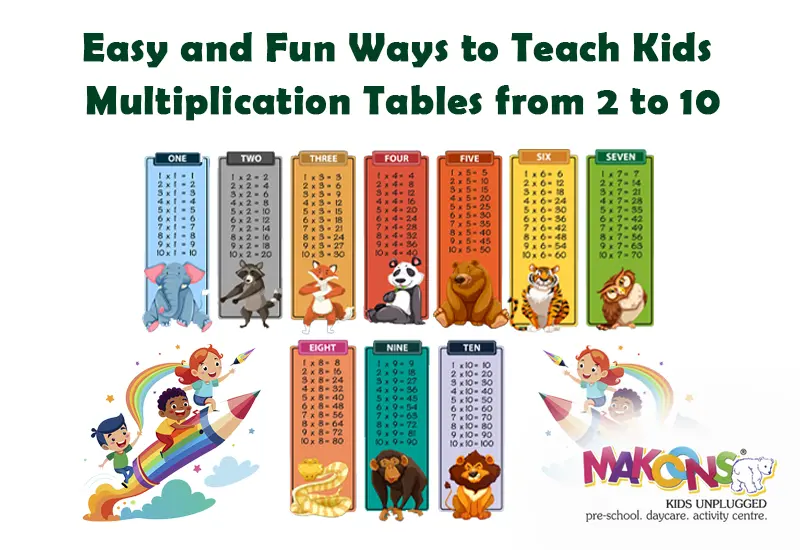
Create a Multiplication Wall Chart
One of the most effective fun methods of learning multiplication tables is a multiplication chart in color.
Place the chart:
- On a wall
- Near the study table
- In the classroom
Children are exposed to it on a daily basis, and frequent visual exposure enhances memory.
You should encourage them to do one table everyday.
Use Real-Life Examples
Children learn optimally when they can associate math with real life experiences.
Examples:
3 plates with 2 cookies each – 3 x 2
4 baskets with 5 apples each – 4 x 5
Counting groups of toys
Rows and columns of crayons
Practical implementation makes children learn how multiplication can be applied in real life.
Quick Recall coins to use Flashcards
Learning is dynamic using flashcards.
How to use:
Show a card with “3 x 4 = ?”
Kids answer quickly
Shuffle cards and repeat
Flash cards enhance speed, confidence and memory.
It works well in the process of teaching multiplication tables between 2 and 10.
Visualize the Multiplications in the Form of Games
Kids learn best through play. The process is involved by turning tables into games.
Try these:
- Multiplication Bingo
- Addiction and subtraction of numbers.
- Memory match card game
- Multiplication board games
- Table treasure hunt
Games ensure that children are motivated and excited and hence they are not aware of the fact that they are learning.
Related Topic: Teaching Preschoolers All Body Parts Names in English
Table of 9 with the Finger Trick
This is an interesting and well known gimmick in teaching the 9 times table.
How it works:
Spread your fingers
For 9 x 3, bend the 3rd finger
Fingers left of it = 2
Fingers right of it = 7
So, 9 x 3 = 27
This is a wonderful magic of children!
Practice with Worksheets
Worksheets are independently practiced with the help of printable ones.
Worksheets help in:
- Revision
- Pattern recognition
- Speed building
- Self-learning
Find multiplication worksheets on children up to the 10-table.
Learn to Memorize in Bits
At once children are not able to memorize everything. Divide the learning process into little manageable objectives.
Example:
Day 1: Table of 2
Day 2: Table of 3
Day 3: Revision of 2 & 3
Day 4: Table of 4
An incremental order eliminates stress and develops confidence.
Reward Progress
- Kids love appreciation.
- They should be rewarded with small incentives such as stickers, stars or certificates when they learn a table.
This creates the motivation and both multiplication tables become fun to learn and not stressful.
Related Topic: Learn 50 Fruits and Vegetable Names in English and Hindi
Sample Multiplication Tables (2 to 10)
Table of 2
2, 4, 6, 8, 10, 12, 14, 16, 18, 20
Table of 3
3, 6, 9, 12, 15, 18, 21, 24, 27, 30
Table of 4
4, 8, 12, 16, 20, 24, 28, 32, 36, 40
Table of 5
5, 10, 15, 20, 25, 30, 35, 40, 45, 50
Table of 6
6, 12, 18, 24, 30, 36, 42, 48, 54, 60
Table of 7
7, 14, 21, 28, 35, 42, 49, 56, 63, 70
Table of 8
8, 16, 24, 32, 40, 48, 56, 64, 72, 80
Table of 9
9, 18, 27, 36, 45, 54, 63, 72, 81, 90
Table of 10
10, 20, 30, 40, 50, 60, 70, 80, 90, 100
Conclusion
It does not need to be a stressful process of teaching children to multiply. Tables may be mastered by kids with creativity, patience, and consistency. Visual aids, games, patterns, songs, and real-life examples enable children to learn and do so in a natural and a joyful way.
With these simple and enjoyable methods to showcase kids how to multiply and divide by 2 to 10, your child would grow to be sure of expressing himself/her in math and acquire long term skills.
What is the easiest way to teach multiplication tables to kids?
The easiest way is to use games, songs, visual charts, and real-life examples. These methods make learning fun and help children understand multiplication instead of just memorizing it.
Why are multiplication tables from 2 to 10 important for children?
Learning tables from 2 to 10 helps children develop mental math skills, faster calculations, and a strong base for advanced topics like division and fractions.
How can parents help kids memorize multiplication tables faster?
Parents can help by encouraging daily practice, using flashcards, identifying number patterns, and practicing through small quizzes or activities. Regular short practice sessions improve memory and confidence.
How can multiplication tables be made fun for kids?
Multiplication can be made fun by using rhymes, skip counting, puzzles, and interactive math games. When learning feels like play, children are more motivated to practice and remember the tables.







 Twitter