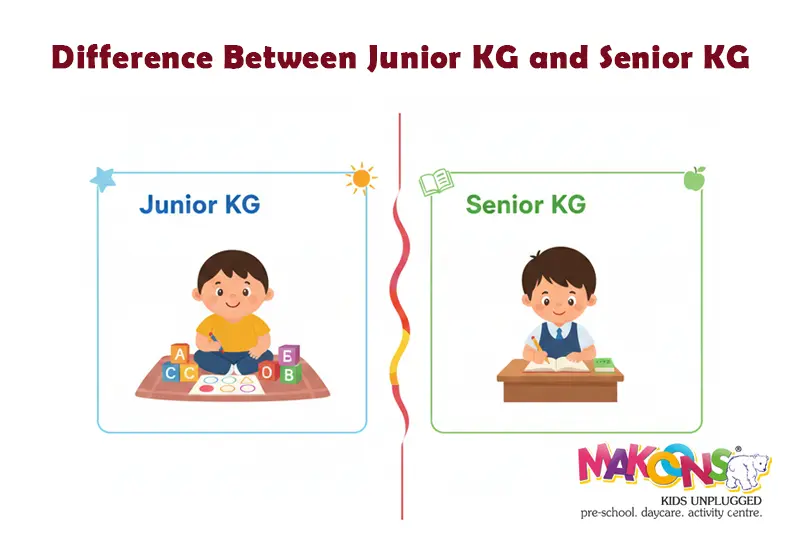
Kindergarten is a puzzling experience to many parents. Such terms as junior KG and senior KG are used interchangeably and are however of different uses in the learning process of a child. Knowledge about the distinction between these two stages would enable parents to make a better choice and help their child more.
This blog describes the main differences between junior KG and senior KG, including KG curriculum differences, preschool learning stages and the support of early childhood education, kindergarten readiness, and critical milestones of child development provided by both levels.
Understanding Kindergarten In Early Childhood Education
Kindergarten forms an important period in early childhood education. It is aimed at assisting the young children to leave their homes or nursery and move to the structured learning environment. Kindergarten facilitates emotional, social, physical and cognitive development as opposed to just focusing on academics.
In Kindergarten, two stages are generally broken:
- Junior KG (Lower Kindergarten).
- Senior KG (Upper Kindergarten).
Each stage has a different development of children.
What Is Junior KG?
Junior KG is typically targeted at children between the ages of 3.5 to 4.5 years. This is a stage where the child is usually introduced to the classroom.
Purpose Of Junior KG
Adjustment is the primary objective of junior KG. Children learn how to:
- Keep off parents, a few hours.
- Follow simple routines
- Interact with peers
- Comfortable in a school setting.
Education is a natural process and occurs at its own pace, which is predominantly through play.
What Is Senior KG?
The next stage is senior KG, which is usually in children of the age group 4.5-6 years. At this age, children have been more confident and are prepared to learn in a structured manner.
Purpose Of Senior KG
Senior KG involves primary school preparation. Children are guided to:
- Acquire initial academic abilities.
- Improve attention span
- Take orders on your own.
- Create responsibility and trust.
This is one of the significant stages in kindergarten preparations.
Significant Disparities Between The Junior and Senior KG
1. Age And Development Level
Junior KG: Children who have not yet developed rudimentary social and emotional skills.
Senior KG: Senior children who possess greater communication and thinking skills.
The stages are correlated with particular child developmental milestones, which guarantee appropriate age-related learning.
2. Learning Approach
Junior KG is concerned with exploration and play.
Senior KG puts forward organized activities with play.
Although the two apply play-based learning, the degree of structure is greater in senior KG.
3. KG Curriculum Differences
The curriculum is one of the most significant dissimilarities.
Junior KG Curriculum
- Rhymes and songs
- Free play and sensory.
- Basic shapes and colors
- Simple stories
- Fine motor skill activities
Senior KG Curriculum
- Letter sounds and word building.
- Concepts and basic mathematics.
- Pattern recognition
- Writing readiness
- Activities on logical thinking.
Such KG curriculum differences assist children to advance without any difficulties in preschool stages of learning.
Related Topic: Step-by-Step Guide for Parents on Senior KG Admission
Preschool Learning Stages Role
Preschool learning occurs in phases, and each phase is based on the other.
- Emotional security and curiosity are supported by junior KG.
- Senior KG builds confidence, independence and thinking.
Omission or rushing of a stage may have an impact on the long term learning outcomes.
Concentrate On Social And Emotional Development
Junior KG
Children learn:
- Sharing and turn-taking
- Expressing emotions
- Listening to adults
Senior KG
Children develop:
- Conflict resolution skills
- Teamwork and cooperation
- Emotional regulation
Such competencies are needed to succeed at school and to have healthy relationships.
Language And Communication Development
The development of language is not rapid in both stages.
- Junior KG is concerned with listening/speaking.
- Senior KG develops vocabulary and sentence construction and early reading.
This progressive development has good premises in early childhood learning.
Intelligence And Mental Abilities
Junior KG
- Recognizing patterns
- Exploring cause and effect
- Observation learning.
Senior KG
- Problem-solving
- Logical reasoning
- Memory development
The skills equip the children with organized education in primary school.
Motor Skills And Physical Development
The two phases aid physical development even though in different contexts.
- Junior KG: enhances the rudimentary coordination and movement.
- Senior KG: perfects writing grip and posture and control.
These developments coincide with significant milestones of child development.
How Junior KG And Senior KG Support Kindergarten Readiness?
Academics is not the only thing in Kindergarten preparedness. It includes:
- Emotional stability
- Ability to follow routines
- Communication skills
- Self-confidence
Junior KG is the base, senior KG is the reinforcement, and it gears up the children to the requirements of Grade 1.
Purpose Of Teachers In Every Stage
In junior and senior KG, teachers have varying roles to play.
- KG teachers in junior classes pay attention to developing and caring.
- The KG senior teachers tutor, empower and bring in accountability.
The two roles play an equally significant role in the learning experience of a child.
Common Parent Concerns
Is Senior KG Too Academic?
A typical senior KG is able to balance learning with play and does not become pressurized.
Can a Child Skip Junior KG?
Missing the junior KG can lead to difficulties in adjusting into the future particularly in the social dimension.
Should Writing Be Compulsory in Junior KG?
One should not be pressured to write.
Selecting The Ideal KG Program
In choosing kindergarten, parents must:
- Know the philosophy of the school.
- Determine whether learning is of the correct age.
- Make emotional development a priority.
- Find a flow between junior and senior KG.
A moderated system is conducive to healthy preschool.
Long-term Effect Of The Two Stages Of KG
Children having undergone both junior KG and senior KG adequately tend to demonstrate:
- Better school adjustment
- Favorable attitudes to learning.
- Strong foundational skills
- Higher confidence levels
These advantages are extended into primary education.
Conclusion
The distinction between junior KG and senior KG is not only based on age but purpose, style of learning as well as developmental interest. Junior KG assists a child to feel safe, curious, and socially free, whereas senior KG prepares a child to continue their studies in a formal environment by creating a structured learning experience and independence.
The knowledge of these differences in the KG curriculum enables parents to foster natural development of their child, acknowledge significant milestones of child growth, and provide good backgrounds in early childhood education.
The two phases are important – and the combination of them makes confident, competent students who are prepared to play.







 Twitter