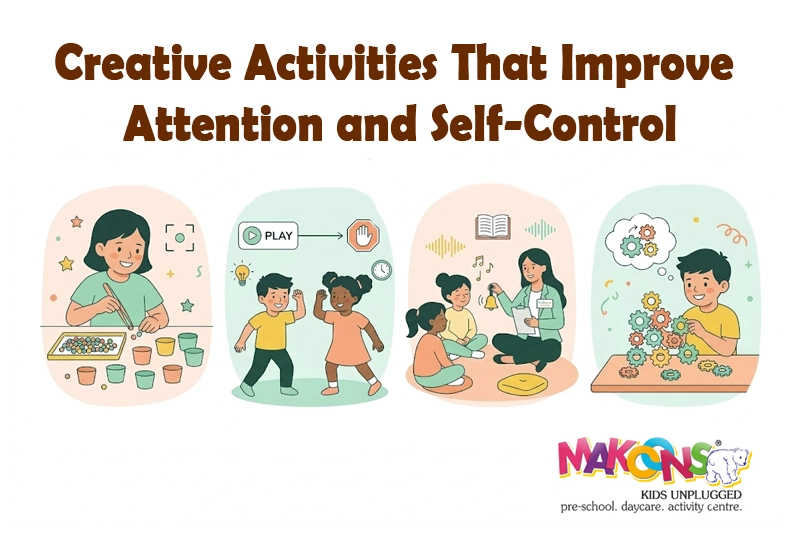
Attention and self-control are two of the most significant skills that children acquire in their early childhood. These skills enable them to be able to listen, to follow instructions, to handle emotions and to finish tasks without any assistance. Children with good attention development are likely to succeed in school, and with good skills of self control, kids develop good social relations and emotional well-being.
The positive side is that children do not acquire these skills by simple discipline. They make them by playing, fantasizing and organising fun. Properly developed creative play among children may contribute significantly to more attention, patience, and behavioral control.
Investigating the interesting focus building activities that facilitate the development of behavior in preschool and enhancing the overall learning activities at the early childhood stage, let us explore these activities.
Why It Is Important To Pay Attention And Have Control When You Are Young
In preschool, children are learning how to:
- Wait for their turn
- Listening without interruption.
- Complete small tasks
- Adhere to multistage instructions.
- Control anger or anxiety.
Such skills are the basis of:
- Classroom readiness
- Academic performance
- Emotional regulation
- Positive peer interaction
This development is natural and fun instead of being the result of stress which is created using creative learning methods.
Related Topic: 51 Super Fun Activities Every Kid Will Love
The Way Creative Activities Can Help In The Development Of Attention
Creative activities prompt children to drive slowly, be keen and remain attentive. Hands-on tasks will trigger active concentration unlike passive screen time.
Benefits include:
- Improved listening skills
- Longer attention span
- Better impulse control
- Greater problem-solving skills.
- Increased patience
At this point we are going to look at tried and true activities.
1. Art And Craft Projects
Focus building Simple art activities are mighty focus builders.
Examples:
- Coloring within lines
- Cutting shapes carefully
- Creating paper collages
- Painting with small brushes
- Building models with clay
How it helps:
- Needs long-term care.
- Both hands move carefully.
- Develops patience to do tasks.
- Develops fine motor control.
Attention is also enhanced as the children focus on minute details.
2. Listening Games And Storytelling
Reading stories and solving questions enhance concentration.
Activities include:
- Read-alone and question-and-answer sessions.
- Story sequencing games
- “What happens next?” predictions
- Acting out short stories
These activities support:
- Memory retention
- Listening accuracy
- Turn-taking
- Emotional understanding
Preschool behavior development is well taught using story based learning.
3. Music And Movement Games
Music is stimulant as well as controlling.
Focus-building music games:
- Freeze dance (stop when the music is stopped)
- Follow-the-beat clapping
- Action songs are songs that are step-by-step.
- Rhythm repetition games
These activities improve:
- Impulse control
- Body awareness
- Listening skills
- Reaction timing
Children are forced to stop and act accordingly enhancing self control.
4. Puzzles And Constructing Activities
Attention is naturally protracted in problem-solving exercises.
Examples:
- Jigsaw puzzles
- Block building challenges
- Pattern-making games
- Shape sorting activities
These tasks help children:
- Focus on details
- Try again after mistakes
- Complete structured goals
- Practice patience
Persistence is encouraged under early childhood learning activities of this kind.
5. Role Play And Pretend Play
Pretend play educates the children to control themselves according to imaginary rules.
Examples:
- Playing “school” or “teacher”
- Acting as a shopkeeper
- Doctor role play
- Restaurant pretend play
These scenarios require:
- Waiting for turns
- Speaking politely
- Following social rules
- Controlling impulses
This organized imagination will facilitate good self control abilities among children.
6. Breathing And Calm-Down Art
Self control is enhanced as children learn to control their emotions.
Simple calming activities:
- Breathing pacing with hand movement.
- Drawing emotions on paper
- Making glitter jars.
- Relaxation stories and directions.
These imaginative practices instruct:
- Emotional awareness
- Patience
- Slowing down reactions
- Mindful behavior
They come in particularly handy at the time of transition or at the close of the high-energy play.
7. Memory And Attention Games
Vitality in the mind is enhanced by short games that demand concentration.
Examples:
- “Simon Says”
- Matching card games
- Spot-the-difference pictures
- Object memory trays
These activities encourage:
- Careful listening
- Observational skills
- Response control
- Development of short-term memory.
They are very efficient center building exercises.
To Improve The Attention Process, Some Tips Are Available To Strengthen The Process
Teachers and parents can improve outcomes by:
- Making activities brief and frequent.
- Lessening environmental noise.
- Providing clear straight forward instructions.
- Complimenting hard work, but not excellence.
- Taking breaks in between activities.
Regularity produces habits that are heavier.
Related Topic: 30+ Fun & Educational Activities for Preschoolers: Physical, Learning & Special Education Ideas
Avoid Common Mistakes
In stimulating the growth of attention in children, avoid:
- Overloading with long tasks
- Assuming the level of concentration of an adult.
- Distracting with punishment.
- Comparing children to peers
- Doing away with play as an after-effect.
Positive instructions promote effective behavioral development.
How Soon Will You Begin To Feel Better?
Attention and control over oneself is a gradual process.
Through frequent creative engagements:
- Preschoolers in younger ages can exhibit slight improvements every week.
- Preschoolers of older age may exhibit an ability to take longer tasks.
- The control of the emotions increases through regular modeling.
One should be patient – development is a gradual thing.
Benefits Of Intense Concentration And Discipline In The Long Run
Early developing children tend to exhibit:
- Improved educational achievement.
- Stronger friendships
- Increased classroom behavior.
- Increased emotional strength.
- Higher confidence
The success in life starts with preschool behavior development.
Conclusion
Strict discipline does not build attention and self control. They develop by taking part in interesting, organized and fun activities. Kids activities are the most appropriate balance between fun and skills.
The use of art, story telling, music, puzzles, role plays and calm-down strategies in day-to-day activities of parents and educators can enhance the strength of building attention in children and equally develop healthy self control behavior among kids.
Creativity and structure activities in early childhood learning make learned students focused, confident, and emotionally balanced.
FAQs
1. What are the most effective creative exercises to enhance focus?
Focus building activities that are very effective are art projects, puzzles, music games, and story telling.
2. What benefits do creative activities have on the self-control of kids?
They make children wait, listen, obey, and control the impulses in an amusing manner.
3. What is the age at which the attention development activities should commence?
Simple activities may begin when one is as old as two to three years.
4. What duration should the focus-building meetings take?
In the case of preschoolers, around 10-20 minutes per activity is the most suitable.
5. Are these activities beneficial to behaviorally challenged children?
Yes. Impulse control and emotional regulation are also frequently enhanced by creative activities which tend to be structured.
6. Do activities based on the screen behave well in the development of attention?
The educational content provided should be limited, though practical creative tasks are more beneficial in the process of developing long-term attention and self-discipline.
Assisting children in concentration now makes them ready in the world to be successful in their lifetime in terms of learning and emotional abilities.






 Twitter