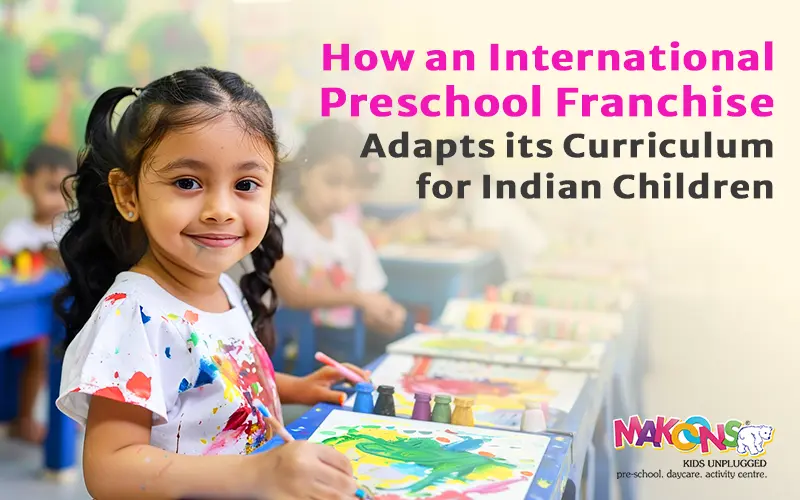
In recent times, there has been an upsurge in the popularity of International preschool brands in India. Their approach in teaching and their child-centred classrooms, which encourage children to learn through play and activities rather than from memorization, are appealing to many parents.
Many people don’t realize that however, a curriculum that works for children in another country can’t be blindly copied and pasted into the Indian classroom.
Children can learn best when they link it to the things they are learning. Hence effective and successful preschool franchises make judicious changes to the curriculum so as to make it meaningful, familiar and relevant to children in India.
Why One Curriculum Doesn’t Fit Every Country?
One can’t imagine a four-year-old in India growing up in the environment of a European, Australian, or American child.
They experience different:
- Languages
- Festivals
- Food habits
- Family structures
- Traditions
- Daily routines
Learning is more difficult and less enjoyable when children don’t relate to the classroom lessons.
Good preschool brands know this and the program is adjusted without losing the good effects of international teaching practices.
Keeping The Global Learning Approach
Although the content may change, the basic idea is generally similar.
The majority of foreign curricula of preschools emphasize:
- Learning through play
- Building confidence
- Developing communication skills
- Encouraging creativity
- Promoting problem-solving
- Supporting emotional growth
These principles are good everywhere since they are based on the natural way of child learning.
Bringing Indian Culture Into The Classroom
One of the largest shifts is to make learning culturally familiar.
Children can learn about for instance:
- Diwali
- Holi
- Eid
- Christmas
- Independence Day
- Republic Day
Story sessions can feature Indian folktales, local heroes, and stories that are age and content appropriate from around the country.
Children feel connected to the learning process when their own culture is represented in the classroom.
Also Read: Curriculum Planning Tips for New Preschool Owners and Educators
Using Examples Children Recognize
Young children learn concepts more quickly when lessons are connected to things that they see on a daily basis.
Rather than using examples from abroad, it is common for a school to choose to incorporate:
- Indian fruits and vegetables
- Wildlife of the area
- Indian transportation
- Community helpers like vegetable sellers, postmen, traffic police etc.
- Familiar family traditions
This helps learning to feel ‘natural’ and not ‘forced’.
Balancing English With Local Languages
There are a number of languages spoken in India and children may attend preschool speaking the language they are used to at home.
Numerous international preschools teach English but acknowledge children’s mother tongue.
Teachers may:
- Help children to be comfortable expressing themselves
- Introduce English gradually
- Utilize local language support as appropriate
- Do not expect fluency without helping children build confidence to do so.
This is a great way to alleviate anxiety and make learning more seamless.
Adapting To Indian Parents’ Expectations
Exploration and play are emphasized in many international programs.
However, Indian parents do have expectations of visible learning outcomes as well.
Many preschool franchises develop a balanced strategy which involves mixing:
- Play-based learning
- Early literacy activities
- Number recognition
- Development of fine motor skills
- School readiness programs
This way, kids can have fun learning and parents can be sure that significant skills are at work.
Celebrating Family Involvement
The grandparents, parents and extended families in India have an important role in the life of the child.
There are a number of the international preschool brand that adapts by organizing:
- Family participation days
- Festival celebrations
- Parent-child activities
- Storytelling sessions
- Cultural events
These activities help develop better home to school links.
Also Read: Teaching Indian Culture and Manners to Kids: A Complete Parent & Preschool Guide
Training Teachers For Indian Classrooms
The best curriculum is only as good as those who teach it.
Typically, international preschool chains spend a lot of money on teacher training to encourage teachers to:
- Understand child psychology
- Handle diverse classrooms
- Adjust activities when necessary to meet local requirements.
- Maintain good home-school connections.
The role of well-trained teachers in bridging the gap between international teaching methods and local reality.
The Goal: Global Learning With Local Relevance
It is not the most successful preschool that attempts to teach Indian children to learn like children in another country.
Rather than that they borrow the best ideas from the rest of the world and mold them in Indian culture and the way of living.
This enables children to:
- Develop confidence
- Improve communication skills
- Build creativity
- Learn independently
- Keep in touch with their heritage
Final Thoughts
The best international preschool curriculum is not one that is adopted as it is found in another country. It’s about knowing what is effective in the wider world and making considered choices for local kids.
The best international preschools in India blend Indian values, traditions and daily occurrences with modern teaching practices.
Children thus get a learning experience that is familiar, but for the future, and this can give them a secure basis for the coming years.
FAQs:
1. Why are adaptations necessary for international preschool curricula for India?
Ans: When lessons are culturally, linguistically and experientially relevant to children, learning is enhanced.
2. Do international preschool franchises celebrate Indian festivals?
Ans: Yes. Major Indian festivals and cultural events are generally part of the learning programmes of most successful brands.
3. Do international preschools have a single language in which instruction is given?
Ans: Not always. In many schools, children learn English slowly and children who speak other languages are supported.
4. Is there an international curriculum that is merely about play?
Ans: No. Play-based learning activities are integrated with early literacy, numeracy and school readiness activities in most programs.
5. How do teachers modify lessons to meet the needs of Indian children?
Ans: The teachers employ real-life examples, stories, culture, activities, which children can relate easily.
6. What is the greatest benefit of the adapted international curriculum?
Ans: It provides universal learning standards that are relevant to the child’s culture, environment and daily activities.







 Twitter