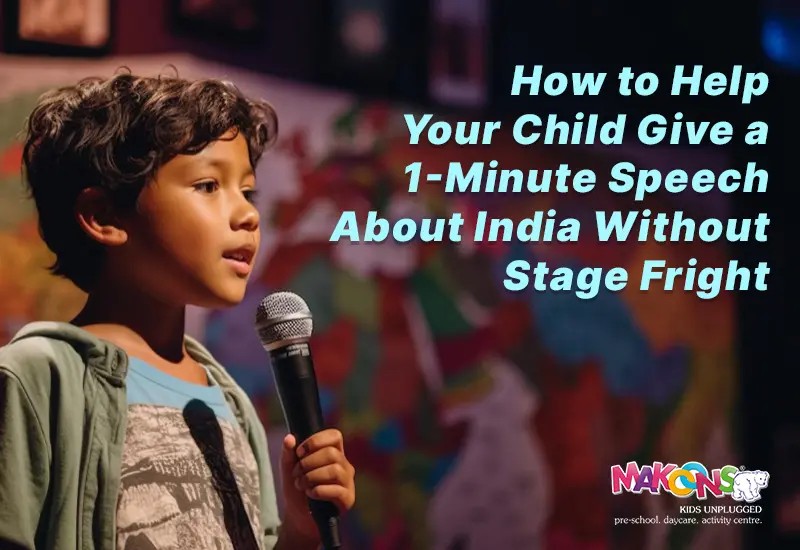
For lots of parents there’s a familiar scene before a school function. At home, your child’s speech is flawless, and he or she is comfortable speaking in a group of familiar people but once he/she sees a stage and an audience, he/she gets quiet.
Don’t be concerned if this occurred in your child’s life. Stage fright is a very common phenomenon with children. For kids, learning to be nervous in front of others is a normal part of public speaking, from delivering an Independence Day speech to public speaking in a classroom or even a special school event.
Fortunately, children can learn to speak with confidence – and enjoy it if they can be properly prepared and supported.
Understand That Stage Fear Is Normal
Parents often think that if a child is confident, then he or she isn’t nervous. That’s not true.
Butterflies are a common occurrence even for adults when it comes to making speeches.
Children might be concerned about:
- Forgetting their speech
- Making mistakes
- Being laughed at
- Public speaking in front of an audience that is not known to them.
Keep The Speech Simple
Parents often make the error of speaking lengthy sentences with challenging words.
A one minute speech for kids on India must be:
- Easy to understand
- Easy to remember
- At an age appropriate level
Children become more confident speakers when they know what to say, instead of memorised lines.
Help Them Connect With The Topic
Discuss about India with the child before taking him/her to give a talk.
Talk about basic concepts such as:
- The national flag
- Famous monuments
- Different festivals
- Indian food
Practice In Everyday Situations
You don’t have to practice as if you were in school.
Use entertaining techniques like:
- Allowing them to address grandparents
- Holding worship services at home for the family
- In front of a mirror
Don’t Focus On Perfect Memorization
If a parent sees a line that their child could have, they will be concerned that their child missed it.
But small mistakes are usually overlooked by the viewer.
Explain to your child that:
- It’s okay to pause
- If you forget a word, it’s okay
- You can laugh and go on
The main focus is on communication rather than perfection.
A child’s confidence and ability to make a few mistakes while speaking makes an impression more than a child who sounds robotic and recites every word correctly.
You May Also Like: Easy and Interesting Science Questions for Kids with Answers
Teach A Few Confidence Tricks
There are simple techniques that can help children to be more relaxed and feel better before they talk.
Encourage them to:
- Slowly breathe out and then breathe in deeply before beginning
- Stand straight
- Be cheerful to the audience.
- Speak slowly
Avoid Last-Minute Corrections
Many parents unwittingly add to the anxiety by repeating instructions just prior to the speech.
Avoid saying:
- “Don’t forget the second paragraph.”
- “Speak louder.”
- “Remember every word.”
Instead, try:
- “You’ve practiced well.”
- “Just do your best.”
- “We’re proud of you.”
Praise The Effort, Not Just The Result
What would it be like for a 5-year old to be in front of 200 people?
Even if the speech is not perfect, give praise for the effort.
Praise them for:
- Going on stage
- Speaking clearly
- Trying their best
- Showing courage
This is because positive experiences today help to develop confidence for future school speeches and presentations.
Why Public Speaking Matters?
School speeches are small things that shouldn’t be considered as an activity but as a life skill that many parents do not see.
Learning to speak before others or in public aids children in developing:
- Confidence building
- Communication skills
- Clear thinking
- Self-expression
You May Also Like: Simple Self-Introduction Lines for Nursery and Preschool Kids
Final Thoughts
It is not an act of speech we are interested in helping a child with, it is about delivering a speech about India. It is about fostering their own self-confidence.
When a child learns to stand, speak and share on stage, he or she acquires a far greater power than applause – Self-Confidence.
Well, the next time your child needs to deliver an Independence Day Speech, don’t be as concerned with every word being flawless, as much as helping your child enjoy the experience.
FAQs:
1. How to minimize performance anxiety in kids?
Ans: Repeat this often, and encourage them and tell them that they will make mistakes.
2. What is the length of a speech for young children in India?
Ans: Children in Preschool & Primary School will benefit from around a minute.
3. Do children need to learn all the words?
Ans: For children it’s better to get the message than exactly the words in every sentence.
4. If my child forgets a line of their speech, what should they do?
Ans: Remind them to stop, smile and go on. Small errors will not be obvious to most viewers.
5. How many times can a child rehearse in preparation for a school talk?
Ans: Typically, it is better to be short in practice sessions and have just a few days of that, rather than long rehearsals over many days.







 Twitter