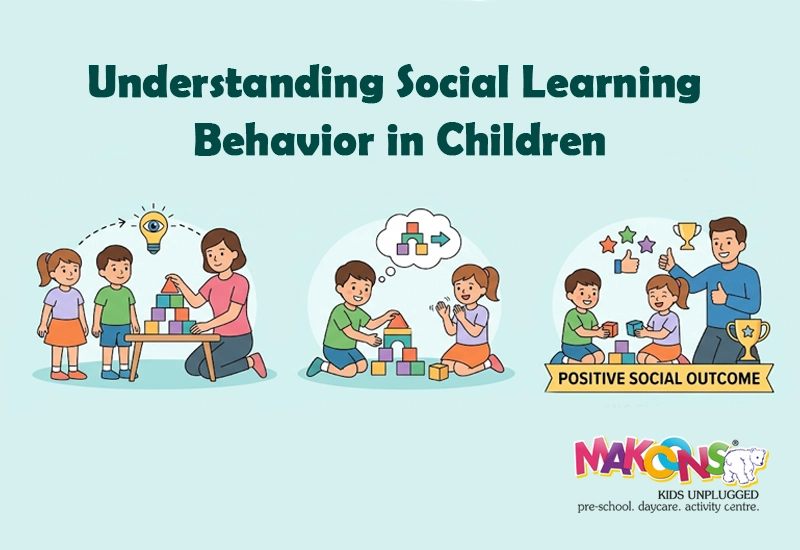
Children learn many things by watching others. They do not learn only from books or teaching. A big part of learning comes from daily life. This is called social learning in children.
Children learn through observation by watching others and they practice what they observe. The parents and teachers together with social friends become their primary sources of learning. Children acquire this skill through their everyday practice of using basic gestures which include saying “thank you” and sharing their toys.
What is Social Learning?
Social learning in children means learning by observing others.
For example:
- A child sees parents greeting others politely
- The child starts doing the same
This learning happens naturally. No formal teaching is always needed.
Social Learning Theory for Kids
The social learning theory for kids explains how children learn from people around them.
It works in three simple steps:
- Observe (watch others)
- Imitate (copy the behavior)
- Repeat (do it again if appreciated)
Example:
- A child sees a friend sharing toys
- The child copies it
- Gets praise
- Starts sharing more often
Why Social Learning is Important?
Early childhood social learning helps children grow in many ways.
1. Better Communication
Children learn how to talk and listen.
2. Good Behavior
They understand what is right and wrong.
3. Confidence
Talking and playing with others builds confidence.
4. Emotional Understanding
They learn feelings like happy, sad, or angry.
Child Social Behavior Development
Child social behavior development means how children behave with others.
They slowly learn:
- Sharing
- Taking turns
- Helping others
- Following rules
These skills take time. They improve with daily practice.
Children Learning Through Interaction
Children learning through interaction is very natural.
Children learn when they:
- Talk to parents
- Play with friends
- Listen to teachers
Example:
- Playing games teaches teamwork
- Talking improves language
- Group activities teach discipline
More interaction means more learning.
Peer Learning in Preschool
Peer learning in preschool is very important.
In preschool, children learn from other children.
How it helps:
- They copy good behavior
- They learn while playing
- They make friends
- They learn to solve small problems
This is often their first social experience outside home.
Social Skills Development in Kids
Social skills development in kids happens through social learning.
Important skills include:
- Saying please and thank you
- Listening to others
- Sharing
- Making friends
- Expressing feelings
These skills help children in school and life.
Role of Parents
Parents are the first teachers in early childhood social learning.
Children watch parents closely.
Parents can help by:
- Showing good behavior
- Talking kindly
- Encouraging children to interact
- Praising good actions
Children copy what they see at home.
Role of Teachers
Teachers support child social behavior development in school.
They help children:
- Work in groups
- Follow rules
- Share and cooperate
- Solve problems
A good classroom helps children learn better social skills.
Challenges in Social Learning
Some children may face difficulties.
Common challenges:
- Shyness
- Less interaction with others
- Too much screen time
- Difficulty in sharing or controlling emotions
With support, children can improve.
Tips to Improve Social Learning
Here are simple tips for social learning in children:
- Let children play with others
- Reduce screen time
- Talk to them daily
- Teach basic manners
- Praise good behavior
Small steps every day help a lot.
Conclusion
Social learning in children is simple and natural. Children learn by watching and interacting.
Children learning through interaction helps them build confidence, behavior, and communication skills.
With support from parents and teachers, children can develop strong social skills for life.
FAQs:
1. What is social learning in children?
Ans: It is learning by watching and copying others.
2. Why is social learning important?
Ans: It helps children learn behavior, communication, and emotions.
3. What is the social learning theory for kids?
Ans: It means children learn by observing, copying, and repeating actions.
4. How does peer learning in preschool help?
Ans: Social exchange is very essential for children, in which, sharing, teamwork, and friendship seek covetously their exuberant participation.
5. How can parents help in social skills development in kids?
Ans: By showing good behavior, encouraging interaction, and praising children.
6. What are signs of good social behavior in children?
Ans: Sharing, listening, helping others, and expressing feelings properly.






 Twitter