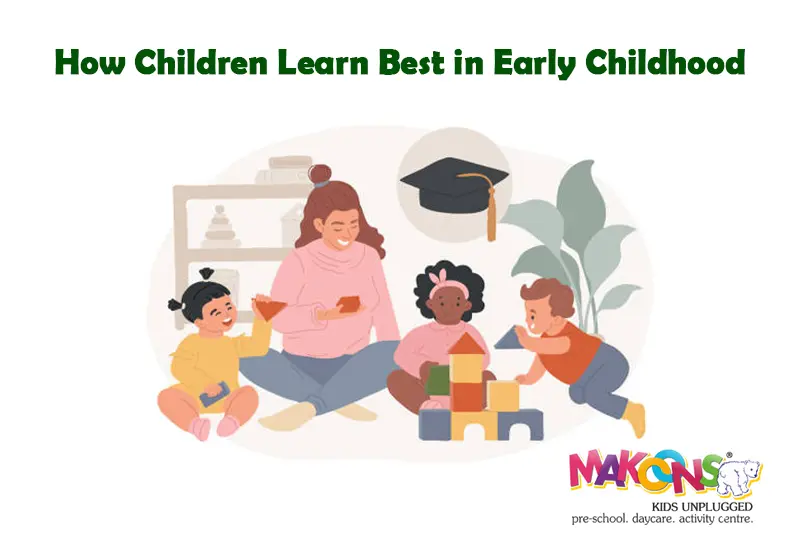
Childhood is among the most important phases of human growth. The brain of a child grows fast between the age of birth and six years and acquires neural connections which determine the way of thinking, behavior and emotional reaction of a child. The knowledge on the best methods of learning in these early years can enable parents and educators to design accommodating conditions that foster curiosity and confidence among children.
According to the research conducted today, children cannot learn with the help of strict instructions only. Instead, they flourish upon exploration, engagement and experiences. With the insight of learning in early childhood, we are able to contribute more towards the development of early learning in kids and a solid base towards the lifelong success of such a kid.
Learning Process with the Child Explained
The child learning process is expounded in a simple way that must be understood in order to effectively support the young learners. Children learn through:
- Observation
- Imitation
- Exploration
- Play
- Repetition
- Social interaction
It is also not like the old students who learn by the experiences they acquire. Young children majorly learn by the experiences they have. They touch, taste, move, listen and experiment on what is around them. Learning is active and not passive in them.
When a child is stacking blocks, he is not simply playing. They are acquiring problem solving, hand eye coordination and spatial awareness. They are reasoning and developing language by repeatedly asking the question, why.
The study of this pattern of natural learning assists adults to apply effective learning methods to young children.
Play-Based Learning is Important
Play based learning is one of the best early childhood learning strategies. Play helps children to play around with ideas in a secure and happy place.
Pretend play helps children to exercise communication and emotional regulation. In the construction activities, they attain logic and mathematical knowledge. They are creative through art.
This strategy underscores the importance of early years education in the sense that the structured play in the preschool environment offers occasions to interact socially and to discover.
Studies have always indicated that children that are subjected to good early education programs exhibit better literacy, numeracy, and social skills at advanced age.
Related Topic: Easy Ways Teachers Can Help Kids Who Struggle to Learn
Collaborative Learning and Social Interaction
Children at a tender age learn through their interactions with others. New vocabulary and new ways of thinking are presented through discussions with peers and teachers. Teamwork promotes collaboration and understanding.
Social learning is another learning method that should not be overlooked when it comes to discussing the best way of learning that children can do. The listening, patience and confidence are developed through a simple group activity such as story telling or singing.
Those teachers that use discussions, open-ended questions, and teamwork are employing effective learning strategies among young children. These plans ensure development of communication skills and emotional intelligence.
The Function of Routine and Structure
Even though play is needed, structure is useful to children as well. Routines are a factor that brings about a feeling of security and comfort. Children can be sure enough to venture out and take risks when they are aware of what to expect.
Circle time, activity time, outdoor play and quiet time are all usually part of daily schedules in preschool. This balance facilitates early learning processes among children as it offers stimulation and rest to them.
Self-discipline is also contributed by structure. Children observe routines, which eventually make them learn to be responsible and mindful of time.
Practical and Real Life Learning
When children encounter things in real life, they are able to learn. They do not memorise numbers; rather they learn counting using a sorting of objects. They do not have to read about plants, but simply plant some seeds.
This hands-on strategy is the most apt way of learning in early childhood. It promotes innovation and critical thinking.
The child learning process will be more relevant and interesting when teachers explain the concepts not in lectures, but in the form of activities.
Positive Reinforcement and Emotional Safety
The learning ability of a child is highly influenced by the emotional state of the child. When children feel that they are safe and supported, they will be more ready to participate and explore.
Positive reinforcement e.g. praise and encouragement strengthens confidence. Mistakes are supposed to be taken as learning opportunities and not as failures.
The key to the understanding of the early years education importance implies that emotional development is as crucial as academic one.
Patient and kind teachers and parents serve to equip children with strength and self esteem. Such attributes improve early education of children.
Related Topic: Learning Without Pressure: How to Keep Preschoolers Motivated
Promoting Inquisitiveness and Interrogation
Learning is a force that curiosity generates. Children are always questioning as they desire to know their world.
Adults that are thoughtful and are willing to explore further are aiding the children in the best way to learn. As opposed to providing direct responses, encouraging the children to find an answer encourages critical thinking.
Open-ended questions like:
What is your guess as to what will happen?
Why do you suppose that was the case?
These evoke thinking ability and language growth. These questioning styles are crucial learning strategies to young children.
The Role of Sensory Learning
The young children are dependent on senses. The brain neural pathways are enhanced through sensory activities, sand play, water experiments, painting and music.
The learning approaches in early childhood use the senses to help a child to retain and comprehend. Multi-sensory learning will make sure that children with various learning styles are able to grasp concepts.
Through the integration of touch, sound, movement and visual components, educators can increase the child learning process as explained in a holistic manner.
Technology and Balanced Learning
Although standard play is important, early learning development among children can also be facilitated by educational technology carefully chosen. Hands-on learning can be used in interactive storytelling applications and digital drawing tools.
However, balance is key. Playing with devices cannot substitute real-life communication and play. Rather, technology implementation is supposed to be done with the purpose of supporting learning objectives.
Balanced integration models the current trends in learning amongst young children and does not compromise the principles of early childhood education.
The Role of Parents in Early Childhood Education
Parents are the most important in strengthening school-based learning at home. Together reading, conversing, and promoting creative efforts reinforce classroom activities.
The significance of the early years education goes further than the school boundaries. A favorable home environment promotes emotional stability and intellectual interest.
When parents know how children learn, they will be able to offer meaningful experiences that will make them grow in their daily lives.
Conclusion
It is an early child stage that defines the future success in academics and personal life. Adults can easily make the children prosper by knowing how to learn in their early years.
It has been demonstrated that children learn through play, contact, inquisitiveness, and practical experience as explained in the child learning process. The importance of early years education in understanding will make emotional, social, and cognitive growth to be considered equally important.
By using effective learning techniques among small children, teachers and parents can help young children learn early in life, in a manner that is both pleasant and significant to them.
Ultimately, understanding how children learn best helps us nurture confident, curious, and capable learners prepared for lifelong growth.
FAQs
1. What are the most effective early childhood learning methods?
Play-based learning, experiential activities, social interaction, and structured routines are among the most effective early childhood learning methods.
2. Why is early years education important?
The early years education importance lies in rapid brain development during this stage, which forms the foundation for future academic and emotional success.
3. How does the child learning process explained differ from adult learning?
The child learning process emphasizes exploration, imitation, and play, whereas adult learning relies more on abstract reasoning and structured study.
4. What are some learning strategies for young children?
Encouraging curiosity, providing hands-on activities, maintaining routines, and offering positive reinforcement are effective learning strategies for young children.
5. How can parents support early learning development for kids at home?
Parents can read with children, encourage creative play, answer questions thoughtfully, and maintain consistent routines to enhance early learning development for kids.






 Twitter