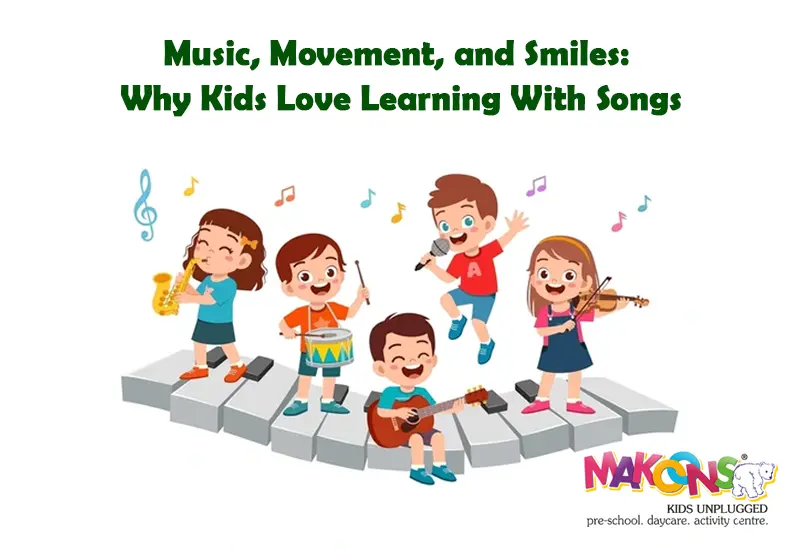
Children are inclined to react to rhythm, melody and movement. They hum, clap, bounce and sway to the sounds before they can even manage to form complete sentences. This instinctive interest is the reason why music and movement in children are such effective tools in a young education setting. It can be a basic alphabet song or an action rhyme but children are excited when it is time to learn. It should seem like a play.
Educating children through songs is becoming a major teaching strategy that teachers in early childhood learning environments around the globe are adopting. Music is not a fun distraction that occurs between lessons anymore, but a focused and deliberate process of developing cognitive, emotional, social, and physical abilities.
We are going to discuss why music is so popular among children, as a form of learning, and how it influences the development of children in significant ways.
The Natural Relationship of Music and Early Learning
Children are programmed to react to sound since their conception. Lullabies calm them. They are caught up by rhythmic clapping. The repetition of the songs enables them to know what is next. Children have comfort and confidence with this predictability.
Teachers exploit this in-built association when they incorporate music based learning in preschoolers. Songs offer structure, repetition, and involvement to the feelings and all these are essential to early childhood education.
There are several parts of the brain that are triggered by music. Children combine memory, language processing, listening, and motor coordination when they are singing. This is one of the largest advantages of music in early education due to this multi-sensory involvement.
Developing Language Skills With the Help of the Song
Vocabulary development is one of the greatest strengths of learning with songs among children. New words are presented in rhythmic and repetitive forms that allow people easier to remember the songs.
For example:
- Letters are recognized through alphabet songs.
- Number awareness is enhanced by counting rhymes.
- Action songs bring in such verbs as jump, clap, and spin.
In songs repetition enhances pronunciation and fluency. Even timid children tend to sing words more comfortably than say them one by one. This is accumulated over time and creates confidence and communication skills.
This is the reason why child development songs are widely associated with aid in early literacy and language development. Music will enable children to hear patterns in sound, which is a prerequisite to reading.
Improving Cognitive and Memory Ability
Have you ever seen that children can easily remember the lyrics of songs but not plain instructions? The reason behind this is that rhythm and melody offer memory anchors.
Children retain information more when teachers employ music based learning with preschoolers. Abstract ideas are easier to understand with the help of a song about days of the week or seasons.
The music advantages in early education also comprise better attention span. Children are attracted to music and it is fast. Teachers also do not have to repeat the instructions orally, but sing them, such as Clean up, clean up, everybody everywhere, and children will react almost immediately.
This play aspect helps in thinking logically, tracking skills and pattern recognition – all important platforms to academic success.
Helping to Physical Development by means of Movement
Music rarely stands still. It invites movement. Gross motor skills are developed with the help of clapping, jumping, marching, and swaying. The fine motor control is enhanced by finger rhymes and hand actions.
Kids’ music and movement can be used particularly in pre-school classes where children require a lot of physical activities. Exercise improves the blood flow and makes young students active.
Children do not only learn to memorize music lyrics when they engage in fun learning with music; they are also building good balance, coordination, and body awareness.
Listening is also enhanced with the help of movement-based songs. Children are also taught to obey commands within the song like, “When you are happy and you know it clap your hands.” This develops self-control and sensitivity.
Promoting Social and Emotional Development
Music establishes shared experiences. A sense of belonging is experienced when children sing in a group. The group’s songs promote cooperation and turn taking.
Emotional expression in early education is one of the most misplaced advantages of music. Songs assist children to recognize and be able to articulate feelings. Happy songs bring laughter. Relaxation is encouraged by serene tunes.
Children learn the words with a specific emotional coloring, such as happy, sad, excited, calm, through songs on child development. This assists them to learn their feelings and those of other people.
Music also reduces anxiety. In children with problems in transitions, a transition song gives them a sense of predictability and comfort. This is an emotional security that enhances classroom behaviour and participation.
Enhancing Creativity and Imagination
Music sparks imagination. Children use creative thoughts when they start to pretend to be animals during a song or make new verses.
Learning with music among preschoolers promotes exploration. Children play with the sounds and instruments, with movements. This imagination fosters self-esteem and self-sufficiency.
Children do not fear expressing themselves in classrooms where fun learning is an important aspect by use of music. They come up with dances, modify lyrics and provide ideas. This type of freedom helps in innovation and the ability to solve problems in the future.
Enhancing Classroom and Routine Organization
Routine is the key to preschool classrooms. Songs help to simplify routines and make them enjoyable.
Teachers use:
- Greetings songs at the beginning of the day.
- Transition songs Clean-up songs
- Goodbye songs to end the day
Such formal musical events render routines foreseeable. Children expect what is going to happen and they are safe and cooperative.
Trying to make music and movement with kids in the routine lowers behavioral difficulties and enhances engagement.
Enjoying the Learning Process and Removing Stress
Children gain knowledge when they are comfortable. Conventional methods of drills could be boring or frustrating. Contrarily, singing songs to children makes learning look like games.
Songs remind abstract concepts and make them fun whether it is teaching numbers, colors, shapes, social skills, etc. This is what makes fun learning with music one of the key elements of the current early childhood education.
Children do not feel pressured. They feel excited. And when children are enthusiastic, education takes place on its own.
Ways to Import Music in Preschool Practically
The following are easy examples of how a teacher or a parent can use music based learning with the preschoolers:
- Welcome song at the beginning of the day.
- Counting songs at math time.
- Add physical breaks in the form of action rhymes.
- Music in quiet time is very soothing.
- Encourage children to make their own songs.
Adults can convert ordinary lessons to memorable experiences by purposely adding songs as a way of developing a child.
Conclusion
Music is not just some form of entertainment in early childhood education, but a potent pedagogical instrument. The extensive advantages of music in early learning are the improved linguistic skills, enhanced memory, better motor coordination, emotional development and increased creativity.
Music in classrooms and movement among the kids will help them develop lively classrooms where they enjoy learning. Education will be fun, interesting and successful through learning using songs to children.
Finally, fun learning with music causes smiles, confidence and curiosity which are the same attributes that create lifelong learners.
FAQs:
Q1.What is the significance of music during early childhood education?
Music aids in language development, memory, coordination and emotional development. The positive effects of music in primary school years are an increase in concentration and interpersonal interaction.
Q2. What benefits does music based learning of preschoolers have on memory?
Rhythm and repetition are employed in songs and this enables children to memorize more than when instructions are talked to them.
Q3. What are some instances of music and movement among children?
Examples of music and movement with preschoolers include clapping games, action rhymes, dance songs and circle-time singing.
Q4. What role do child development songs play in helping to develop language?
Songs also teach new words in a tune without much stress on children to articulate correctly and repeat sentence structure.
Q5. Does music-based fun learning work with every child?
Yes. Listening to music is a fun way of learning and it involves different senses thus accommodating various styles of learning as well as developmental requirements.







 Twitter