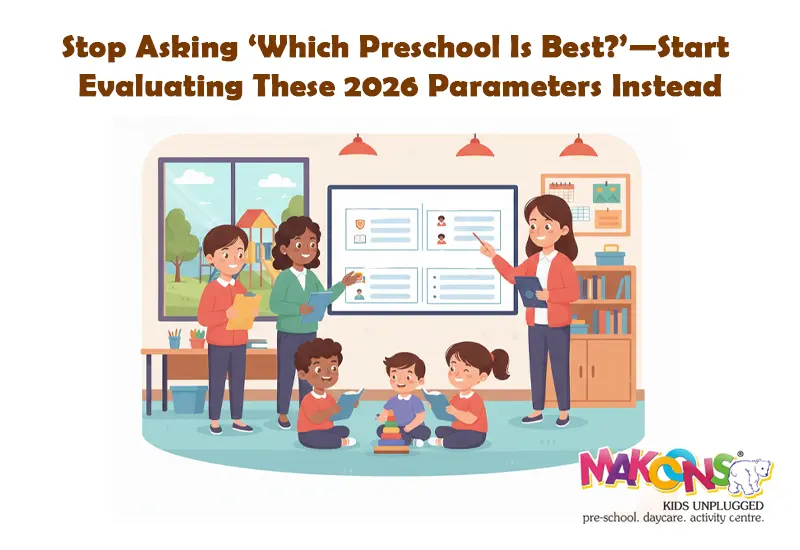
Many parents ask one common question. “Which preschool is the best?” This question sounds simple. The explanation needs to be more detailed before we can conclude. The best preschool option does not exist because each child has unique needs. Every child possesses unique characteristics. Each family requires different solutions. Preschool education will experience rapid transformations in 2026.
New teaching methods are coming. Parents are more aware. Children need more than just books and toys. Instead of asking which preschool is best, parents should ask better questions. They should look at clear preschool evaluation parameters. This helps in making the right decision. This blog is a practical preschool selection guide.
It explains how to choose the right preschool in 2026. The language is simple. The points are easy to understand.
Why “Best Preschool” Is the Wrong Question?
The word “best” is confusing. What is best for one child may not be best for another. Some children need more care. Some children are very active. Some children take time to adjust. A preschool may be famous. It may have many branches.
But that does not mean it suits your child. Parents should focus on the preschool admission evaluation. They should check how the school works every day. They should check how teachers treat children. This approach leads to a better decision.
Preschool Selection Criteria 2026: What Has Changed?
Preschool education in 2026 is not the same as before. Earlier, parents looked at:
- Big classrooms
- Fancy buildings
- English-speaking teachers
Now, parents look deeper. Today’s preschool selection criteria focus on:
- Child safety
- Emotional care
- Learning through play
- Clean environment
- Parent communication
These are real needs. These affect the child every day.
Parameter 1: Child Safety and Security
Safety is the first factor to choose a preschool. A good preschool must be safe at all times.
Check these points:
- CCTV cameras in classrooms
- Secure entry and exit
- Verified staff
- Safe furniture
- Clean toilets
Ask how children are picked up. Ask who is allowed inside. Safety is not optional. It is a basic requirement. This is one of the most important preschool evaluation parameters.
Parameter 2: Hygiene and Health Practices
Young children fall sick easily. A preschool must follow strong hygiene rules. Check if the school:
- Cleans classrooms daily
- Washes toys often
- Teaches handwashing
- Provides clean drinking water
Ask about sick child policy. Ask if parents are informed quickly. Good health practices show responsibility. They also show care. This is a key factor in preschool admission evaluation.
Parameter 3: Teacher Quality and Training
Teachers shape a child’s early years. Do not check only teacher degrees. Check how teachers behave with children. Good teachers:
- Speak calmly
- Listen to children
- Encourage, not force
- Handle emotions gently
Ask about teacher training. Ask how often training happens. A warm teacher makes a big difference. This is one of the most important factors to choose a preschool.
Parameter 4: Child-to-Teacher Ratio
Too many children in one class is a problem. Small children need attention. They need help with eating, talking, and emotions.
Check:
- Number of children per teacher
- Presence of helpers
- Supervision during play
A lower ratio means better care. This supports learning and safety. This parameter is often ignored. But it matters a lot.
Parameter 5: Teaching Method and Curriculum
In 2026, learning is not about pressure.
Preschool learning should be:
- Play-based
- Activity-based
- Age-appropriate
Children should learn through:
- Stories
- Songs
- Games
- Art
- Movement
Avoid schools that push reading and writing too early. Early pressure creates stress. This is a key preschool selection criteria for 2026.
Parameter 6: Focus on Emotional Development
Emotions are important in early years.
A good preschool helps children:
- Express feelings
- Handle separation anxiety
- Build confidence
- Learn sharing
Ask how teachers handle crying children. Ask how new children are settled. Emotional safety builds trust. Trust helps learning. This is an important part of how to choose the right preschool.
Parameter 7: Daily Routine and Structure
Children feel safe with routine.
Check the daily schedule:
- Balance of play and learning
- Snack time
- Rest time
- Outdoor time
Too much sitting is not good. Too much activity is also not good. A balanced routine supports growth. This is a practical preschool evaluation parameter.
Parameter 8: Parent Communication
Parents should not feel disconnected.
A good preschool:
- Shares daily updates
- Talks openly with parents
- Calls when needed
- Welcomes feedback
Ask how teachers communicate. Ask if there are regular meetings. Strong communication builds trust. This is often missed in preschool admission evaluation.
Parameter 9: Environment and Infrastructure
The school environment affects children.
Check if the preschool:
- Has safe play areas
- Uses child-friendly furniture
- Has bright and clean classrooms
Bigger is not always better. Safe and functional is better. This is a practical factor to choose a preschool.
Parameter 10: Values and Culture of the Preschool
Every preschool has a culture.
Some focus on discipline.
Some focus on freedom.
Some focus on balance.
Ask about:
- Discipline methods
- Conflict handling
- Inclusivity
Choose a preschool whose values match yours. This makes the preschool journey smoother.
Making the Best Preschool Decision Guide Work for You
Do not rush the decision. Visit the preschool. Observe quietly. Watch how children behave.
Watch how teachers respond. Make a checklist of preschool evaluation parameters. Compare options calmly. The best preschool decision guide is one that fits your child.
Conclusion
Stop asking, “Which preschool is best?”
Start asking:
Is this preschool safe?
Is my child happy here?
Will my child feel cared for?
Preschool selection criteria in 2026 are child-focused. They are not brand-focused. Use clear preschool evaluation parameters.
You should learn the process for selecting an appropriate preschool. The evaluation process for preschool admissions requires careful consideration. The most suitable preschool for your child does not depend on which one is most popular. The suitable preschool for your child exists as the location that provides your child with a secure and joyful environment for learning. That is the best choice.
Which is better pre primary or Montessori?
Neither Montessori Method nor pre-primary school is always better—it depends on your child.Montessori focuses on independent, hands-on learning, while pre-primary uses structured routines and teacher-led activities.Choose the one that fits your child’s personality and learning style best.
How to Choose best school ?
To choose the best school, observe your child to see if they enjoy free exploration or structured learning. Consider your goals—whether you prefer independence-focused learning like Montessori Method or traditional school readiness. Also visit schools and look for a safe, supportive environment, or programs that combine both styles.
Is Montessori good for a 3 year old?
The 3-year Montessori experience tends to nurture a joy of learning that prepares them for further challenges. This process seems to work best when children enter a Montessori program at about3 and stay at least through the kindergarten year.
What are the 3 R's of early childhood education?
The 3 R’s of Early Childhood Education are Relationships, Repetition, and Routines.They help children feel safe, supported, and ready to learn.Strong relationships build trust, repetition helps children remember, and routines create a stable learning environment for healthy development






 Twitter