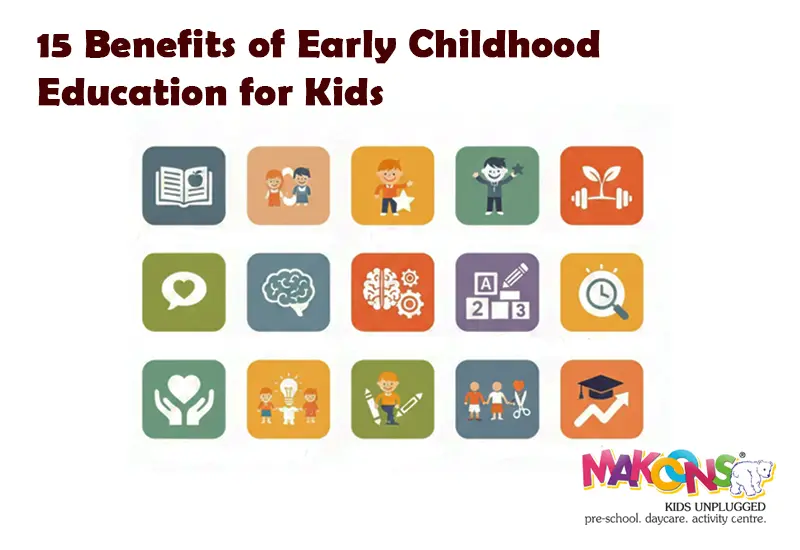
In a child’s life early childhood education is a very significant factor. The first few years are the basis for later learning, conduct, and wellness. Everything that a kid acquires during this phase becomes lifelong. Education in the initial years fosters an all-around development of a child – social, emotional, mental, and physical.
Being educated pretty early in life and starting preschool provides a child with care in a secure and structured environment. The kids are free to do their own discoveries, inquire about things, and practice the necessary skills. This blog will go over the 15 main advantages of early childhood education and how it contributes to the overall development of a child.
Explore the Benefits of Early Childhood Education
1. Builds a Strong Learning Foundation
The education in early stages of one’s life is a great assistance in the formation of learning habits which will last throughout life. Such habits consist of listening to, observing and properly understanding directions. Youngsters are introduced to letters, numbers, shapes, and colors which later on forms the foundation of their academic learning.
Kids thrive better in school in the long run if they have become acquainted with most of their subjects.
2. Improves Language and Communication Skills
New words come to preschool children every day. They not only learn to express their ideas but also to communicate nicely. Teachers encourage the little ones to talk, ask questions, and share their experiences.
This process results in vocabulary enrichment and better sentence formation. The children will become so proficient that they will be able to communicate effortlessly in both school and daily life.
3. Supports Social Development
Social interaction is amongst the biggest advantages of preschool. Children get to know other children who are their age. Moreover, they play together, share toys, and practice waiting.
Through all these activities, kids are able to make friends. Moreover, they also get to learn the rules of conduct during group interactions.
4. Emotional Growth
Vocabulary enrichment and better sentence formation are the results of this process. The children will become so proficient that they will be able to communicate effortlessly in both school and daily life.
The teachers’ support allows the kids to deal with their feelings calmly. This method is a part of building up emotional strength and confidence.
5. Develops Cognitive Skills
Cognitive abilities are characterized by such mental processes as thinking, reasoning, and problem-solving. Through the activities of early childhood education, which are mainly puzzles, storytelling, and playing simple games, these cognitive abilities get developed.
These activities enhance the memory and the attention span. They also develop children’s capacity to think logically and to take decisions.
6. Promotes Independence
Preschool is the location where young ones are supported to perform tiny works on their own. The works may be of very small magnitude like putting the things back in the bag, cleaning up the play area, and having meals by oneself.
Developing this kind of independence helps in building self-esteem in the children. They become the ones who are proud when they finish a task or activity all by themselves without anyone’s assistance.
7. Improves Motor Skills
The very first stage of education comprises physical activities that are drawing, cutting, running, and jumping. Such activities are beneficial to the development of both fine and gross motor skills.
Fine motor skills help with writing and holding objects. Gross motor skills help with balance and coordination.
8. Builds Discipline and Routine
In early childhood education, kids get accustomed to a schedule that is repeated every day. Such a schedule consists of learning, playing, eating, and sleeping that are all doneFixed at specific times.
Adhering to a timetable makes the children realize about time management. The kind of schooling that they are going to experience later becomes less challenging because they have gotten used to it already.
9. Encourages Curiosity and Creativity
Artistic activities are the foundation of the preschool educational approach. Different kinds of activities such as drawing, and painting, along with music, storytelling, and role-playing are included in this category.
Kids are free to raise inquiries and dig into the concepts. This nurtures the development of curiosity and imagination, which are the qualities needed for the whole learning process of life.
10. Improves Focus and Attention
Children who are enrolled in early learning programs participate in exercising their sitting, listening, and doing activities skills. Gradually, this will lead to better concentration and longer attention spans.
These skills are essential for classroom learning. Children find it easier to concentrate during lessons.
11. Teaches Basic Life Skills
Early childhood education helps children learn basic life skills. These include hygiene habits, manners, and communication etiquette.
Children learn to say “please,” “thank you,” and “sorry.” These skills help them become responsible individuals.
12. Builds Confidence and Self-Esteem
When children achieve small goals, they feel proud. Teachers encourage and praise efforts, not just results.
This positive environment builds self-esteem. Confident children are more willing to try new things and face challenges.
13. Supports School Readiness
School readiness is one of the major early learning advantages. Children become familiar with classroom rules and learning methods.
They know how to sit in groups, follow instructions, and complete tasks. This makes the transition to formal school smooth and stress-free.
14. Encourages Positive Behavior
Early childhood education contributes to the moral development of kids through their teachers’ gentle and persistent guidance.
Children are taught significant values, among which is respect, cooperation, and empathy. The development of these qualities would be integrated into their personalities and consequently impact their behavior during the future.
15. Creates a Love for Learning
The biggest benefit of early childhood education is a positive attitude towards learning. When learning is fun, children enjoy it.
Play-based learning makes education exciting. This love for learning continues as children grow older.
Role of Early Childhood Education in Overall Child Development
The comprehensive child development skills are supported by early childhood education. Mental, emotional, social, and physical development are all areas of focus.
School difficulties are often faced with better preparation by children who have gone through preschool. Teachers report faster adjustment and higher performance in the case of such children.
Besides, coactivity makes even the tiniest learners grow more secure and self-reliant, thus making it easier for the little ones to adapt to changes, such as starting a new school.
Long-Term Early Learning Advantages
Studies indicate that kids who get early education are happier and more successful in life. They also display better grades and better social behavior.
The benefits of early education include better developing skills in solving problems. These kids are more likely to be winners at school and in their future career.
Conclusion
The academic aspect of early childhood education does not only include letters and numbers. It is a process of developing life skills, giving self-esteem and providing the future with a strong basis.
The advantages of preschool are not limited to academics. They nurture the development of a child’s personality and his or her lady-like and strong abilities.
Putting money into early childhood education is the same as putting money into a child’s future. The first years are the most important ones. Giving the proper learning environment at this stage can create a difference that lasts a lifetime.






 Twitter