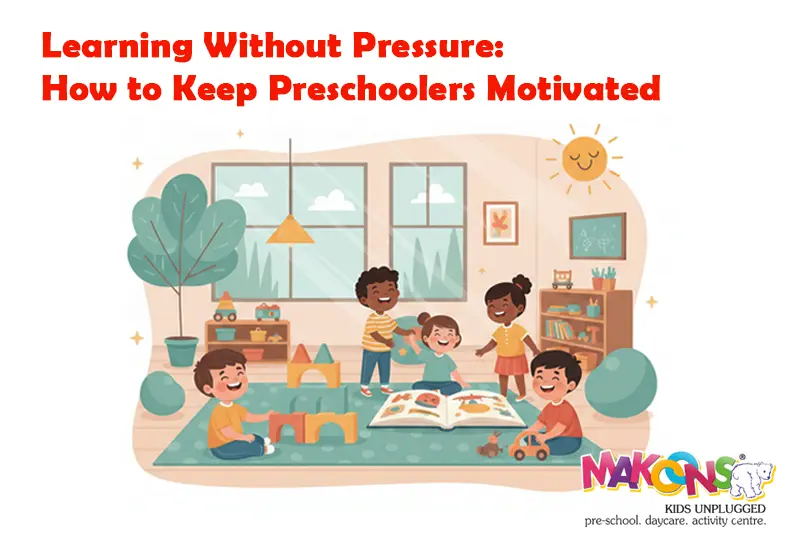
The primary years of a child’s life are filled with wonderment, interaction, and discoveries. If the preschool children are learning in a safe, happy, and curious environment, they are the ones who get the biggest gain from the whole cycle of learning. When stress is the main aspect of learning, even topics with a lot of attractions can lose a child’s interest in a very short time. Thus, learning devoid of pressure is a key element at the very beginning of development. It gives the child a chance to acquire self-confidence, creativity, and a favorable outlook on learning for the whole life.
The Importance of Preschool Motivation
Preschool motivation is a child’s intrinsic want to discover, experiment, and gain knowledge. The children in this period are not influenced by grades or prizes.
- Develop an interest in learning
- Build self-confidence
- Improve social and emotional skills
- Learn at their own pace
Children who experience compulsion in their learning might feel nervous and also frightened to err. Definitely! This situation can demotivate some people. On the contrary, non-pressured learning allows the children to have fun all the way through and not focus on the result only.
Understanding Learning Without Pressure
Learning without pressure means removing fear, stress, and comparison from the learning process. It does not mean no structure. It means having gentle guidance instead of strict control.
In a pressure-free environment:
- Mistakes are allowed
- Effort is valued more than outcomes
- Each child’s pace is respected
- Learning feels like play
This approach is helping students to learn for their own sake. They decide subject-content according to their enthusiasms, abilities, and emotions.
Related Topic: Easy Ways Teachers Can Help Kids Who Struggle to Learn
Child-Centered Learning
There are no books or curriculum for child-centered learning; the child comes first.
In child-centered learning:
- Children choose activities based on interest
- Teachers act as guides, not controller
- Teachers are there to direct the process rather than to take control of it
- The child’s first teacher is the environment and the child learns through playing and experimentation
This method increases preschool motivation because children feel heard and valued.
Creating a Supportive Learning Environment
A supportive environment plays a big role in motivation in early childhood. The space should feel welcoming and safe.
Simple ways to create this environment include:
- Bright and clean learning spaces
- Easy access to toys and books
- Calm and positive adult behavior
- Clear routines with flexibility
When children know what to expect, they feel secure. Security helps them focus and explore freely.
Role of Play in Preschool Learning
For preschoolers, play was the most effective way of learning. All preschool learning activities are to be playful and hands-on.
Through play, children learn:
- Language and communication
- Problem-solving skills
- Social skills like sharing and waiting
- Fine and gross motor skills
Examples of simple preschool learning activities include:
- Building blocks
- Role play like shop or home
- Drawing and coloring
- Singing action songs
These activities encourage young learners without pressure. They make learning enjoyable and meaningful.
Encouraging Young Learners Through Positive Words
Words have a strong impact on children. Positive language supports preschool motivation.
Instead of saying:
- “You are wrong”
- “Do it properly”
Say:
- “Let’s try again”
- “Good effort”
Praise effort, not perfection. This helps children feel proud of trying. It also teaches them that mistakes are part of learning.
Related Topic: How Parents and Teachers Can Work Together to Support Nervous Kids
Avoiding Comparison and Competition
One of the negative effects of comparison during early childhood can be the decrease of motivation. Child development is not uniform, that is, there is a wide difference in terms of the specific order and timing of developmental stages in each child.
Avoid statements like:
- “See how fast your friend did it”
- “Others can do this already”
Such words can make children feel insecure. Focus on individual progress instead.
Encouraging young learners means appreciating small improvements. Even simple achievements matter.
Giving Children Choices
The practice of giving options is supportive of student lead learning by building a sense of feeling in the children that they have the power to choose.
Simple choices can be:
- Choosing between two activities
- Picking a book to read
- Selecting colors for an art task
When children make choices, they feel responsible and motivated. This builds independence and confidence.
Keeping Activities Short and Simple
Preschoolers have short attention spans. Long activities can feel tiring.
Preschool learning activities should be:
- Short
- Simple
- Flexible
Break tasks into small steps. Allow breaks. Observe when a child loses interest and change the activity if needed. Learning without pressure respects the child’s mood and energy.
Importance of Routine Without Rigidity
Routine gives structure. It helps children feel safe. But too much rigidity can create stress.
A balanced routine includes:
- Fixed times for meals and rest
- Flexible learning and play time
- Space for free play
This balance supports preschool motivation and keeps learning natural.
Role of Teachers in Motivation
Teachers play a key role in motivation in early childhood. Their attitude matters more than teaching tools.
Motivating teachers:
- Listen patiently
- Show warmth and care
- Encourage questions
- Accept different learning styles
A calm and positive teacher helps children feel confident. Confidence leads to better learning.
Role of Parents in Encouraging Young Learners
Learning does not stop at preschool. Parents also influence preschool motivation.
Parents can support learning without pressure by:
- Reading with children daily
- Talking about their day
- Allowing free play at home
- Avoiding over-scheduling
Simple conversations and shared activities build strong learning habits.
Related Topic: Teaching Toddlers at Home – Without Coercion
Handling Mistakes in a Healthy Way
Mistakes are a natural part of learning. How adults respond to mistakes affects motivation in early childhood.
Instead of correcting immediately, try to:
- Ask questions
- Give hints
- Allow the child to think
This approach encourages problem-solving and reduces fear of failure.
Using Real-Life Learning Experiences
Real-life experiences are powerful learning tools. They make learning meaningful.
Examples include:
- Counting fruits while shopping
- Talking about colors in nature
- Sorting toys at home
These moments support child-centered learning and encourage young learners naturally.
Signs of Healthy Preschool Motivation
A motivated preschooler often:
- Asks questions
- Tries new activities
- Shows excitement in learning
- Plays independently at times
The following indicators make it clear that the process of learning without pressure has been effective.
When to Raise an Alarm
A kid’s persistent fear, denial, or learning-related stress signals that the child is being pressured.
In such cases:
- Reduce expectations
- Observe the child’s interests
- Communicate with teachers
Early support helps restore motivation in early childhood.
Conclusion
Learning pressure-free is truly a must for the healthy development of preschool kids. When kids can feel secure, appreciated and inquisitive preschool motivation comes up. Learning that is based on children and their needs, interests, and habits is slow or fast for each individual child. Just a few of the activities mentioned above plus the use of positive language and playing in a fun way will all be among the things that support young learners.
When grown-ups put children’s learning joy at the forefront, the kids gradually form self-esteem and hate no more the learning practice. The foundation laid is so solid that it can be used for lifetime growth and success.






 Twitter