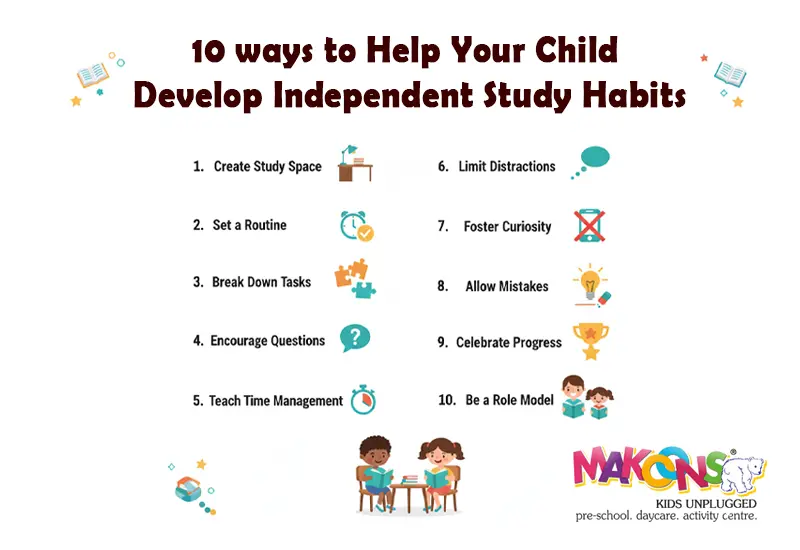
The requirements in the modern academic world are rather dynamic and, therefore, children are supposed to learn far beyond what they learn in textbooks. They are taught to be independent in their thinking, organize their time and responsibility in their own learning. This is where independent study habits are needed. Children taught to study independently will develop confidence, self-discipline and a love of life long learning.
The question many parents ask would be how to make a child study without the use of constant reminders, pressure, and supervision. That is best achieved by establishing proper environment, attitude and routine that can enable children to learn themselves. The independent study cannot be built in a single night, it is a slow process that requires time, instructions and practice.
Learning Independent Study Habits
Independent study habits imply that a child can plan on its part, concentrate, and do learnings with the least supervision. This involves goal setting, planning study content, motivation and going through work by oneself. Such practices do not just work within academic circles; they determine the ability to solve problems and personal accountability.
Good studying abilities among students contribute to ensuring that children become confident students that do not fear challenges.
1. Developing An Consistent Routine
Set routine contributes significantly to the creation of discipline. Learning by children becomes a habit and not an activity they abhor when they study at the same time every day. The routine makes children mentally ready to be focused on important work and minimizes procrastination.
This is necessary in establishing a routine of studying that is comfortable and free of stress.
2. Organizing A Special Study Area
An empty and well-organized study environment enhances focus and minimizes distractions. The room should not be fancy, it just must be regular and without noise, television, or clutter. The brain is more likely to put the children into study mode when they relate a particular place with learning.
This atmosphere promotes long term independent study behaviors.
3. Encouraging Goal Setting And Planning
When children are made to have small but attainable objectives, they learn how to handle tasks on their own. They should not be told what to study but question them about what they intend to accomplish in a session. This straightforward practice creates ownership and responsibility.
One of the best ways of motivation towards self-learning is goal setting.
4. Learning To Manage Time Intuitively
Time management should not become a strict rule. Request children to divide tasks into small parts and have brief rests in between periods. In this way, burnout will be avoided and they will be able to remain more focused.
With time, children would learn to keep time by themselves- this is a vital life skill that is not necessarily academic.
5. Allowing Kids To Learn The Hard Way
Fear of failure is one of the obstacles that may prevent independence. Children are afraid to work on their own when they are constantly corrected by their parents. Letting children do things wrong, and then learn how to do it, builds a sense of confidence and strength.
The errors are inherent in the process of learning and they are a significant aspect of building good study skills amongst students.
6. Lessening The Reliance On Prompts
Children cannot learn the aspect of responsibility due to constant reminders. Rather than instructing them to study over and over again, covertly remind them of their routine, making them remember on their own. Children can be helped to be in charge using visual schedules or planners.
This progressive change promotes unpressured self-learning among kids.
7. Promoting Inquiry Over Study
Learners that are independent are inquisitive learners. The book, video, or conversation should be encouraged to explore what the children are passionate about. Children start perceiving education as fun as opposed to mandatory when they are not forced to examine.
Curiosity enhances motivation and enhances long-term learning behavior.
8. Giving Advice And Not Being Controlling
Parents are role players that are supportive rather than dominant. You may not sit with your child during the period of his or her study, but visit him/her periodically. Questions such as; what did you learn today? instead of having to correct all the answers.
This proportion is beneficial in that it makes children feel supported, yet they still need to work on their own.
9. The Effort Over Results Recognition
Rewarding hard work rather than grades teaches children to appreciate education over grades. Children will become more eager to do something and learn independently when they feel that they are appreciated in their attempts.
Confidence and motivation are reinforced through the use of positive reinforcement.
10. Calculating Independent Learning As A Parent
Children learn by observing. As parents read books or plan or acquire new skills, children imitate them. Being curious and disciplined in everyday life will make a strong statement.
It is one of the most powerful tips on how to study quietly that parents usually disregard in kids.
Employing Support Of Independence
The use of simple tools, such as planners, checklists, or timers can assist children to plan their study time and not to be supervised all the time. The tools enable the children to monitor their progress and be responsible.
Progressively children become less dependent on parents and more on their systems.
Realizing That Independence Is A Long Process
Each child grows at his or her rate. Certain children can adjust well whereas others require assistance. Comparison of children might cause strain and discouragement. Long term success relies on patience and persistence.
Learning on your own is strengthened through time and encouragement.
The Importance Of Independent Study Habit In The Future
Independent children do better in school and in terms of emotions. They gain problem-solving abilities, confidence, and flexibility which are needed in college and in the workplace.
Great independent study skills do not only equip children with exams, but also life.
Conclusion
One of the best gifts that parents can give to children is assisting them gain independent study habits. Parents support the 10-year-old with a positive environment, promote responsibility, and give children the opportunity to learn at their pace, which preconditions self-assured and competent students.
Under the optimal guidance and autonomy, children may easily acquire self-education skills, good habits and outlooks towards learning. Such habits remain with them even after school years which determines their future success.







 Twitter