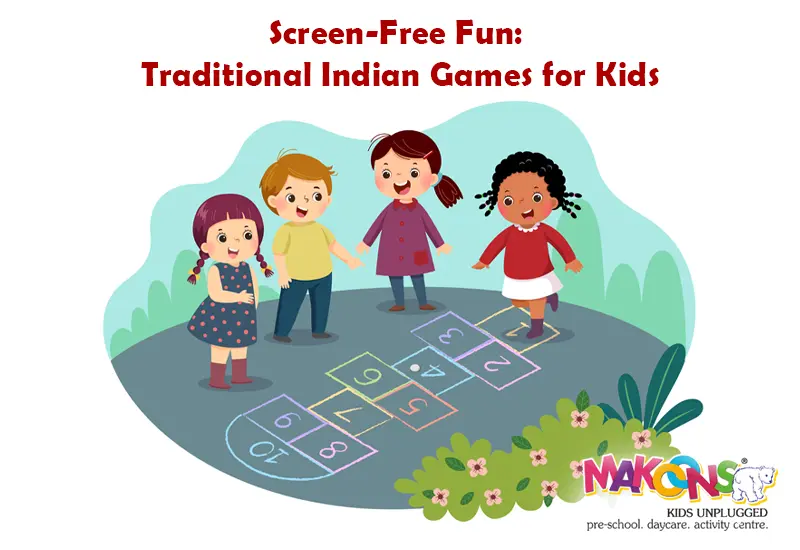
Childhood was quite different in the past because evenings were filled with the pounding of little footsteps in narrow lanes, voices shouting names in the distance, and the radiant laughter ringing in the gaps between houses. Children didn’t ask for screens. They asked, “Who’s playing today?” Games began spontaneously, rules were agreed on the spot, and play continued until someone’s mother called them home.
Today, childhood looks different. Screens arrive early and stay long. Phones, tablets, televisions, and gaming consoles quietly replace movement and conversation. Many parents now find themselves actively searching for screen free activities for children, not because screens are harmful by default, but because something essential is getting lost.
This is where traditional Indian games for kids quietly return to relevance. These games don’t need downloads or instructions. They need time, people, and a little space. And they offer far more than entertainment.
Why Screen-Free Play Still Matters?
Children learn best when their bodies and minds work together. Screens often keep the body still while the mind is overstimulated. Traditional play does the opposite. It encourages movement, interaction, and patience.
When children engage in screen free learning activities, they practice real-world skills. They learn how to wait, how to argue and resolve, how to lose without giving up, and how to win without showing off. These lessons cannot be taught through videos or apps.
More importantly, screen-free play allows boredom. And boredom, quietly, gives rise to creativity.
The Simplicity of Indian Childhood Games
One of the most beautiful things about Indian childhood games is how little they require. A few stones. A piece of chalk. An open patch of floor. Sometimes, nothing at all.
These games were born in homes where resources were limited but imagination was not. They adapted easily to weather, space, and age groups. Younger children watched older ones play and slowly joined in. Rules were flexible, often debated, sometimes broken—and then rewritten again.
This adaptability is what makes them timeless.
Related Topic: Screen-Free Fun Activities To Build Gross Motor Skills In Children
Indoor Games that Brought Families Together
Not every child could always play outside. That’s why Indian indoor games held a special place in homes.
Ludo was more than a board game. It was an exercise in patience. Children learned early that luck doesn’t always favour you, and sometimes a long wait ends in disappointment. Those lessons stayed.
Antakshari filled evenings with music and laughter. Children learned new words, improved memory, and gained confidence without ever calling it practice. Shy voices grew louder over time.
Games like Chowka Bara or Ashta Chamma sharpened counting skills naturally. No one sat children down to teach numbers. They learned because they wanted to win.
These offline games for kids slowed time. They encouraged conversation. They brought siblings, cousins, and grandparents into the same space.
Outdoor Games that Shaped Resilience
Outdoor play was once the foundation of physical confidence. Many traditional Indian games for kids were demanding, but never forced.
Kabaddi required focus and breath control. Kho-Kho demanded speed and strategy. Lagori encouraged teamwork—one child rebuilding stones while others defended.
Children fell, argued, dusted themselves off, and played again. There were no referees, no trophies, and no audience. Just the game and the joy of playing it well.
These games taught children how to listen to their bodies and understand limits—skills that structured sports sometimes introduce much later.
Cultural Roots Hidden in Play
Traditional games carry culture quietly. They pass down language, rhythm, and social values without formal teaching.
When children play these games today, they connect to something older than themselves. Parents often find joy in teaching games they once played, bridging generations without effort.
These cultural games for children remind families that learning does not always come from new tools. Sometimes it comes from memory.
Relaated Topic: Screen-Free New Year Activities That Keep Kids Engaged and Learning
Social Skills Grow Naturally through Play
One of the major concerns of parents is the child’s ability to mingle with other children socially. Children’s current technology enables kids to be by themselves even when they are “connected.” This is because physical games require the child’s presence.
Children have to be able to explain rules to others, resolve conflicts over rules, and accommodate others’ moods. They develop empathy when a person feels left out.
No worksheet teaches this. Only real interaction does.
Bringing Traditional Games into Modern Homes
Parents often assume these games belong to another time. In reality, they only need space in the routine.
Weekend afternoons. Family gatherings. Rainy evenings. Short breaks between homework. Traditional games don’t require long hours—just intention.
Instead of removing screens abruptly, parents can offer alternatives. Children are more open to change when joy replaces restriction.
Learning Without Pressure
Many modern screen free learning activities try to recreate engagement through structured tools. Games have always done that effortlessly.
Counting stones, recalling lyrics to songs, analyzing moves, or working together as teammates all help develop cognitive and emotional abilities in ways that occur naturally. Children learn because they want to play again.
And because learning happens without pressure, it stays longer.
What Children Truly Gain
Children who regularly engage in offline games for kids often show stronger focus, better emotional balance, and improved confidence. They are comfortable in groups. They adapt quickly. They handle boredom better.
These qualities matter long after childhood ends.
Final thoughts
Screens are an everyday aspect of modern culture, and they do have their role. However, childhood need not be entirely digital and technology-driven in order to be significant.
By engaging their children in **Traditional Indian Games for Kids**, parents provide them with the invaluable experience of connection, movement, patience, and happy times.
These games help remind kids that sometimes fun is not always found in gadgets such as smart TVs and even in their mobile gadgets. Fun is also found in humans, in laughter, in being there – in being present. Perhaps this is what children need to learn most these days.







 Twitter