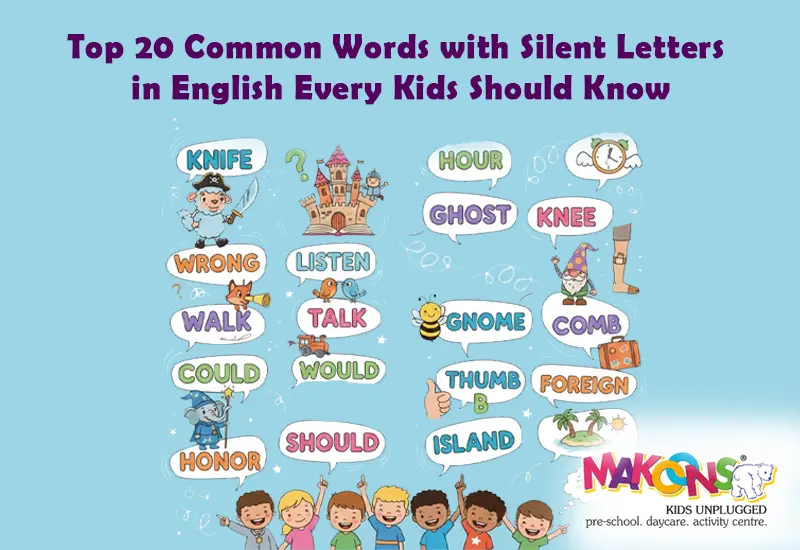
English is a fun language. But sometimes, spelling can confuse kids. One reason is silent letters in English words. These are letters we write but do not pronounce. They are there in the spelling, but when we say the word, they stay silent.
For example, in the word knife, we do not say the “k.” It is silent. Words like these often confuse children when they start learning to read and spell. That is why it helps to know the most common silent letter words.
In this blog, we will look at 20 words with silent letters for kids. We will also share simple silent letter examples, explain why they are tricky, and give some English spelling tips for kids to make learning easier.
Why Silent Letters Matter in English Words?
Silent letters make English spelling tricky. Kids often ask, “Why write a letter if we don’t say it?” That is a good question. Many silent letters are there because of old English and words borrowed from other languages. Over time, the way we speak changed, but the spellings stayed the same.
For kids, learning these words early is helpful. It saves confusion later. It also builds confidence in reading and writing. That’s why teachers often focus on tricky English words for kids that include silent letters.
Top 20 Common Words with Silent Letters in English
Here is our list of 20 simple words every child should know.
1. Knife
The “k” is silent. We only say “nife.”
Example: She used a knife to cut the apple.
2. Knee
Again, the “k” is silent. We say “nee.”
Example: He fell and hurt his knee.
3. Knock
The “k” is silent. We say “nock.”
Example: Please knock on the door.
4. Know
The “k” is silent. We say “no.”
Example: Do you know the answer?
5. Gnat
The “g” is silent. We say “nat.”
Example: A gnat flew near the lamp.
6. Gnaw
The “g” is silent. We say “naw.”
Example: Dogs like to gnaw on bones.
7. Write
The “w” is silent. We say “rite.”
Example: Please write your name on the paper.
8. Wrong
The “w” is silent. We say “rong.”
Example: It is wrong to tell lies.
9. Wrist
The “w” is silent. We say “rist.”
Example: She wore a watch on her wrist.
10. Sword
The “w” is silent. We say “sord.”
Example: The knight carried a sword.
11. Island
The “s” is silent. We say “iland.”
Example: They went on a trip to an island.
12. Honest
The “h” is silent. We say “onest.”
Example: Always be honest with your friends.
13. Hour
The “h” is silent. We say “our.”
Example: The class will start in one hour.
14. Castle
The “t” is silent. We say “cass-ul.”
Example: The king lived in a big castle.
15. Listen
The “t” is silent. We say “lissen.”
Example: Listen carefully to your teacher.
16. Whistle
The “t” is silent. We say “wissul.”
Example: He blew a whistle at the game.
17. Autumn
The “n” is silent. We say “aw-tum.”
Example: Autumn is the season of falling leaves.
18. Thumb
The “b” is silent. We say “thum.”
Example: She hurt her thumb while playing.
19. Climb
The “b” is silent. We say “clime.”
Example: The children will climb the tree.
20. Doubt
The “b” is silent. We say “dout.”
Example: I have no doubt about the answer.
These 20 are among the most common silent letter words kids will see in books, lessons, and everyday life.
Related Topic: Words with Silent ‘K’: Examples and Easy Memory Tricks
Why These Words Are Tricky?
These words are confusing because kids often try to pronounce every letter. For example, they may say “k-nife” or “h-onest.” That is normal. With practice, they learn that some letters are just silent.
The key is to give children clear silent letter examples and lots of practice. Reading aloud also helps. When kids see the spelling and hear the correct sound, they remember better.
English Spelling Tips for Kids
Here are a few simple tips to help children learn words with silent letters for kids:
- Group by letters: Teach all silent “k” words together (knife, knee, knock, know). Kids will see the pattern.
- Use word cards: Write the word on one side and the sound on the other.
- Practice reading: Read stories that include tricky English words for kids with silent letters.
- Play games: Word puzzles and spelling games make practice fun.
- Repeat often: Silent letters take time to remember. The more kids see them, the easier it becomes.
These small steps make spelling less scary and more enjoyable.
Why Kids Should Learn Silent Letters Early?
Silent letters are part of everyday English. They appear in school books, signs, and stories. If children learn them early, they become confident readers. They also make fewer spelling mistakes later.
For parents and teachers, teaching silent letters in English words can be fun. Use real-life examples. A simple equation: words seen on signs, from books, and also words picked up during kid conversations. This way, children learn without much pressure.
More Silent Letters in English Examples
The 20 words we listed are the most common. But English has many more. Here are a few bonus ones you can share with kids:
- Psalm (silent “p”)
- Design (silent “g”)
- Subtle (silent “b”)
- Receipt (silent “p”)
- Edge (silent “e”)
These are harder, but older kids may enjoy the challenge.
Making Learning Fun
The best way to teach tricky English words for kids is through fun. Turn practice into a game. For example, ask kids to “spot the silent letter” in a word. Or have them compete to list as many silent letter words as they can in one minute.
You can also let kids draw pictures of words like “knife” or “castle.” When they see the word and image together, they remember faster.
Final Thoughts
Silent letters make English fascinating. They may seem tricky at first, but with increasing practice, children quickly. Starting with these 20 words, children have a solid foundation. These common silent letter words appear frequently in reading, writing, and talking.
Silent letters examples combined with practice and games make it possible for kids to tackle these difficult spellings. With support through simple lessons, parents and teachers make the journey a whole lot easier.
Remember, learning words with silent letters for kids is not just about spelling. It is also about building confidence. The more kids read and practice, the better they get at English.
So, next time your child says “k-nife,” just smile and gently remind them. “The k is silent.” With time, they will get it right, and they might even enjoy finding more silent letters on their own!
Why do some English words have silent letters?
Many English words have silent letters because they come from old languages or historical spellings that stayed the same even though pronunciation changed over time.
What are some common examples of silent letter words?
Some common examples are knife (k), thumb (b), write (w), and honest (h) where one letter is written but not spoken.
How can kids easily learn words with silent letters?
Kids can learn silent letter words by reading regularly, practicing pronunciation, and using simple word lists or phonics activities.
Which letters are most commonly silent in English words?
Some of the most common silent letters are b, k, w, h, and l in words like thumb, knife, write, honest, and walk.







 Twitter