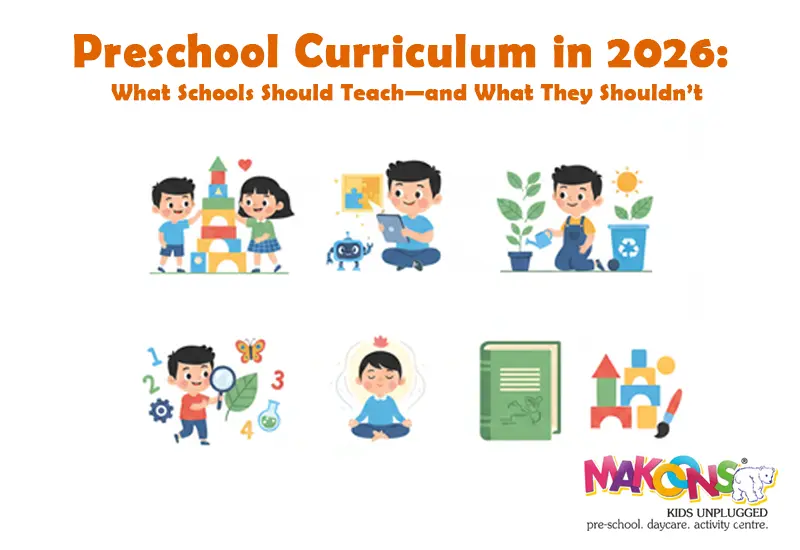
The pace of preschool education is evolving. With the approach of 2026, parents and educators are coming to the point of understanding that early learning is not about pushing children into academic achievements but to assist children grow in a healthy and balanced manner. It is assumed that the preschool curriculum 2026 will be more focused on skills, creativity, and emotional growth and not on textbooks and pressure.
Effective early childhood curriculum forms the basis of lifelong learning. It influences the thinking, interaction of children and their response to the world. In this blog we shall discuss how the modern pre-schools ought to be structured, what must not be incorporated, and how the preschool curriculum in India may be modified to suit the future.
Reasons Why Preschool Curriculum Should Be Updated?
Children in this day and age are growing up in a different world. Education requires a smarter method due to technology, the changing family structure, and new learning requirements. The old system of teaching is no longer relevant to the developmental requirements of the young children.
Modern preschool education is not aimed at producing early toppers, but competent, inquisitive, and confident learners.
A preschool curriculum of the future should:
- Behavioural adaptability toward a child.
- Promote discovery and creativity.
- Target emotional and social development.
- Get children ready to live in real life.
What Schools Need To Teach In Preschool Curriculum 2026?
1. The Essence Of Play-Based Learning
One of the most significant aspects of early education is a play based learning curriculum. Children get to learn better when they are participatory and when they are enjoying the process.
Children learn through play:
- Problem-solving skills
- Language and communication
- Sharing and cooperation habits.
- Creativity and imagination
Play does not imply the absence of structure. Children learn without stress because of the planned activities.
2. Key Abilities Of Preschool Children
Schools should not only concentrate on the alphabets and numbers but rather concentrate on skills that enable the preschool children in general development.
Important skills include:
- Speaking and listening with confidence.
- Feeling healthy expression.
- Basic decision-making
- Developing independence
- Learning to follow routines
These abilities are useful in enabling the children to adapt to formal schooling.
3. Development Of Language And Communication
Good communication skills are an ingredient of the early childhood curriculum. Natural vocabulary development in children is achieved by storytelling, rhymes, conversation and role play.
The syllabus of the preschool in India must similarly in the Indian context:
- Favored multilingual exposure.
- Promote freedom of expression in children.
- Adore home languages and English.
This creates trust and cultural affiliation.
4. Early Mathematical And Logical Thinking
About math at preschool there need not be worksheets or tests. Children, rather, need to learn through their day to day activities, which include:
- Sorting toys
- Counting steps
- Recognizing patterns
- Puzzles and playing board games.
The activities enhance thinking capacity and provide great pillars of future education.
5. Social And Emotional Learning
Emotional development is one of the most crucial sections of the preschool curriculum 2026.
Preschools are expected to assist children:
- Understand feelings
- Learn empathy
- Build friendships
- Handle small conflicts
These skills prove to be more valuable than initial academic success and result in more long term success.
Preschool Learning Outcomes That Are Indeed Important
Clarity and realism of preschool learning outcomes make teachers and parents realize the development of a child without making comparisons or pressing.
At the preschool age, children are expected to be in a position of:
- Share fundamental needs and ideas.
- Take part in team activities.
- Follow simple instructions
- Demonstrate interest and eagerness to learn.
- Manage basic self-care tasks
These are development-oriented, and not performance-oriented.
What Schools Should NOT Teach In 2026
1. Learning By Heart And By Rote
Creativity and confidence may be detrimental when children are forced to memorize information that they do not understand. There is no need for long homework or repetitive writing during preschool.
2. The Pressure To Study At A Young Age
Early education should not involve exams, rankings and competition. Children do not develop at the same rate and when compared, it causes stress and fear of learning.
3. One-Size-Fits-All Teaching
Every child is unique. A strict regime where all children are supposed to learn in a similar manner is not healthy in growth. The early childhood curriculum should be adaptive and child focused.
4. Overindulgence In Screen-Based Learning
Although technology is not bad, excessive use of screens may decrease physical activities, socialization, and imagination. Practical experiences must be given priority.
Preschool Syllabus In India: A Pre-school On The Way To Balance
The Indian preschool syllabus is slowly shifting towards a child friendly and more balanced approach. Now parents are becoming more conscious that emotional, social and cognitive development should be equally enriched by early learning.
The success of an Indian preschool curriculum must:
- Combine cultural values and contemporary teaching.
- Promote creativity and play.
- Take off the stress on the young learners.
- Engage parents in the education process.
This equilibrium enables the children to develop with self-esteem and happiness.
Teacher Role In Current Preschool Education
Educators are very crucial in influencing the learning experiences. Teachers in the contemporary environment of preschool education serve the role of:
- Guides and facilitators
- Observers of child behavior
- Advocates of emotional growth.
- Partners with parents
Professional teachers make children feel secure, appreciated and eager to learn.
Conclusion
The preschool curriculum 2026 is not teaching more, but teaching better. Good preschool learning outcomes, play based learning curriculum and emphasis on the essential skills of preschool children can produce confident and competent human beings.
With the changing demands, it is time to stop using pressure-based systems in preschools and make the process meaningful and joyful. Children thus grow naturally and they come to love learning throughout their lives–and there is the real success of early education.






 Twitter