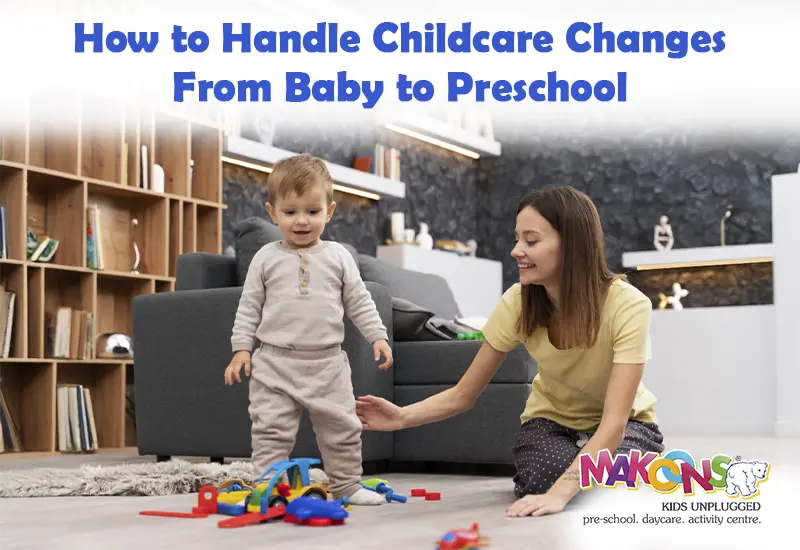
Children develop fast, and each of the stages is accompanied by a new routine, feelings, and expectations. Among the largest transitions that parents have to undergo include taking the child through various childcare transitions- between infancy and toddlerhood and ultimately to preschool. What is just a baby care turns into a more formalized setting with routines, social interactions and early education.
Such changes are thrilling and may be emotional and overwhelming to both children and parents. The art of how to be with your child through this experience- baby to toddler, then to daycare to preschool could help the process to be much easier and enjoyable.
This guide will take parents through such stages and provide practical and heart-felt advice.
The Comprehension of the Baby Care to Toddler Care Shift
The first type of child care is based on comfort, safety, feeding schedules, and gentle stimulation. The world of a child expands when he or she enters into toddler age. They are inquisitive, more active and willing to discover.
The following changes are tend to be quite pronounced:
- Children start to adhere to more routine.
- Time in activities increases -songs, sensory play, early communication skills.
- There is the initiation of socialization, however brief and tentative.
- Early independence, such as feeding or toy selection, is promoted by caregivers.
Toddlers are more conscious of what is around and hence parents tend to experience emotional highs and lows. There are those children who embrace and there are those who are resistant and others adapt easily. Being patient and consistent assists the child to feel safe during these early childhood transitions of childcare.
Getting Ready to the Move between Daycare and Preschool
When a child attains the age of 2.5-3 years, most families start to shift out of daycare to preschool. This is among the largest advances in the early childhood. Preschool brings about a more orderly day which has learning plans, group work, early academics and routines preparing the children to move to the subsequent school.
This transformation can bring excitement, yet it is also a cause that can provoke the feeling of uncertainty both to the child and the parent. It is important not to consider daycare and preschool two different worlds, but as two developments in the same direction.
However, typical changes that your child will experience are:
- Less individual learning and circle time.
- Early numeracy and literacy interventions.
- Routines in the classroom including lining up, sharing materials and group work.
- Greater social norms.
- Strict schedule of meals, play and learning.
The knowledge of these changes will enable parents to overcome the transition with the children rather than be caught off guard by new behaviour.
How to Assist Your Child to Adapt to Preschool
The initial months of preschool are very critical. Even the most self-assured children require time to establish trust with unfamiliar teachers and get used to a more energetic environment. The process can be simplified by using simple preschool adjustment tips.
The following are some of the effective methods that can be used by many parents:
- Discuss preschool with your child. describe their activities, with whom they will interact and what their day will be like.
- Play together before the first day in the preschool. Children that observe the classroom early are likely to settle at a faster rate.
- Have practice activities at home- such as the shoe-on game, small backpack game, etc. or even washing hands.
- An early-hesitations nerves can be soothed with a comfort item such as a soft toy, small cloth, family photo.
- The short but positive goodbye makes children aware of what they should expect every morning.
- Change is a process that requires time, and thus it is worth celebrating even minor progress. Even a few minutes without crying can serve as a major accomplishment of a child.
Treatment of Preschool Separation Anxiety
Preschool separation anxiety is experienced almost by every family. Children can cry, hold onto or be reluctant to go into the classroom particularly in the first week. This is instinctive and self-temporal.
Parents may help the child by:
- Having a regular drop-off schedule.
- Not taking time to say goodbye.
- Remaining composed when the child is angry.
- Relied on teachers to console and mentor the child.
- Assuring the child that he or she will be picked up at the required time.
The majority of children get settled in a few days after they have recognised that preschool is a safe and enjoyable environment. The important thing is that the child should be supported, not pressed.
Making the Preschool Transition easier with Activities
Children are more adaptive with what is expected of them. Even basic preschool transition exercises done at home would warm up the mind of a child towards learning in a classroom.
The following are some of the helpful activities:
- Reading picture books on preschool.
- Performing simple pretend-play-teacher and pretend-student.
- Simple commands, such as, sit, stand, clean up etc.
- Playing as a group with other children.
- Arts and craft activities to create concentration.
These minor activities will create a feeling of familiarity, which will decrease fear on the first day.
Emotional Expectancies of Parents
Parents are usually concerned about the way their child will cope; however, the transition has an impact on adults as well. It’s normal to:
- Emotional to leave your child in a new place.
- Freud over whether your child is adapting.
- Wonder whether you did the correct preschool.
- Compare the progress of your child to others.
It is important to keep in mind that all children differentiate. It is an objective not to be perfect but to improve. Few tears or hesitations do not imply that the child is not ready. All they need is time and assurance.
Establishing an Immediate Long-term Smooth Transition
It is not only about the first day but building a stable rhythm when it comes to childcare transitions. Kids are creatures of routine and thus the things such as sleep, eating habits, and morning routines will make them adapt.
Parents can also:
- Reinforce learning at home
- Share new preschool skills.
- Maintain the calmness of weekends in the initial weeks.
- Promote self sufficiency by giving small age-based tasks.
The transition of the child is more positive and smooth with a continuity between home and school.
Conclusion
Any change in the area of baby care to toddler care, and later into preschool form of care is one of the most significant transitions in early childhood. Every stage contains development, self-reliance and emotional education. These changes can be made safe and exciting to little ones by patience, communication, and careful planning by their parents.
Nobody can tell when it comes to getting used to a toddler schedule or transitioning out of daycare and into preschool, overcoming early fears, or getting ready to start a classroom, children do nothing without feeling understood and supported. Through consistent practices, supportive parenting, and smooth transition exercises, families will go through all the stages with assurance.
Why is the transition from baby care to preschool important?
This transition is important because children move from basic care routines to structured learning, social development, and independence, which prepares them for formal schooling later.
How can parents help children adjust to preschool easily?
Parents can help by talking positively about preschool, practicing simple routines at home, visiting the classroom beforehand, and keeping goodbyes short and reassuring. These steps help children feel safe and confident in a new environment.
Is separation anxiety normal when children start preschool?
Yes, separation anxiety is very common when children start preschool. Many children may cry or feel nervous during the first few days, but with consistent routines and reassurance, most adjust within a short time.
What skills should children learn before starting preschool?
Before starting preschool, children should practice basic independence skills such as washing hands, eating on their own, carrying a small bag, and cleaning up toys. These skills help them feel more confident in a classroom setting.







 Twitter