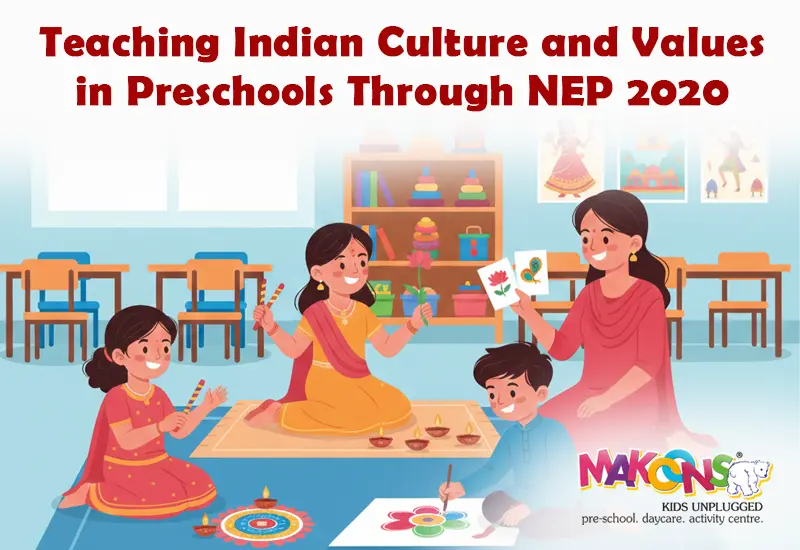
The National Education Policy (NEP) 2020 has ushered in a revolution in early education in India. For the first time, we have a real emphasis on promoting the integration of the academic with cultural, and value-based learning from the preschool level.
The explanation is straightforward. When a child visits their origins early on, they will have their identity developed, respect for their traditions, and a sense of belonging.
This guide describes how NEP Indian culture preschool initiatives are currently influencing early education, how preschool essential NEP 2020 values are coming into play in the classroom, and how schools and parents can help embody some of the Indian culture and heritage in daily learning.
Why Teach Culture and Values in Preschool?
Preschool is not just about learning ABCs and 123s. It is the time where children develop values that will last a lifetime. Children are like sponges between the ages of 3–6 years; they pick up behaviors, ideas and emotions very quickly. By being exposed to Indian traditions and cultural practices, children develop:
- Respect for diversity in a multi-cultural Indian society.
- A sense of identification and belonging.
- Ethical base for decision making.
- An understanding of the significance of community/family ties.
The NEP cultural education framework for preschool is very strong; values are not being taught as hard and fast lessons; they are being incorporated into everyday activities.
NEP Values for Early Education: The Big Shift
Preschool has traditionally started out focused and pushed on literacy and numeracy. NEP 2020 expands this vision by focusing on:
1. Ethical and moral education – Teach children the ability to define right from wrong.
2. Cultural wisdom and Indian traditions – Knowing about festivals, folk tales, and heritage.
3. Environmental ethics – Values like reverence for the environment and sustainable living.
4. Social ethics – Sharing, helping, and respecting others.
This NEP preschool ethics inways of knowing emphasizes learning beyond books into action in real life.
NEP Indian Culture Preschool: What You Need to Know
According to the NEP 2020 for Culture, the curriculum for preschool includes:
- Stories from the epics and folk tales – Simple tales from Panchatantra, values from the Jataka tales, and local stories in regional languages.
- Celebrating festivals – Not just the ceremonies but the values (i.e. Diwali = sharing happiness, Holi = coming together, Eid = compassion).
- Songs and rhymes in regional languages – Building pride for local culture.
- Arts and crafts based on heritage – Warli painting, rangoli, clay modeling.
- Value-based activities – Planting a tree, helping a friend, or role-play pretend kindness with dolls.
How to Teach Indian Traditions in Preschool: Real Life Examples
1. Through Routines of Daily Life
- Greet each other with Namaste.
- Say thank you and sorry as appropriate.
- Practice cleanliness before eating as part of preschool values NEP 2020.
2. Through Stories and Role Play
- Enact the story of “Lion and the Mouse.”
- Dress up as community helpers (farmer, teacher, doctor).
- Use puppets and story telling preschool activities for moral stories.
3. Through Festivals and Other Events
- Small celebrations of major Indian festivals, especially focusing on their meaning.
- Invite parents to share cultural practices with children.
- Organizing heritage days where children learn traditional songs, dances, and food habits.
Curriculum Heritage Activities in National Education Policy (NEP)
| Activities | Value s/ Skills Taught | Examples |
| Folk Art Activity | Creativity, Pride in culture | Children create mehndi patterns |
| Festival Food to Share | Kindness, Gratitude | Children bring small homemade food items. |
| Story Circle | Listening, Different morals | Stories within Panchatantra or Akbar-Birbal |
| Nature Walk | Environmental sense | Collecting leaves and learning the names of the trees |
| Traditional Festival Games | Working with Joy | Lagori, Gilli-Danda, and Hopscotch |
These preschool curriculum heritage activities give children some connection to the tradition and make learning more fun.
Preschool Ethics NEP: Making Values and Culture Normal in Learning
Values should not be taught through lecture, rather through experience. NEP suggests methods such as:
- Learning by doing: Cleaning up or putting away toys after free play teaches children responsibility.
- Circle time discussions: Discussions about kindness, respect, fairness and so forth.
- Peer interaction by suggesting sharing crayons, or taking turns.
- Most importantly the children at some point will model the teachers’ behaviors (polite, honest, patient).
This makes it much easier to incorporate world religion customs such as NEP Indian traditions, under preschool ethics into learning.
Cultural Education NEP and Preschools Multilingual Education
The NEP method encourages the use of the primary or regional language/mother tongue as a language of learning in preschools. This approach is an integral part of learning because it provides:
- Preserving local culture and traditions.
- Sharing story context when reading and oral education story-telling.
- An added sense of pride and appreciation for language and locals.
Example:
A preschool in Karnataka could use regional Kannada children’s rhymes and folklore, while a preschool in Punjab can share children’s folklore.
Parents’ Role Preschool Values NEP 2020
Parents are a child’s first teachers. Preschools can work with families to extend values into a home setting:
- Family story-telling time with grandparents sharing traditional stories with local values.
- Involve parents by attending festivals at the preschool as a family.
- Share a one page monthly sheet of theme-learning-parent take home activity as their menu plan or checklist.
- Encourage families to plan traditional screen-free games over the weekend to extend learning values.
- When schools and family/community think about making values fun to work with the child and so values can become a way of life.
Long Term Benefits of NEP Culture Curriculum
- Cultural Value and Confidence – Children grow up becoming proud of their heritage.
- A Stronger Identity – They feel rooted to an academic identity but with respect to others.
- Better Social Skills/Confidence – Values of sharing, kindness, empathy become a daily habit for the child.
- Global Preparation – Enjoying their own culture prepares children to understand the multicultural world.
- Holistic Development – Cognition, emotional and moral, or behavioral development together.
Challenges in Teaching Indian Culture in Preschools
- The over-commercialization of festivals may distract from the real values.
- Teachers may need training in culturally relevant education.
- There may be a greater emphasis in urban preschools on Western cultural activities.
- Creating balance with modern learning and traditional learning can be a challenge.
- The solution can be in practical ideas or independent cultural themed activities that are simple and age-appropriate for preschool, along with appropriate teacher training of the NEP.
Conclusion
The NEP 2020 reforms state that early childhood education is not just about doing well in school or brook exams, but rather helping children develop a sense of character, values, and identity which is core NEP for preschool education. NEP Indian culture preschool development programs can help children to develop more pride as responsible citizens who have character and compassion. Not only through preschool heritage activities, festivals, literature, storytelling, and hands-on culturally themed learning, children become more at home in preschool than their homes and not only engaged at school but carry those values throughout their life as proud citizens grounded in India.
The message is clear: early years education should not only be helping someone to have a village education in year one, but also be persistent throughout our lives. But this starts with values and cultural ethical measures or processes designed to let values act as the functions of children learning as a learning process, which starts at preschool where values not only become part of learning but a way of life.
Why is it important to introduce cultural values at the preschool stage?
Early childhood is the best time to shape values and behavior. When children learn about their culture at a young age, they develop a sense of identity, respect for traditions, and stronger emotional and social skills.
How can preschools practically teach Indian culture under NEP 2020?
Preschools can use simple methods like storytelling (Panchatantra tales), celebrating festivals, teaching regional songs, and engaging kids in traditional art and craft activities. Learning through experience makes culture easy to understand and enjoy.
What role do parents play in cultural learning as per NEP 2020?
Parents play a big role by continuing cultural learning at home. Activities like storytelling with grandparents, celebrating festivals together, and encouraging traditional games help children connect deeply with their roots.
How does NEP 2020 support cultural learning through language?
NEP 2020 promotes learning in the mother tongue or regional language, especially in early years. This helps children understand concepts better and stay connected to their cultural background and traditions.






 Twitter