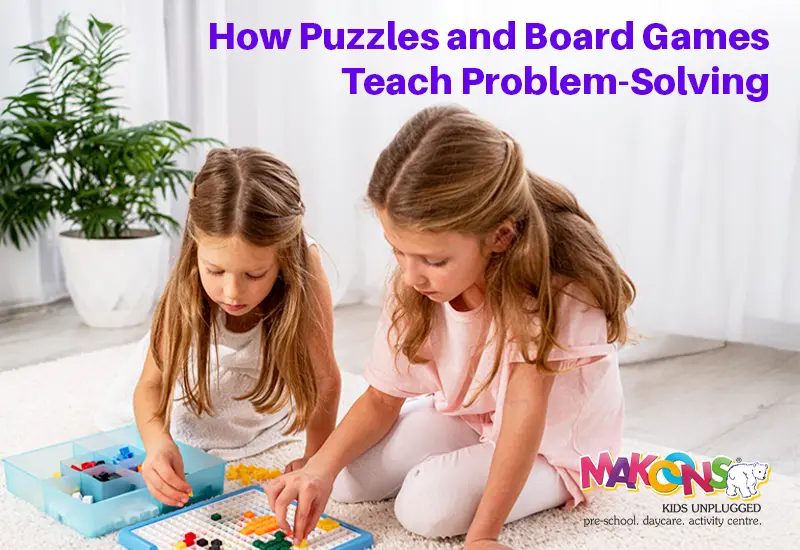
Early childhood education is much more than identifying letters and numbers, it encompasses building skills of life that children will carry through their school years and beyond. One of the most effective and enjoyable means to build these skills is by utilizing puzzles and board games. Whether children are fitting shapes together, matching pieces, rolling dice, or moving game pieces, the playful interactions help children learn important problem-solving, logic, and cognitive flexibility, just to name a few.
In this blog, we will examine the reason puzzles preschool learning and preschool board games are important in developing children’s thinking skills, how they foster patience and teamwork, and what specific skills they nurture. We will also provide practical examples of similar problem-solving activities that preschool teachers and parents can implement, as well as, discuss the long-term benefits of games in everyday learning.
Why Problem-Solving is Crucial in Early Childhood?
Problem-solving is more than arriving at an answer, it is developing the ability to think critically, decide between alternate options, and persist through overcoming obstacles.. Within a preschool setting, these skills become milestones that could include the following areas:
Cognitive Skills: How to think analytically, logically, and have the ability to recall experiences.
Social Skills: Working productively and cooperatively with peers, and learning respect for one another’s space and ideas.
Emotional Self-Regulation: When problem-solving may seem impossible or challenging, how to manage that sense of frustration.
Creativity: Thinking of multiple approaches to the same solution, and wondering….”What can I do differently?”
When preschoolers are presented with planned activities like puzzles or board games, they are given early exposure to real life problem-solving strategies that require practice on concepts such as planning, strategy, and decision making. These are foundational skills where level represents early stages of thinking that can develop over a lifetime.
Related Topic: Problem-Solving Exercises / Activities for Preschoolers
How Puzzles Improve Thinking Skills?
1. Developing an understanding of logical relationships
Puzzles preschool learning are skills exercises in a sense of logic. For example, if a child fits a square piece into the square hole, he or she is learning about spatial movement, cause and effect, and even classification. This is the basis for preschool logic activities they will experience later in math and science: using logical reasoning to make sense of their environment.
2. Building memory and attention
Puzzles also require attention. A child must remember the pieces already tried and where specific colors and shapes belong. It requires effort to stay attentive while developing memory skills. Research confirms that memory and attention improve cognitive skills greatly and these were present in puzzle play when children are engaged.
3. Highlighting patience and persistence
No one solves a puzzle instantly, some time is spent trial and error. When children are challenged but continue to try, they are learning to persist, which links with all types of problem solving. This level of tenacity in the face of frustration allows children to reason about problems with confidence later in life.
4. Supporting fine motor skills
Picking up, examining, and fitting together pieces significantly develops hand-eye coordination. While some may view these developments as physical tasks, they are also related to mental development, as children learn to use some coordinated efforts, reflection and detail in strategies to address the “problems” created by puzzles.
Related Topic: How Pretend Play Teaches Kids to Solve Problems?
How Board Games Play a Role in Problem-Solving Skills With Preschoolers?
The aspects of social problem-solving are included with preschool board games. While puzzles are often exclusive or an individual activity, preschool board games offer cooperative play, with the addition of rule following, and strategic play also.
1. Learning rules and structure
Each board game has rules and following the rules promotes discipline and fairness while practicing around rules. Understanding shared rules is a needed skill in problem-solving in the larger environment outside the board.
2. Fostering Strategic Thinking
Simple games such as “Snakes and Ladders” or memory card games, allow kids to strategize their next move, anticipate the outcomes of those moves, and change their strategy once they realize things don’t work out as expected—this is part of preschool age thinking development.
3. Developing Social and Emotional Skills
Taking turns, celebrating winning, and handling losing, these are all part of problem solving challenges preschoolers face in board games. Those emotional lessons are just as significant as thinking skills.
4. Promoting Math & Counting Skills
The rolling of a die, matching numbers, and counting spaces on a board, all encapsulate easy ways to build basic math skills. All of this relates to educational board games for kids, creating a balance of fun and developing numeracy.
The Benefits of Puzzles and Board Games in the Process of Problem Solving
1. Develop Cognitive Flexibility
Through the engagement of puzzles and board games, kids are taught there is more than one way to solve a problem, whether that is trying a new piece to a puzzle or picking a different strategy for the game.
2. Promote Decision Making
Preschoolers have to make quick decisions in board games. Over time preschoolers will begin to thoughtfully evaluate their choices, which is an important piece in problem solving.
3. Build Collaboration Skills
Group puzzles and team-based games, teach kids how to negotiate ideas, communicate, and compromise with others. Similar social skills also develop from outdoor play as well.
4. Less Screen Time
With the many concerns regarding kids being on screens for long periods of time during this, “digital age,” puzzles and preschool board games format a hands-on, interactive and brain stimulating option.
Related Topic: How to Solve 2×2 Rubik’s Cube:4 Easy Steps for Preschoolers
Problem-Solving Activities for the Preschool Classroom
Here are a few simple measures teachers can use to accompany puzzles and games into their daily lessons:
Shape Sorting Puzzles: Develops pattern recognition and logic.
Color Matching Boards: Develops memory and visual processing.
Basic Jigsaw Puzzles: Develops persistence and eye-hand coordination.
Memory Games: Develops recall.
Counting Board Games: Develops number sense, as well as problem-solving.
Role Play Strategy Games: Develops creative problem-solving in social situations.
By embedding these activities into one’s lessons, teachers are providing an enjoyable, engaging learning environment that engages children’s willingness to tackle challenges.
Problem-Solving Outside of School: Parent Involvement
Parents also can build problem-solving skills at home.
Listed below are a few simple ideas:
- Puzzles made at home with cut-out pictures.
- Family board game nights to create relationships as well as problem-solving.
- Daily requested challenges for your kids, like asking them to set the table or sort laundry into color and size.
- Story-based puzzles, where you are reading a story, and the child arranges the story in order with cards.
All of these activities provide a connection back to the learning involved in entertaining activities; they help carve out spaces that turn everyday moments into opportunities for growth.
Impact of Long-Term Puzzles and Games
- Children who puzzle preschool learning and board games for kids tend to:
- Show higher professionals when managing academic or social unwillingness to work.
- Show better skills in cooperative group work, both in school and in life.
- Have increased self-esteem as they see for themselves the success of independently solving a dilemma.
- Show increased academic readiness, specifically in math understanding, science learning, and logic.
These benefits are more than enough evidence why puzzle and games for problem-solving activities preschool should not be an option, but a life for children preschool program quality logic and schema.
Related Topic: What Are Some Unique & Fun Creative Exercises Preschool Kids Can Try?
Conclusion
During preschool years children are innately curious, and excited to explore. This is the moment in their lives in which initiating puzzles and board games, while keeping them entertained, creates rich affordances for the development of cognitive build and social intelligence.
Puzzles preschool learning builds patience, logic and concentration. Preschool board games create cooperatives, lessons of teamwork and problem-solving skills and adaptability to a more strategic game/situation.
If you are a parent, add more fun puzzle time at home. If you are a teacher, put games into your lesson plans. If you are providing preschool, understanding the quality of the preschool problem-solving activities children enjoy will be a selling point of your program as they are enjoyable.
What skills do board games teach apart from problem-solving?
Board games also teach important skills like teamwork, decision-making, and following rules. Kids learn to take turns, plan their moves, and handle winning or losing in a healthy way.
Are puzzles better than board games for learning problem-solving?
Both are useful in different ways. Puzzles mainly build individual thinking, focus, and logic, while board games develop social problem-solving, strategy, and communication skills. A mix of both gives the best results.
At what age should kids start playing puzzles and board games?
Kids can start with simple puzzles as early as toddler age, while basic board games can be introduced around 3–4 years. The key is to choose age-appropriate activities so children enjoy learning without feeling frustrated.
How often should children play puzzles and games for better learning?
Regular play, even for 15–20 minutes a day, is enough to build strong thinking skills. Consistency matters more than long hours, as repeated practice helps children improve gradually.







 Twitter