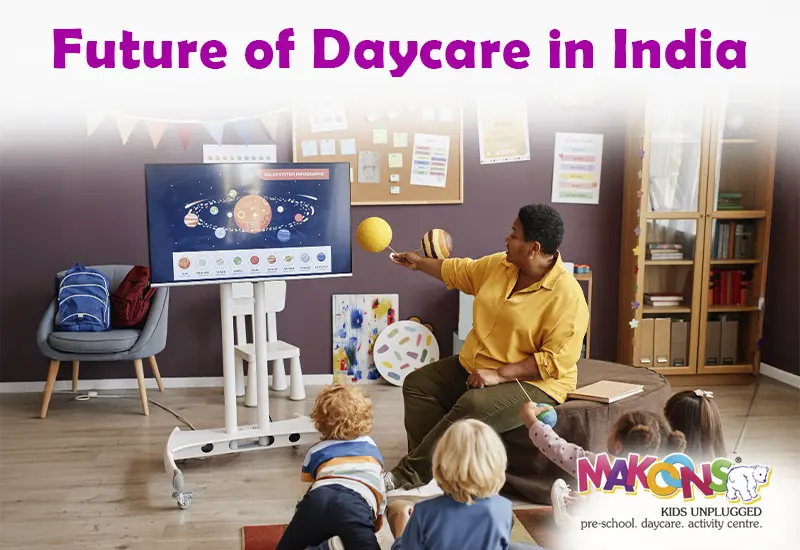
The child care industry is experiencing a major change in the social and economic environment of India which is fast changing. As the family set-ups have evolved, working-parent families have increased, and the topic of early childhood development has gained importance, the issue of whether daycare in India is going to be eliminated or not is more urgent than ever. This paper discusses the modern trends in the Indian daycare, the daycare governmental policies and policy, the future outlook of the daycare market and future implications of the childcare sector in India. We shall also touch the franchise opportunity of such Makoons Daycare and such like models in this growing space.
Market Growth & Projections
India is experiencing a healthy growth in the organised daycare and early childhood care industry. A report by IMARC Group shows that the size of the Indian pre-school/childcare market stood at USD 4.6 billion in 2024, and is expected to grow to USD 11.0 billion in 2033 at a CAGR of approximately 9.54 percent between 2025 and 2033.
A different research study by TechSci Research predicts that the preschool/child-care market in India will increase by USD 4.78 billion in 2025 and USD 8.56 billion in 2031 (CAGR of approximately 10.2). By all accounts, there is continuous speculation that the industry of childcare in India will experience a tremendous growth in the near future due to urbanisation, dual-income households, rising disposable incomes and changing parental demands.
To organisations and franchisors like Makoons Daycare, this translates to the fact that the market to be addressed is large and growing, an opportunity to scale operations, differentiate based on quality and take market share in Tier 1 cities and Tier 2 cities.
India-Trends that Have Influenced the Daycare Sector
a) Emerging of two-earner and nuclear families.
Families of Indians are increasingly having two working parents and fewer multi-generational families that can offer informal child-care. That increases the demand for professionally handled daycare services. As an illustration, according to IMARC, there are nuclear families and working women as the main driving forces of the market.
b) favouring full-day care + structured early-learning.
Instead of the mere custodial day-care, parents are demanding centers with provision of early learning, play-based curriculum and orderly routines. As analyzed by IMARC, the segment of full day care (as opposed to after-school care) is turning out to be a major source of growth.
c) Technological adoption & up-to-date infrastructure.
Digital tools, parent-communication applications, CCTV surveillance, smart classrooms and modular curriculum are in the ascending trend. The trend articles observe this change of trends in daycare in India.
d) Chain model expansion and franchise.
There is increased growth of organised players and franchise models. The differentiation is done through the use of standardisation of curriculum, branding, proven pedagogy and brand trust. This is in line with the expansion of the daycare/preschool market.
e) Service and place innovation.
The trends of daycare india also show that there is growth outside the city centres to commuter suburbs and corporate campuses. Service innovations are based on after-school care, workplace creches, and flexible hours (when working in shifts).
Related Topic: Best Daycare Franchise in India | How to Start Your Own
Government Policies/Regulatory Environment
The place of policies on the daycare scenario and the future of daycare in India is crucial. The following are some highlights of the major policy points:
a) basic schemes and early childhood care.
This scheme, the Integrated Child Development Services (ICDS), provides care, nutrition and pre-school education to children below 6 years as well as their mothers particularly in rural-low-income settings.
The government has realised the significance of the early childhood care and education (ECCE) during the lower years of schooling.
b) Day-care/creche policies & loopholes.
Regulatory frameworks are still disjointed even after growth. In an article by India today, it is noted that although there are a number of state specific laws that govern creches, there is a virtual lack of a national, uniform and comprehensive law on day-care facilities.
For example:
The Maternity Benefit (Amendment) Act, 2017 requires the provision of creche facilities in the laying off of more than 50 employees.
Subsidised childcare is provided to low-income mothers who are working through the National Creche Scheme (Palna).
c) Quality, safety and standardisation.
With the rise in demand, more attention is paid to safety standards, training of staff, child-staff ratio and infrastructure. Nevertheless, it is still not fully implemented as there are gaps between the implementation of the state level and the disorganized nature of many providers.
d) Implications to franchisors/providers.
Standardised Daycare chains and the franchise such as the Makoons Daycare that works in a more standardised way (quality, curriculum, brand) can enjoy the regulatory push. However, they should also guarantee compliance, high safety and documentation to be able to take the lead in this area.
The Future: Major Prediction and Opportunities
This is what the future of the daycare in India would probably be like and how the daycare market would develop.
a) High growth and segmentation still.
The space will grow considerably since childcare services in India are projected to grow at 9-10 CAGR in the period between 2025 and 2033.
Among that, the full-day care, after school care, corporate onsite daycare and hybrid digital and physical models will increase.
Providers will differentiate according to the age-group (infants, toddlers, pre-schoolers), hours of service (flexible, extended hours) and place (urban suburbs, office complexes).
b) The change to development instead of care.
Parents will also insist on not only supervision but quality early-childhood development – bilingual exposure, STEM-play, Montessori or Reggio, health and nutrition integration. Daycare will be more educational and not custodial.
c) Franchising and consolidation.
The organised (brands, franchises) will increase more rapidly than the unorganised. Those who climb up through various points, robust marketing, standardised curriculum and use tech in running their operations will be the leaders. This provides a massive opportunity to franchise-model in India.
Competitors such as Makoons can cash in on the brand loyalty, quality and repeatable business.
d) Tier 2/Tier 3 city expansion
Although the metros and Tier 1 cities will be hot, the Tier 2 and even Tier 3 cities which are experiencing growth in working-parent households, an increase in income, and a lack of branded daycare will be of great growth.
e) Regulatory maturation and focus on quality.
Regulatory frameworks in the market will tend to tighten up as the market expands. The providers with the best-practice safety standards, educated employees, certified curriculum and transparent operations will be distinguished and be able to charge high prices.
Related Topic: Daycare Franchise Cost in India: Full Price Breakdown
Challenges & Caveats
No growth story takes place without difficulties. In India, the childcare business continues to experience:
- Inequalities in licensing standards and differences in state-to-state regulation.
- Problem of affordability: not all the families can afford high-quality daycare, particularly in smaller cities.
- Lack of appropriately trained early-childhood educators and personnel.
- Space, safety, hygiene Infrastructure constraints (space, safety, hygiene) in most unorganised centres.
- Parent expectations and reality: with the increasing demand, it may be challenging to maintain the same level of quality in different centres.
Therefore, the future of daycare in India is bright, but the providers and investors have to deal with these threats and develop sustainably with quality-driven growth.
Stakeholder Implications
Entrepreneurs & Franchisors (e.g., Makoons Daycare): There are clear prospects of expansion at scale, with a structured franchise model, with particular focus on quality, brand and curriculum, and particularly underserved geographies.
- Investors: Daycare franchises are a good investment model due to their high growth and recurring revenue, although its success relies on the rigour of operations and suitability to the local market.
- Working parents: Have higher expectations of choice, extended hours of service (more), corporate tie-ups, and early childhood care of high quality.
- Policymakers: Must create better regulation systems, harmonise accreditation, promote safety and non-discriminatory access of different socio-economic lines.
Related Topic: Daycare Business Models in India: Which One Is Right for You (Home Based, Corporate, Premium, Hybrid)
Conclusion
To conclude, the childcare sector in India is at a crossroad. The future of daycare in India is projected to be growth and change – a move beyond bare bones custodial care to professionally run and technology enhanced daycare brands based on education. The industry trends in India are on full-day models, franchise expansions, more coverage outside metro cities and increasing quality expectations. As the outlooks of the market growth are good and the government policies that support daycare businesses gradually improve, the industry is ready to be exploited by smart investors, entrepreneurs and franchisors. In the case of a brand such as Makoons Daycare, the opportunity is considerable, though, they have to concentrate on quality, brand differentiation and scalable operations.







 Twitter