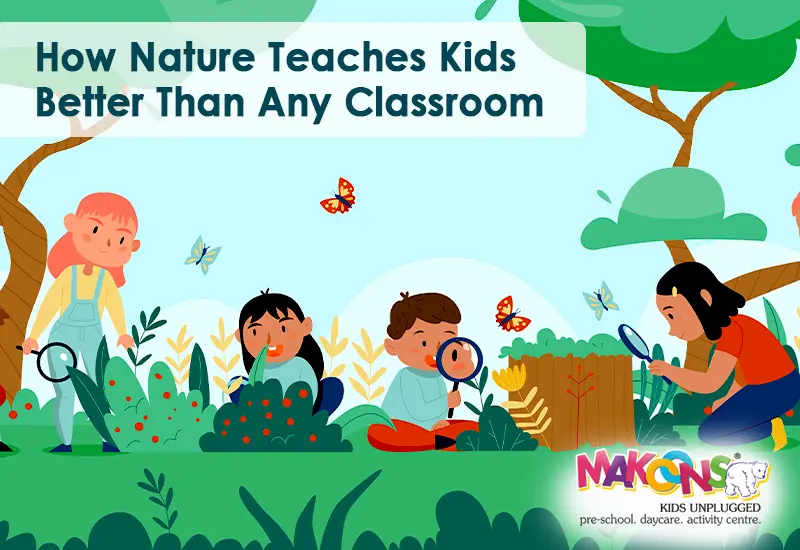
Children being children, they are explorers naturally. Provide them with a garden, or a park, or even a puddle and they will know innumerable ways to play, to inquire and to learn. Nowadays, with the advent of digital education where screens and formal education are the norm, field-based learning in children recovers the magic of the discovery.
The benefits of outdoor education extend far beyond exercise and sporting activities – nature fosters imagination, investigation, critical thinking and emotional stability. In simple terms, the best teacher a child would ever have is the natural world. Get ready to discuss the positive impact of learning nature on children to establish life skills, maintain emotional health, and enhance their cognition of the surrounding world.
Why Nature Is the Best Classroom?
There is a classroom that is constructed with walls and desks but nature is open, alive, and full of possibilities. Nature In nature all rustling leaves, all buzzing insects or running streams are lessons to be learned.
Learning activities in nature make learning a process to kids and not a memory. Children do not just read about science, they touch it, see it, and feel it.
For example:
- Math may be taught by counting pebbles.
- Biology is learned by observation of plants.
- Sandcastle building instructs on engineering and teamwork.
The best part? Kids do not even know that they are learning – as they are having fun.
Outdoor Education Advantages to the Children
Outdoor education has vast opportunities on children spending time outside because it results in academic, emotional, and social benefits. Nature does not only stimulate curiosity, but also builds up attention and self-confidence.
Enhances Inquisitiveness and Solutions
Children question when they see something new; when they see a leaf that they have never seen before. “What is this?” “Why does it look like that?” It is these natural questions that lead to exploration and self-directed learning – the basis of creativity and scientific thinking.
Improves Concentration
It has been found out that outdoor play alleviates stress and enhances attention tastes. Children that spend time in nature go back to their studies more focused and calm.
Promotes Cooperation and compassion
Outside settings encourage teamwork – be it in construction of a fort or on an adventure. Children are taught to share, communicate and respect the ideas of other people.
Improves Physical and Emotional wellbeing
Exposure to sunlight, movement and fresh air stimulates immunity and general wellbeing. Nature is also an emotional comfort, as it decreases anxiety and increases happiness.
Enhances Green Consciousness
With environmental education of the pre-schoolers, children grow up understanding that they are a part of nature and not different. This creates the feeling of responsibility in conserving the environment.
Related Topic: Learn 50 Fruits and Vegetable Names in English and Hindi with Makoons Preschool
Lessons that Children Learn Under the Nature:
Children learn through nature as a result of observation, play and curiosity. Nature, as opposed to the conventional classroom, promotes active learning – touching, smelling, exploring and discovering.
Among the main lessons that the children learn under the nature are:
- Patience – It is learning to wait and watch as plants grow or animals move around to show kids that good things come to those who wait.
- Flexibility – The seasons change, the weather changes – children are taught flexibility and toleration.
- Imagination – Castles are made out of rocks and magic wands made out of sticks. In the country imagination flourishes.
- Cause and Effect – Children observe the way things can affect the environment such as watering a plant or picking rubbish.
Nature never has a hurry-on-board – and that is the magic of it. It allows children to learn by doing, failing and trying again the very meaning of the true education.
Outdoor Games and Activities with Kids
You do not need a forest or mountain to initiate nature activities among kids, a backyard, park, or even a garden off the balcony can do miracles. The following are some of the creative ideas to start with:
Nature Scavenger Hunt
Prepare a list of things of nature: a yellow leaf, a feather, a flat rock, etc. and make kids find them. This develops observational skills and interest.
Leaf and Bark Rubbing
Make crayons and paper and trace the patterns or the texture of the leaves or a tree trunk. It is an excellent sensory and artistic experience.
Mini Garden Project
Kids should be able to grow herbs or flowers. By learning nature through this experience with kids they learn the concepts of care, patience, and the circle of growth.
Bird Watching
Ask children to watch birds, listen to callings and educate names. It gives more concentration and affection to living beings.
Outdoor Storytime
Take reading outdoors. Reading under a tree is a union of the environment and imagination, which is a potent combination in the creative process.
Such outdoor activities with children turn mundane environments into learning and fun living classrooms.
Educating Preschoolers on the Environment
It is the ideal time in preschool where environmental education can be applied among preschoolers. Young children are by nature animal, tree and outdoor lovers and therefore it does not take much to foster the relationship at a tender age.
Simple ways to start:
- Plant a Tree Together-Let kids call it by name and take care of it every single day.
- Recycling Games – Learn to sort up garbage in bins It is a fun color activity.
- Nature Walk Talks -discuss the dependence of plants and animals on one another.
- Art in the View of Nature Make use of leaves and flowers, also stones, in craft projects.
All these activities make kids feel that they are environmental heroes, as well as teach them the principles of empathy, sustainability, and respect towards all living things.
Related Topic: 20 Famous Dry Fruits Names in English and Hindi: With Benefits
Learning and Playing Outside: The Core of Development
Outdoor activities and education are not only recreational but also educational, emotional and very developmental. Children are independent and can make decisions because they play outdoors.
Climbing trees, jumping puddles, or making mud pies may seem to be made fun, but they are exercises in:
- Risk-taking and confidence
- Coordination and motor motor skills.
- Creativity and imagination
The freedom that nature provides to kids is that they can push boundaries without much risk, and the experiences gained allow them to learn. Nature appeals to all the senses and makes a well-rounded and confident child as compared to the screens or indoor toys.
Field Trips in nature for children
Kids’ nature learning experiences are not limited to school trips, outdoor activities once in a lifetime but rather they are familiar to the identity of a child. When a child associates with nature frequently, he or she becomes an adult who appreciates and conserves nature.
The following are some of the deeper learning experiences the nature provides:
- Observation: For ants to build a nest one learns how to concentrate.
- Cause and Effect: The curiosity on science is built by observing the way sunlight helps plants to grow.
- Accountability: Garden and pet care makes one responsible.
- Lesson: Sitting in silence in the open air teaches not to be too emotional and mindful.
All the breezes, all the bird music, or all the drops of rain become little yet significant instructors.
Conclusion
No book can be compared with lessons that nature teaches. From the smallest insects to the majestic trees, there is something that all the components of the natural world can teach.
Curiosity is fostered by nature based learning among kids. We promote confidence by means of outdoor learning and playing. And with environmental education of preschoolers we plant the seeds of responsibility and compassion. Children brought up in a natural way do not merely become smarter, he or she become wiser, kinder and more in touch with the world that supports them.
How does nature improve a child’s learning ability?
Outdoor learning boosts curiosity and critical thinking because kids are actively exploring instead of just listening. Studies also show that children who learn in natural environments often perform better academically and stay more engaged.
What skills do children develop through nature-based learning?
Nature helps children develop problem-solving, creativity, independence, and decision-making skills. Activities like climbing, building, or observing animals teach them how to think and act on their own.
Does spending time in nature help children emotionally?
Yes, nature has a calming effect on children. It reduces stress, improves mood, and helps them feel happier and more relaxed. Kids also become more confident and better at handling emotions.
How can parents and teachers include nature in everyday learning?
Simple activities like nature walks, gardening, outdoor games, or observing birds and plants can make learning fun. Even small outdoor experiences can help children connect with the world and learn naturally.







 Twitter