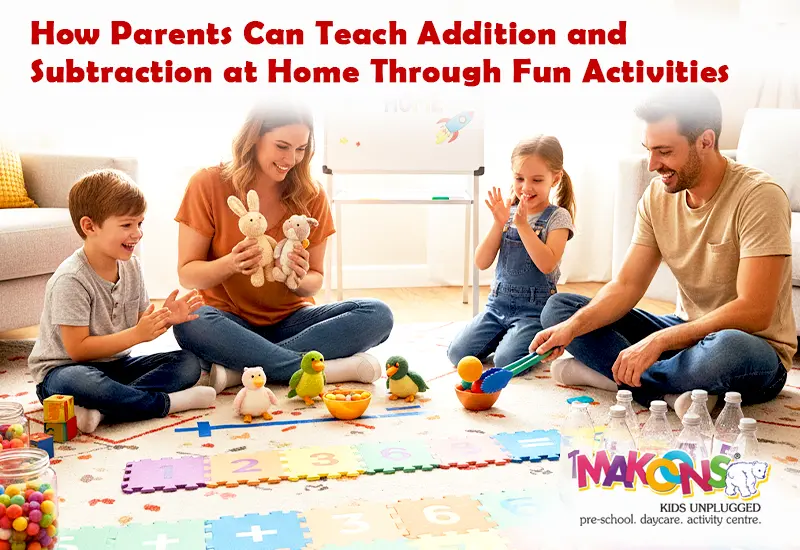
Mathematics is one of the most important skills children begin to develop in their early years. Among the first concepts kids encounter are addition and subtraction. While these may sound basic to adults, for children they are the foundation of problem-solving and logical thinking. Parents play a powerful role in building this foundation. With the right approach, teaching math at home can become fun, engaging, and stress-free.
This guide explores creative ways parents can introduce additional activities for kids and subtraction activities for kids through games, daily routines, and interactive play. The goal is to make play school math learning simple and enjoyable for young minds.
Why Parents Should Teach Math at Home?
While schools provide structured lessons, children often learn best when concepts are reinforced in a familiar environment. Here are some reasons why parents teaching math is effective:
1. Personalized Learning – Parents know their child’s pace and can adapt activities accordingly.
2. Everyday Practice – Math can be included in daily routines such as cooking, shopping, or playing.
3. Confidence Building – Children feel comfortable learning with parents and are less afraid of mistakes.
4. Stronger Bonding – Learning together makes math an enjoyable family activity.
Easy Ways to Start with Preschool Math Learning
Before diving into structured games, parents can start with easy math for preschoolers using daily situations:
- Count fruits while placing them in a basket.
- Add two toy cars to three and ask, “How many now?”
- Share snacks between siblings to show subtraction.
- Clap hands while counting aloud to strengthen number sense.
These natural interactions lay the groundwork for formal addition and subtraction activities later.
Fun Addition Activities for Kids
Addition becomes much easier when introduced as play. Here are engaging addition activities for kids that parents can try at home:
1. Toy Counting Game
- Collect small toys like cars, blocks, or dolls.
- Ask your child to take 2 toys and then add 3 more.
- Count together: “2 plus 3 equals 5.”
2. Dice Addition Race
- Roll two dice together.
- Add the numbers on both dice.
- The child moves ahead on a board or path by that total number of steps.
This works as a fun math game for children while reinforcing number bonds.
3. Snack Time Addition
- Use fruits, biscuits, or candies.
- Ask: “If you have 4 biscuits and I give you 2 more, how many do you have now?”
Kids learn while enjoying snacks.
4. Addition with Playing Cards
- Pull two cards and add the numbers.
- Whoever gets the highest total wins.
This keeps learning competitive yet fun.
5. Building Blocks Addition
- Stack blocks for each number.
- Add stacks together to visualize bigger numbers.
A perfect activity for preschool math learning.
Related Topic: How to Introduce Basic Math Concepts to LKG Students?
Fun Subtraction Activities for Kids
Just like addition, subtraction can also be taught playfully. Below are creative subtraction activities for kids:
1. Balloon Pop Subtraction
- Inflate 5 balloons.
- Ask your child to pop 2.
- Then ask, “How many balloons are left?”
2. Snack Sharing Game
- Place 6 grapes on a plate.
- Eat 2 and let the child count how many remain.
This turns subtraction into a fun snack-time activity.
3. Toy Store Role Play
- Set up a pretend toy shop at home.
- Give your child 10 pretend coins.
- Each time they “buy” a toy, subtract the cost.
This teaches real-world math applications.
4. Staircase Subtraction
- Start at the top of a staircase.
- Ask your child to step down 3 steps from 10 and count aloud.
- Movement-based learning keeps kids active and engaged.
5. Story Subtraction
- Tell simple stories like: “You had 7 apples. You gave 3 to your friend. How many left?”
- Children love stories, and math becomes memorable.
Fun Math Games for Children (Blending Addition & Subtraction)
Games that combine both operations make math exciting. Parents can try:
- Board Games with Numbers – Use snakes and ladders, but with addition and subtraction challenges on each turn.
- Math Bingo – Instead of regular numbers, call out problems like “2 + 3” or “7 – 4.” Kids must solve to mark their board.
- Treasure Hunt Math – Hide objects with math problems written on cards. Solving the problem leads to the next clue.
- Hopscotch Numbers – Write math problems inside hopscotch squares. Kids must solve before hopping forward.
These fun math games for children encourage learning while playing.
Tips for Parents Teaching Math at Home
- Start Small – Begin with numbers up to 5, then move to 10, and later to 20.
- Use Real Objects – Children learn faster when they can touch and see items.
- Keep It Short – Short, playful activities are more effective than long lessons.
- Encourage Mistakes – Mistakes are part of learning; celebrate effort.
- Repeat Regularly – Consistency builds strong math habits.
- Praise Success – Positive reinforcement boosts confidence in learning.
Related Topic: How to Teach Numbers 1–20 in Fun and Easy Ways?
Benefits of Learning Addition and Subtraction at Home
- Better School Readiness – Kids who practice math at home grasp lessons faster in preschool and school.
- Problem-Solving Skills – Early math builds logical thinking.
- Confidence with Numbers – Children grow comfortable with numbers instead of fearing them.
- Family Bonding – Parents teaching math make learning interactive and joyful.
Preschool Math Learning Beyond Numbers
Apart from addition activities for kids and subtraction activities for kids, preschool math also involves:
- Patterns – Arranging blocks in red-blue-red-blue.
- Shapes – Identifying circles, squares, and triangles.
- Comparisons – Teaching bigger vs. smaller, more vs. less.
- Sorting – Grouping toys by color or size.
These activities make easy math for preschoolers more holistic and connected to the real world.
Conclusion
Teaching math at home doesn’t require textbooks or complicated methods. With creativity and play, parents can easily introduce addition and subtraction to young learners. Whether through toys, snacks, or pretend games, children learn best when math feels like fun.
By practicing regularly, using real-life examples, and engaging in fun math games for children, parents can turn everyday moments into learning opportunities. With these methods, parents teaching math will not only build strong number skills but also nurture curiosity, confidence, and joy in learning. Math is everywhere at the dining table, in the toy box, and even in a simple family walk. With these ideas, preschool math learning becomes a happy journey that prepares children for a bright academic future.
Related Topic: What’s Inside a Preschool Syllabus? Core Subjects and Fun Activities Explained
FAQs
Q1. What is the best way to start teaching addition to preschoolers?
Ans: Start with real objects like toys or fruits. Use small numbers (1–5) first and make counting playful.
Q2. How can I make subtraction easy for my child?
Ans: Use daily situations like sharing snacks or removing toys from a basket to demonstrate subtraction visually.
Q3. Are games effective for teaching math at home?
Ans: Yes, fun math games for children keep them engaged, help with practice, and reduce fear of numbers.
Q4. How long should math activities last at home?
Ans: Short sessions of 10–15 minutes are enough for easy math for preschoolers.
Q5. Can preschoolers really understand addition and subtraction?
Ans: Yes, when taught through play, preschoolers quickly grasp basic addition activities for kids and subtraction activities for kids.







 Twitter