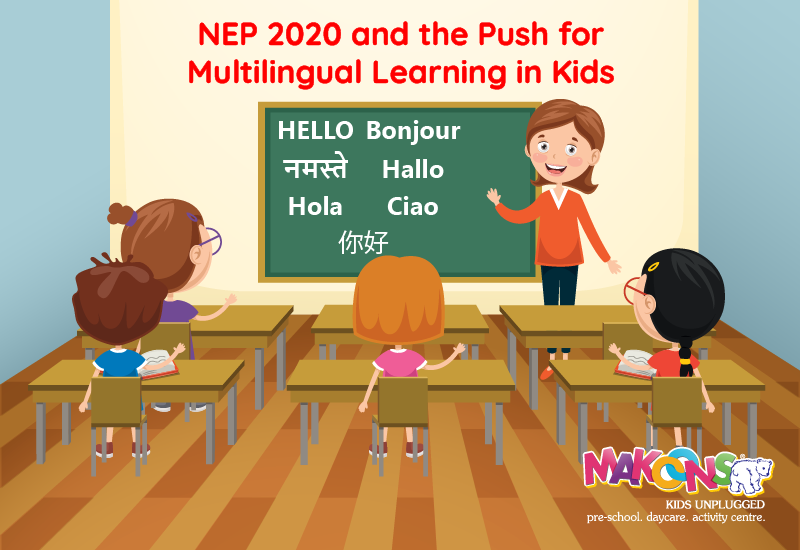
The National Education Policy 2020 (NEP 2020) in India marks an extraordinary transformation in early childhood education by establishing bilingualism in preschools as the foundation of language reforms. This momentous policy reform seeks to transform the way children engage with language in preschool environments and aims to provide the opportunity for all children to experience a variety of multi-lingual learning opportunities, which will facilitate cognitive and cultural opportunities for children.
The NEP Multilingual Preschool Vision
The new NEP multilingual preschool guidance encourages children to learn and interact in two and more than one language from the earliest years. While this initiative is intended to cultivate cognitive development and nurture children’s respect for India’s multilingual context, the NEP 2020 language policy outlines the mother tongue or local language as the medium of instruction especially for foundational years. If possible, children will start their learning in schools in a regional language, while English and other Indian languages will be introduced as subjects.
Reforming Language Preschool Education Under the NEP 2020
The preschool language reforms under the NEP aim to ensure every child has the opportunity to become proficient in two or more languages in a natural and playful learning context.
Central to this is the Three-Language Formula which requires preschool age and primary students to learn three languages (two of which should be Indian languages).
This education policy provides flexibility and allows schools and parents to determine and select the languages children will learn to meet the needs of their community, preventing a single language of implementation in schools from becoming a top-down policy.
The use of the mother tongue promotes understanding, learning with better academic performance and achievement in school.
Multilingual education NEP 2020 recognizes the cognitive, social, and psychological benefits of multilingualism for life. The research cited in the policy shows that comprehension in the child’s mother tongue or conversational and familiar language helps to lay the foundation for key concepts, logical reasoning, and communication skills. This should extend to at least Grade 5, or ideally Grade 8, as a balance of local languages and global readiness.
The Benefits of Multilingual Education and Multilingualism:
- Improved cognitive flexibility and brain development.
- Better academic achievement and reading comprehension.
- Greater empathy, cultural competence, and social acceptance;
- Stronger foundation for learning English and other global languages.
- The early language education NEP also supports language learning through natural acquisition, building language skills through story-telling and play-based activity in the child’s daily experience or local context.
- Instead of rote learning, children interact, sing, play, and read across their languages, with effective language distinction, conversing and developing literacy with the guidance of the teacher who is thoroughly trained on multilingualism.
- This environment is child-centred, with a focus on oral language proficiency across their languages, and readiness for future language acquisition. The NEP enables readiness for language acquisition, where children are able to explore, imagine, and do.
The Early Language Learning NEP – Preschool Curriculum
The preschool curriculum designed under the NCF-ECCE and supported through NEP, is also designed to accommodate multilingualism seamlessly.
The NCF-ECCE framework developed by NCERT demonstrates NEP’s vision with curriculum, pedagogy, learner support, and assessment, including:
- Inclusive lesson plans, introducing oral language in mother tongue, Hindi, English and other home or regional languages. Multilingual textbooks and digital e-learning resources across the DIKSHA platform, covering 36 languages (32 Indian and 4 foreign).
- Activities based on local culture, stories, and traditions that connect language development with culture.
- The curriculum is adaptive, allowing teachers and parents to choose the best route for their children.
The Second Language Multilingual Advantage in Preschool
Research unquestionably supports preschool age multilingual advantage for children exposed to two or more languages early in life. For instance, they:
- Utilize better memory and attention skills.
- Demonstrate better problem-solving and creative thinking.
- Adjust more quickly to new environments and cultures.
- Demonstrate greater ability to learn another language later on in life.
- Multilingual children are also good at thriving academically and socially in school, preparing them for 21st century connected lives.
Preschool Bilingual NEP Possibilities
Although the NEP stresses multilingualism, it also supports bilingual education approaches as a transitional path for under-resourced schools. In preschool bilingual NEP frameworks, home language and a second language (often Hindi or English) are introduced, and as children develop, those languages can be gradually stacked, and children will learn an additional language beyond their home language.
This type of bilingual education will equally distribute children across all homes, regions, and backgrounds to learn language early, in line with the principles of NEP 2020.
NEP 2020 Language Policy: Adaptation, Issues, and Innovation
The NEP 2020 provides an ambitious language policy, with changes that are difficult to adapt, when it comes to language policy for action.
Teacher Development: the NEP advocates for ongoing professional development to support teachers who work with multilingual education. This includes recruiting teachers who have a conversational level of fluency in more than one language, and building professional capacity for teachers of multilingual classrooms.
Resource Development: it is critical to develop high quality learning resources, digital resources, and supplemental resource materials in multiple languages.
Community Engagement and Parent Engagement: for change to be a success requires changing the attitudes of parents and communities around Mother tongue language education in the home and cultural communities in which children develop, particularly where there are cultures of resistance stemming from systemic constructs within societies.
Flexibility: the NEP encourages flexibility in language changes making it quite possible to grow-ing gradual changes in local settings.
Innovation is a key component of the NEP: There is a call for innovative uses of technology, mobile apps, and digital resources as means of creating accessibility and a fun and exciting learning experience for students and families.
The Cultural and Social Influence through Multilingual Education
The NEP preschool curriculum language policy supports language education linked to cultural education. For children at preschool age, when they learn via traditional songs, stories and values – it is critical for them to learn at least their local language and a second Indian language to strengthen their identity as children, to strengthen respect for diversity and pride in India’s plural tradition.
Children learn at NEP multilingual preschool classrooms, giving them practical skills by learning in the local language while learning languages together for learning in the many ways of being culturally respectfully, culturally plural.
Conclusion
It has introduced a substantive change in our approach to preschool and primary education, because of NEP 2020 language policy introduced a flexible, inclusive and culturally relevant multilingual approach to learning. This provides exciting opportunities for children and their potential as learners, scholars and creative citizens of a diverse global society. Teachers, parents and other educators need to collaborate to address future issues that will come from the loss of the right for every child to learn and clearly express themselves in more than one language, by across and within classrooms celebrating children’s learning of their home language to expand their learning journey.
Read Also : How Early Education Programs Impact Brain Development in Kids?






 Twitter