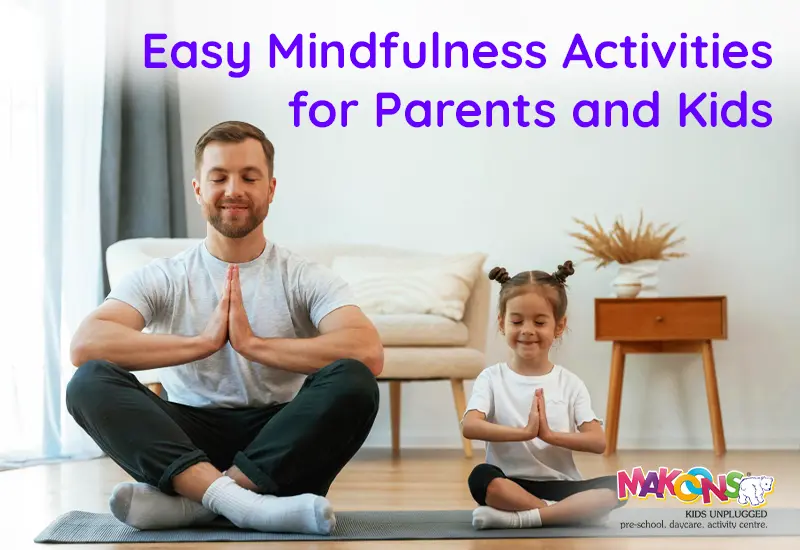
Mindfulness is more than just an ‘in’ thing; it is a helpful practice for all adults and children that can help all of us to have a little more peace, mindfulness, focus and relaxation in our lives. During early childhood, children begin the learning process of being able to regulate their own emotions, to focus and have an understanding of their world. Practicing mindfulness at an early age carries meaning that remains with the individual beyond that time. Mindfulness is also a meaningful process for parents to connect with their children, de-stress their lives and find balance in their world. The blog will share some simple, fun, clean and easy mindfulness activities for preschoolers and some ideas for families to do together at home. These activities will not only be fun, calm, and creative, but will also help support children in their development towards emotionally strong skills, as well as support a parent to practice mindfulness in their parenting.
Understanding Mindfulness In Early Childhood
What is Mindfulness?
Mindfulness doesn’t need to be complicated, expensive, or time-consuming! The best thing about mindfulness experiences is that they can be simple and short, which is developmentally appropriate for children! Here are a few easy ideas that parents and early years educators can try at home or at preschool!
Why do Preschoolers Need Mindfulness?
Children experience big feelings, and at times are not sure how to manage those big feelings.Simple and preschool appropriate relaxation exercises guide children on how to learn skills to manage frustrations and upsets, reduce anxious thoughts and feelings and gain more self regulation. Mindfulness activities also support kindness to others, and patience for themselves, and increased focus and attention.
The following are skills that will benefit children at home, at school, and through their life span.
Benefits for Parents.
There is benefit in practicing mindfulness for parents and caregiver as well. Mindful parenting will allow for more connection, less stress, and more patience. Mindful parenting models, what calm and presence look like in the moment for children, and allows children to practice doing that more often.
Core Mindfulness Outcomes for Children.
Emotional Development
Mindfulness supports child emotion awareness and a child mindfulness practice allows them to learn to pause, breathe, and reflect to respond (instead of crying or tantrums).
Attention Capacity
Working on child attention tasks will helps their attention spans improve. Activities such as mindful coloring, breathing, or general mindfulness, are all experiential ways to input longer attention spans with your child at bedtime, or during play, or learning experiences.
Sleep & Calming Techniques
Calming and relaxing meditative techniques for toddlers can foster good sleeping habits in children, while calming and relaxation meditations can help toddlers’ (e.g., young children) busy minds (or rapid-fire thoughts) slow down, and ultimately, help parents to assist children in a calmer transition to sleep.
Empathy and Compassion for Other People
Preschool experiences that foster wellness also encourage children’s compassion and kindness for other people, and eventually, gratitude. Learning experiences using mindfulness techniques are particularly useful for developing our connections with others and emotional intelligence.
Mindfulness Activities that are Appropriate for Development with Child Development
Mindfulness does not need to be difficult, expensive, or time consuming. The best part of mindfulness experiences is that mindfulness can be simple, brief, and appropriate for children of all ages! Here are a few straightforward ideas that you can try at home or in preschool.
Breathing Techniques
Breathing Balloon
Have children imagine a balloon expanding in their belly. The child will breathe in and imagine air filling their belly. The child will then let the air back out to return the balloon to its original size very slowly. This is a nice relaxation strategy for preschoolers and it is also a fun component to add and give a child the particulars to work in observing breath and being mindful about it.
Counting Breaths
Give a number. When the child inhales, have them count “one” and as the child breathes out, count “two.” Continue upto 5 breaths. This process helps with maintaining their focus and in the process teaches patience.
Mindful Movement
Animal stretches
This is a fun-minded approach to practicing mindfulness. Icebreakers could include “stretch like a cat” or “standing long and/or tall like a giraffe” or “flap your arms like a butterfly.” The ideas of simple movement, being gentle, and fun for preschoolers incorporate wellness and mindfulness into a co-active activity as well as an awareness evolution.
Walking Mindfully
Ask the children (parents can join) to walk slowly around the room for a moment and notice their steps. Parents can also walk ‘mindfully’ with their child next to them quietly walking.Sensory Awareness
Hearing Awareness
While children’s eyes are closed, have them listen to the sounds around them, such as birds outside, people’s feet walking, ticking of the clock, etc. This experience creates a way to keep children’s awareness tight in a large environment and is also an opportunity to practice listening.
Touch and Feel
Provide the children with some different objects (a smooth stone, a piece of soft fabric, a pinecone) and ask them how the object felt. All of these types of preschool wellness activities are activities to practice observation and vocabulary in context.
Creative Mindfulness Color
Have your child use crayons to notice colors, strokes, and patterns of areas they fill in when possible. Coloring can be a stop of pause also where you might stop an activity like at lunch time and color.
Gratitude Drawings
Encouragement children, everyday also every week one time canvas and create a drawing of something they are thankful for. This practice also helps integrate being mindful as well as being thankful with their creativity.
Simplifying Meditation for Preschoolers
Meditation may feel complicated but it is more playful and short for preschoolers.
Guided Visualization
Parents can guide their children in visualizing a safe space or place they happy such as relaxing on the beach or a garden with simple and gentle words providing a descriptive practice. Guided visualizations would be a preschool type of meditation simple but gets children to feel released using their imagination as positive practice.
Teddy Bear Breathing
You can ask the child to rest on their back with a stuffed teddy bear on their belly while they look at the teddy bear rise and fall – just focusing on the teddy bear is a visual way to practice noticing our breath and to start breathing mindfully.
Loving-kindness Meditation
Children can also close their eyes and repeat phrases to themselves like, “may I be happy” “may my family be safe,” “may my friends be healthy.” This is a great way to combine some of the tips for children with compassion, and an extra way that mindfulness can be being kind to others.
Exercises for Child Learning Mindfulness that can be done at Home
Mindful Eating:
This invites children to slow down and eat their food mindfully, so they can notice the taste, smell etc. A single raisin works well, or a tiny piece of fruit. The meaning behind mindful eating is to give children the tools to be able to develop more capacity to focus and be intentional about eating and to not be in a distracted state during eating a meal.
Storytime Mindfulness
You could try stopping after a few pages of reading during story time and ask the child what they think the character feels. This builds empathy and allows children to practice being with their feelings.
Five Senses Game:
Encourage children to name five things they see, four things they touch, three things they hear, two things they smell, and one thing they taste. This fun little game will help them become present again.
Read more : Pros and Cons of Personalized Learning in Early Education
Mindfulness for parents
How parents can model being calm with children
Children will learn more from watching then they will from listening.The act of practicing mindfulness, as a parent, is really modeling calmness, patience, mindfulness.
Setting the tone in the home
When parents begin each day with some deep breaths and/or expressing what they are grateful for, parents are setting a tone that all children take notice of, and thus guide children to start each day in their parents calm presence.
Being present with your children
Be present with your children during the interaction and be fully focused. When playing or talking with children, be sure that you are not doing anything else. If the parent is present and puts down their phone to be engaged, then the parent is modeling mindfulness to help regulate stress.
Instead of getting stressed out, the mindful practice can look like taking a moment, pause, and breathe before reacting to your children.That itself is modeling emotional regulation of self.
Play and Mindful
Mindfulness and mindful practice does not need to feel like a “lesson”. If parents model mindfulness in the form of fun games, art or music, then your children will be engaged and ready to practice.
Musical Mindfulness:
Play soft music, and have your children sway, clap and/or move slowly to the music.
Nature walks
Go outside and explore with your child! Have your child begin noticing trees, leaves, clouds or flowers. Nature walks can be one of the easiest calming practices for children because they also connect the child to their environment.
Read more : Best Preschool Field Trip Ideas to Boost Learning & Fun
Bedtime Routine:
Create a mindful bedtime routine – use slow gentle breaths and/or storytelling to help your child transition to sleep, after play.
Opposition to mindfulness:
Attention Span Children will preschool-age probably want to be sitting still. Start with shorter sessions (usually no more than 5 min) and gradually increase length over time substantially, while You and your child are doing mindfully / mindfulness preschool activities.
Routine.
When you are doing mindfulness, you are generally more likely if you to practice for shorter, everyday periods (compared to a long but delayed practice activity). Consistency = habit!
Make it fun.
When children engaged in practicing mindfulness think even slightly it was like play, they will be more likely to be and aware. Using toys, songs, crafts, or images of mindfulness that are playful will continue to help facilitate mindfulness, however they choose to practice.
Example Daily Mindfulness Routine
The following example showing parents can work mindfulness into their typical daily routines.
| Time of Day | Activity | Benefits |
| Morning | Balloon Breathing | Starts off day focused and settled |
| Afternoon | Five Senses Game | Raises awareness and curiosity |
| Evening | Gratitude Drawing | Develops reflection and kindness |
| Bedtime | Teddy Bear Breathing | Supports restful sleep |
This routine takes an estimated ten-fifteen minute practice of each timing of the day.
Conclusion
Mindfulness is no exact or even nor does it tend to be optimal. Mindfulness is being mindful! Mindfulness is not always noble, but breathing activities, exercise (movement), mindful play games, short visualizations, and guided activities, they help children learn to: re-center, calm themselves, focus or celebrate feelings.
Parents benefit too, reconnect with being calm and peaceful time with your child.
Practicing mindful preschool activities are it is supporting families to connect each other and develop preschool practices of skills (practice into everyday families) of patience, compassion, and focus in even when challenging. Mindfulness is about being intention; even in simple, child mindfulness tips of mindful preschool relaxation practices or or mindful play activities that allow mindful children to connect to sensations that create interest in mindfulness, for children, activity that calms (all relate). Mindfulness is also process family growth and/or learning for both mourning enjoyment and otherwise!
Continuing, these habits sustain children’s emotional health (social/emotional wellbeing) and development of mental healthiness for families, and sustain calm families. Mindfulness is not simply a practice and practice with children, it is a repeated process of events, that brings or connection at end of the day we get, or as parents!!
Read Also : The Importance of Mindfulness Activities in Preschool Curriculum







 Twitter