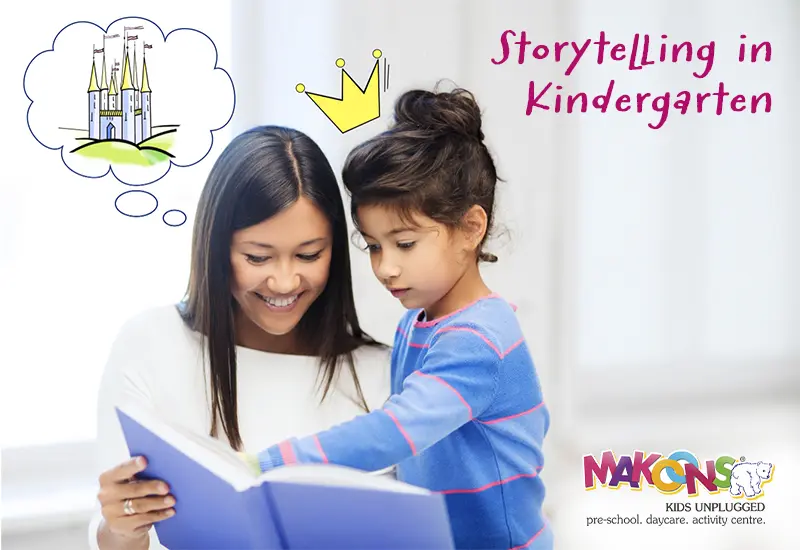
Stories begin to provide windows to other worlds very early on in life. In the busy preschool environment, they provide a bridge to children’s play, learning, and social interaction on a daily basis. Children can exercise their imagination and creativity in the preschool environment if stories are used effectively, to spark a love of learning they would carry for life. Stories provide an engaging environment for children wherein active learning can occur, children can build, visualize and retell wonderful adventures through storytelling.
Developing Kids’ Imagination and Creativity
- Storytelling is a catalyst for children’s creativity because it gives them permission to create settings, characters, and events/facts inside their minds—not instead learning from pictures on a screen.
- As children hear stories and participate in storytelling, they conceive of voices, movements, and outcomes—or even invent their own twists and alternate endings.
- These opportunities allow deeper thinking and unlock their minds’ more developed zones of imagination and experience and promote other creative thoughts from children.
- Children can become different characters and try on feelings/form impressions about things.
- Imagining resolutions inside of stories also promotes fledgling problem solving and empathizing.
- Open-ended stories are especially good at developing flexibility and independent thinking.
Enhancing Language and Literacy Abilities With Storytelling
Sharing or reading stories aloud, on an ongoing basis, is one of the best ways to increase their vocabulary, comprehension, and pronunciation skills. Here is the way they learn through storytelling and practicing the skills required before falling into the trap of developing incorrect habits.
Learning Words Through Storytelling:
- Narrators may stop the narrative and explain difficult words to expand vocabulary.
- Children can be asked to repeat words (echo storytelling) to develop recall and pronunciation.
- Stories introduce patterns (language patterns), rhythms, and rhymes—all of which are essential.
Sharing and Promoting Stories:
- Storytelling is unique in how it promotes both attentive listening skills and increased attention span, two important factors necessary to achieving reading success.
- Academic research has established that early and regular exposure to narrative structure helps students develop better literacy skills, and enhances their ability to be effective communicators.
Storytelling Supports Social, Emotional, and Cultural Awareness
- Children who are part of storytelling experiences learn about characters with either challenges they face, working with others, how to demonstrate emotions, or how to resolve interpersonal conflict.
- This structure of developing empathy relates to work in kindergarten social development and social emotional intelligence.
- Technically with storytelling, we are demonstrating working collaboratively with a willingness to sacrifice for the greater good, being engaged in storytelling as a group, and of negotiating.
- Culture based storytelling experience also developed respect and awareness of those who are different from us.
- When the children are engaged in co-creating the story or discussing the story they are generating patience, listening, and consideration for another point of view.
- By engaging children in a storytelling experience (e.g. voice, puppets, gestures, or role playing) children are contributing to memories and state of friendships in groups in the classroom.
Practical Application of Storytelling for Kindergarten
Keep it fresh. Mix the read aloud, dramatization and/or creatively add to the retelling. Below are some fun ideas: Below are some fun ideas:
Circle Time Storytelling: Children are all seated in a circle, read the story, and ask students to retell either random events, or their favorite character types in the story.
Story Bag: Put various items into a bag that vary in size and shape (puppets often work best); select some of the items in random order, and come up with a story.
Echo Storytelling: Kids repeat punch words, sounds, or character sounds with you, many stories even work well for this.
Role-Play Stories: Children act out stories or take on the characters in a story. This is good context for language, emotions, etc.
Story Mapping: Children retell a story mostly by drawing.
Story Retelling: Ask children to retell stories in a variety of ways. Remembering and story acting or drawing are examples of practice to support recall through story retelling and build confidence in storytelling.
Story extensions: Once a story has concluded, ask the question (or questions) “What happens next?” “If you were the character what would you do?”
Vocabulary Builders: Use opportunities within classroom routines to make connections to the key words in the story to things in real life, actions in real life, and emotions in real life.
Building a rich storytelling environment
- Carve out time during the day where it is storytime so children have a real sense of routine and expectation from it.
- Create a comfortable space to gather for story-time (the “story corner”), and use puppets, costumes, or props to suggest stories to create.
- Diversify stories based on genre, cultures, or story length. The more exposure, the better!
- Encourage children to share family stories or assist in the creation of new stories.
- Invite learning by creating a wall of words (with specific words from stories), drawings from stories, as well as recommendation on additional stories.
- Educators could also use technology in the forms of digital storytelling, virtual ‘guest story tellers’ in order to enhance children’s exposure.
Enhancing Child’s Creativity through Storytelling
- Allow children to create their own ‘creative endings’ to stories or have them illustrate again the scenes that they continue to imagine in their minds.
- Provide ‘choose your own adventure’ series or branching story books to help the child understand making decisions in storytelling.
- Connect storytelling to art, music, dance or play so children can have multiple opportunities for sensory engagement in stories.
Read more : Easy Interesting 20 Short Story in English With Moral For Kids
Benefits at a glance
| Area | Storytelling Impact |
| Language Skills | Expands vocabulary, improves pronunciation |
| Literacy Skills | Boosts listening, comprehension, and recall |
| Imagination | Sparks creativity, flexible thinking |
| Social Skills | Builds empathy, patience, conversation |
| Emotional Intelligence | Teaches emotion awareness, regulation |
| Cultural Understanding | Broadens worldview, appreciation, respect |
| Confidence | Supports public speaking, self-expression |
| Classroom Community | Fosters laughter, bonding, routine |
Conclusion
In a world where screen time is overly common, storytelling in the kindergarten classroom is seen as one of the most modest but effective vehicles to promote imagination, language and stimulate a life-long learner! Early childhood educators and families can create the building blocks of literacy by embedding storytelling in the everyday classroom routines, exploring the pictures in picture books along with creative collaboration, and enhanced children’s ‘story-telling voice’ so they can engage in reading alouds either in the classroom or home! This creates ways of developing literate, creative, and emotionally resilient children! When children engage in activities around storytelling, children become better listeners, better thinkers (e.g. think through their decisions), and better communicator. Children come with such a budding vocabulary, self expressiveness, or social awareness and understanding that create the building blocks for academic and personal success. The joys of storytelling and audience engagement will create your child’s world rich with vocabulary, ideas and culture and dreams.
Read Also : Thirsty Crow – Famous Story with Moral for Kids







 Twitter