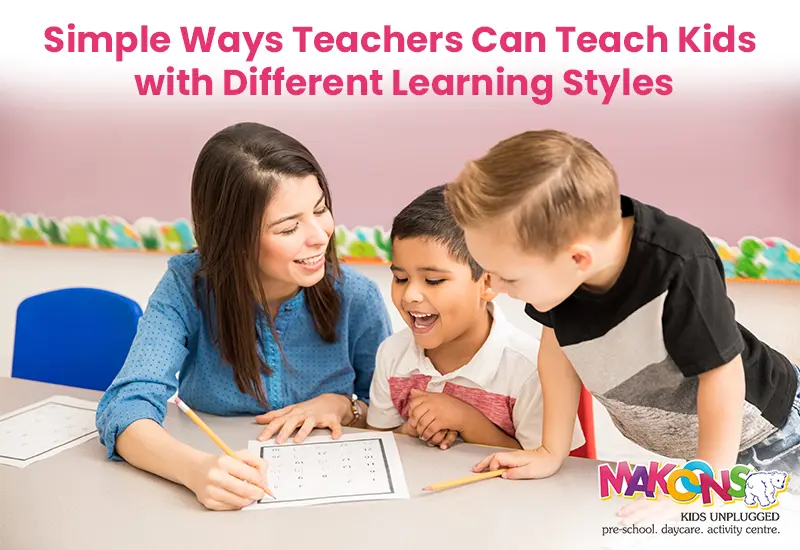
Every child is unique, not just in personality or interests but in how they learn best. Recognizing and encouraging learning styles of preschool children is about helping all young children become successful learners. Using the multiple intelligences theory of preschool learning, we can create many types of experiences to encourage each student’s strengths while providing engaging and shared learning activities. Below are some accessible teaching strategies for preschool aged children for each learning style.
Preschool Learning Styles and Understanding Multiple Intelligences
Children may be visual learners, auditory learners, kinesthetic learners, logical learners, musical learners, social learners, and solitary learners, or show some combination of these identified in Howard Gardner’s theory of multiple intelligences. Understanding these inform preschool educators in identifying best learning teaching practice to use within preschool learning styles, to better create inclusive preschool classrooms and celebrate as many children’ s successes as possible. Below are the intelligences:
- Verbal-linguistic (word smart)
- Logical-mathematical (number/reasoning smart)
- Visual-spatial (picture smart)
- Bodily-kinesthetic (body smart)
- Musical (music smart)
- Interpersonal (people smart)
- Intrapersonal (self smart)
- Naturalist (nature smart)
Differentiated Instruction Preschool: Why and How
Differentiated instruction preschool is a wonderful way to “match activity and/or presentation style to the range of learning preferences in the same classroom.” The benefits are enormous: better participation, more in-depth understanding, and happier, more confident children.
Activity-Based Preschool Teaching Strategies
Visual-Spatial Learners
Charts, picture stories, illustrated books, and visual schedules.
Allow children to create drawings, color, or create an artistic collage to demonstrate learning.
Add interesting preschool activities that include action: action songs, dancing, role play, or building. Incorporate opportunities for “movement breaks” and additional opportunities for hands-on learning.
In terms of logical-mathematical, consider activities that do sorting, patterns, counting games, and puzzles.
Choose materials like matching cards, nature collections, or simple “science detective” challenges to engage learners.
Musical learners
Sing songs, chant rhymes, and let children play with simple instruments.
Make connections to musical tunes by linking them to numbers, letters or daily routines.
Interpersonal learners (people smart)
Give youth time to work together, share, talk, and play partner games.
Allow children to teach each other new songs or skills.
Intrapersonal learners (self-smart)
Assign time to think and reflect independently, like journal drawing or personal daily emotions charting.
Celebrate individual children’s successes regardless of how small or large.
Naturalist learners (nature smart)
Plan activities that include doing activities in nature: taking a nature walk, gardening, or being outside observing animals or plants.
Use real leaves, rocks, and natural item collection, as well natural items, for counting, patterns, and recreating simple sets.
Preschool teacher strategies
Watch and rotate: Take time to watch how each child best absorbs concepts; rotate your teaching experiences.
Mix activities: Mix ways to address every learning style all the time, for example; a song (musical), with gestures (kinesthetic), and pictures (visual).
Small group learning: Break away from the whole group to teach activities in small groups. The children can join the learning center in the small group according to their preferred way to learn that day.
Choice board: Choice boards provide a menu of connected activities. Provide children the option of choosing to draw, build, sing, or tell a story about the same topic.
Class collaboration: Celebrate each other’s differences—let “experts” (i.e. music lovers, builders, storytellers) teach peers in their favorite way.
Preschool learning styles approach: Sample fun activities
Weather center
Draw the weather (visual), sing weather songs (musical), and chart the weather (logical).
Dramatic play (community helpers!)
Put on costumes (kinesthetic), act out in role-play drama and tell a story (verbal), build related things (spatial) and take turns as customer and other helpers (interpersonal).
Nature collage project
Collect leaves and petals from nature to use for your project (naturalist), use glue to glue them into a specific plan (kinesthetic/visual) and talk verbally about the project (verbal), sort into by color or shape (logical).
Preschool classroom hacks learning styles
Use color coded or labeled pockets (or boxes) in order to have all learners supported when organizing and keeping materials in storage known and neat.
Keep music handy to play during transition times—music helps calm animated students or refocus your students during transitions.
Provide individual “calm corners” desks or tables that have finger puzzles or quiet time activities for kids who may need calm time.
Use children’s charts, and visuals and emotional thermometers keep at their eye level posters for coordinating children’s created ideas.
Teacher encouragement/assessing
Confirm that a child’s effort and thinking can surpass an emphasis on “correct” answers. Each time you give feedback for efforts and/or taking risks, let them know “what a great story!”, “what a creative solution!” etc. Lastly, encourage children to regularly share their thinking with words- either verbally or in writing or with pictures to represent their thinking and show their process of reasoning.
Conclusion
Preschool is an appropriate time and place to acknowledge the ample ways learners learn. Supporting a play-based teaching philosophy and incorporating purposeful, strategically planned learning experiences, preschool teachers/educators ensure children feel heard, valued and when possible, successful. With a preschool classroom management style that incorporates games, songs, stories, guided and independent investigations, group play, and outdoor nature based play every child has the opportunity to shine and develop their passion for learning.
Read Also : Teaching Kids to Love Challenges While Learning







 Twitter