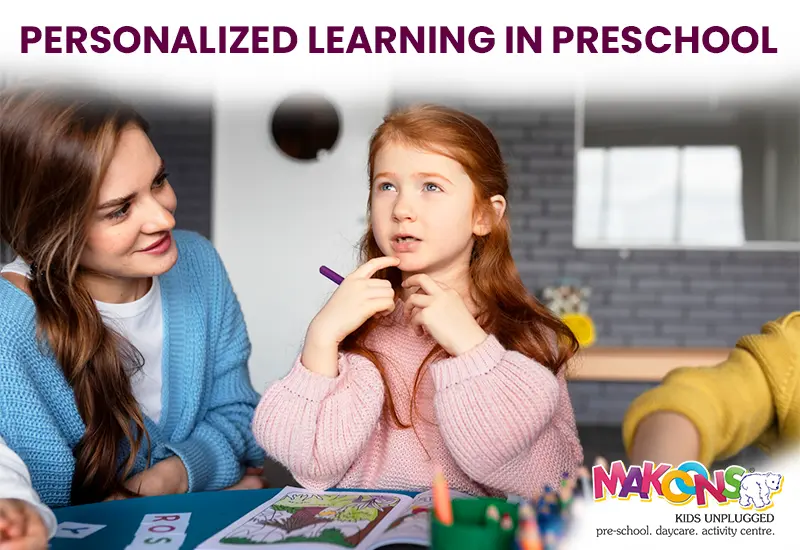
The personalized learning movement is a growing trend in the early learning environment which intends to make instruction customizable to the student and provide options based on their needs, pace of learning, and interests. While this child-centered learning model has the potential to harness the strengths of a young child, it is important for caregivers and educators to assess both sides of personalized learning in preschool education. The following is an overview of the pros and cons of personalized preschool teaching strategies, why these strategies matter, and how to provide a lens of innovation and tradition to support all preschool learning styles in practice.
What is personalized learning in preschool?
Personalized learning in preschool means adapting lessons, activities, and pacing of progress directly to the needs of each individual student, rather than treating each child the same. This could look like:
1. Teachers modify presenting reading and writing stories, projects, or games as an interest to a child’s development and abilities.
2. Using adaptive digital tools that provide feedback to the learner, while allowing for children to set their own pace.
3. Setting up activity centers to allow for different learning styles including art, building, and reading to accommodate needs.
4. Observing and assessing often enough to notice the strengths and gaps, as well as preferences in how each child displays learning.
5. This is often described as personalized learning in preschool or adaptive learning for children, since this puts the child in their own learning pathway.
Pros of Personalized Learning in Early Learning
1. Flexibility and Support
Children learn in assignments-several different ways; visual, physical movement, or through song. The models of personalized learning address the differences in preschool learning styles by including content presented in many ways, which can lead to deeper understanding.
2. Promotes Independence and Engagement
When children get to choose their own activities and have a say in the decisions that affect them, their natural curiosity becomes heightened and this translates directly into ownership, engagement, and intrinsic motivation. Children take their own pace, and the environment has a greater chance of facilitating children to continually be somehow invested in their learning opportunities.
3. Covers Learning Gaps and Stretch Potential
Personalized learning applications enable teachers to easily intervene when a child is having difficulty with a specific skill or to advance to the next topic when a child is excelling; the model allows for individualized records and gives more targeted feedback and support that can avoid boredom and frustration.
4. Encourages Critical Thinking and Decision Making
Preschool teaching practices that allow children to choose their own activities and to investigate more open-ended problems that allow for higher level thinking and hypothesis making promote higher-order thinking, problem solving and self-assessing.
5. Builds Confidence and Skills for Life
Choosing activities, managing a project, and keeping track of their own progress encourage the development of executive function skills—such as goal setting, time management, and perseverance, even at an early age.
Cons of Personalized Learning in Preschool
1. Resource and Cost Implications
Personalized learning in preschool can have significant resource and cost implications, both in your budget and through needing extra materials, more teacher planning time, and where digital resources are involved, money for technology and training your staff for the use of technology; this can put additional strain on already stretched and strapped school budgets and in some cases entire communities.
2. Equity and Access Gaps
Not all children have equal access to use of high-quality technology or a family at home to support their new learning opportunities. Without sufficient thought and planning, personalized learning may worsen achievement gaps related to family circumstance and family access.
3. Training of Teachers and Workload
The effectiveness of personalization processes has considerable implications for the training of teachers in assessment, use of technology, use of flexible lesson plans related to age appropriate and individualized recommendations. It creates planning and administrative work, and adds on to already full plates.
4. Limited Social/Peer Learning
When we over- personalize children, they could lose out on collaborative play, group projects, and important social-emotional learning opportunities. Making sure we are balancing individualized work with group work seems to be crucial for their entire development.
5. Assessment and Curriculum Mapping
It is not easier for the educator to have children following their own individual paths, while still being able to meet the overall curriculum expectations/curriculum guidelines or external regulation guidelines.
How do we find a balance for preschoolers’ personalized learning for an equitable education?
Here are some strategies.
1. Mix Individualized and Group Activities
Mix self-choice activities with explicit teacher-led circle times, songs and partner games to provide space for children to benefit from both self-paced learning and group-based learning.
2. Mindful Use of Technology
Limit how much screen-time young children can experience and provide high-quality adaptive technology, providing tools that enhance, not replace, hands-on exploration/creativity, and face-to-face experiences.
3. Ongoing Staff Professional Development
Make ongoing professional development available for educators that allows staff to feel confident in assessing, differentiating, and supporting children’s differing needs (including special needs)
4. Equity planning
Make access to resources and support available to all children, including the children identified as having special needs, or who have had less access to similar experiences outside school.
5. Monitor and Measure
Make sure you are constantly observing and checking in for progress. Use that evidence to adjust so all children are moving forward—not just the child who is quickest, or has access to more support.
6. Engage Families
Ask families to share the strategies that are working, share what their children learn at school, and suggest practices they can complete at home to make each environment more connected.
Conclusion: Should Personalized Learning be Done by Every Preschool?
Personalized learning in preschool has the opportunity to elevate educators’ experiences; and to help each teacher get to know each child- therefore harnessing a meaningful way to support each child as they learn and grow, while being challenged in their own unique way. All of this still must be mindful of equity, resources, and social development. By being able to combine child-centered learning, focused assessment
Read Also : Preschool vs Home Learning: Which Works Best for Toddlers?






 Twitter