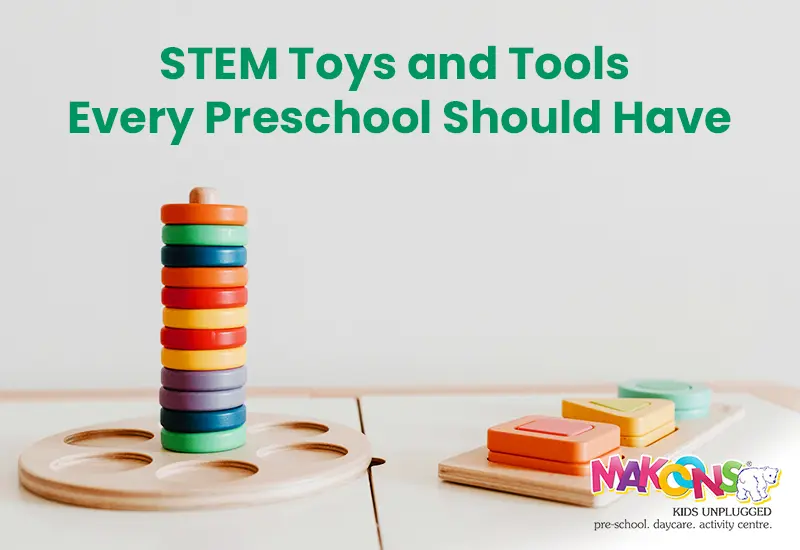
Preschool marks the beginning of a child’s personal exploration. A child of this age tests ideas, asks inquisitive questions, and simply delights in the act of playing. Such a child is best introduced to STEM concepts at this age for specific reasons.
STEM represents Science, Technology, Engineering, and Mathematics. However, for young children, it does not imply difficult lessons. STEM education is offered to preschoolers and it involves enjoyable activities, play-based learning, and basic experiments.
The right toys and tools can make this journey exciting. With the right resources, teachers and parents can turn playtime into learning time. In this blog, we will talk about the best toys and tools every preschool should have. These help in STEM education for preschool and make learning fun.
Why STEM Toys Are Important for Preschoolers?
Preschool kids learn best through play. They are too young to sit for long lessons. But they love to touch, build, sort, and create. STEM toys give them this chance.
- They build curiosity. Kids begin to ask why and how things work.
- They teach problem-solving. Children learn to try, fail, and try again.
- They encourage teamwork. Many STEM activities can be done in groups.
- They build confidence. Kids feel proud when they solve a problem.
- They connect play with learning. Blocks, magnets, and puzzles turn into mini science lessons.
For parents, STEM learning at home becomes easier with these toys. For teachers, these tools make preschool STEM ideas simple to use in class.
Tips Before Choosing STEM Toys
Not all toys are useful for learning. When buying STEM toys for preschoolers, keep these points in mind:
- Safety first. Toys should be safe, non-toxic, and without small choking parts.
- Simple to use. Preschool kids cannot handle very complex sets. Choose simple ones.
- Encourage open play. Toys that can be used in many ways are the best.
- Durable. Toys should last long because kids will use them daily.
- Fun. Above all, toys should be enjoyable. If kids enjoy, they will learn faster.
STEM Toys and Tools Every Preschool Should Have
Here is a big list of toys and tools that support STEM activities for preschoolers. These are easy to use at school and at home.
1. Building Blocks
Blocks are a must-have for every preschool. They come in wood, plastic, or foam. Children can stack them, build towers, or create houses.
STEM skills: Balance, shapes, design, problem solving.
Activity idea: Ask kids to build the tallest tower they can.
2. LEGO Duplo
These are bigger than normal LEGO pieces, so safe for small kids. They are great for creating cars, houses, and animals.
STEM skills: Creativity, engineering, patterns.
Activity idea: Create a simple color pattern like red-yellow-red and ask children to continue.
3. Magnetic Tiles
These colorful tiles stick together with magnets. Children love to build with them.
STEM skills: Shapes, magnetism, structure.
Activity idea: Build a small house and test if it stands strong.
4. Gears and Wheels Sets
These sets have gears, wheels, and connectors. Children can make simple machines.
STEM skills: Motion, cause and effect.
Activity idea: Ask kids to connect gears and see how one gear moves another.
5. Puzzles
Puzzles are simple but powerful STEM tools. They help children think and solve problems.
STEM skills: Logic, problem solving, patterns.
Activity idea: Start with simple shape puzzles. Then move to pictures.
6. Counting Bears or Beads
These small toys are great for math play. Kids can sort, count, and make groups.
STEM skills: Numbers, sorting, early math.
Activity idea: Ask kids to group by color or size.
7. Measuring Tools
Simple rulers, measuring cups, or tape measures are great for kids. They love to measure toys, books, or even their shoes.
STEM skills: Math, size, comparison.
Activity idea: Use cups to measure how many scoops of rice fill a bowl.
8. Balance Scales
A toy balance helps kids test weight. They can put blocks or toys on each side and see what is heavier.
STEM skills: Weight, comparison, math.
Activity idea: Ask, “Which is heavier, three blocks or one toy car?”
9. Magnets
Big safe magnets let children test what sticks and what doesn’t.
STEM skills: Science, observation.
Activity idea: Magnet hunt around the classroom.
10. Water and Sand Play Sets
Buckets, funnels, spoons, and cups are enough. Kids love pouring and filling.
STEM skills: Volume, capacity, cause and effect.
Activity idea: Ask kids to guess how many cups of water will fill a jug.
11. Simple Science Kits
Kits with safe items like droppers, magnifying glasses, and test tubes.
STEM skills: Observation, early science.
Activity idea: Use a magnifying glass to look at leaves or small toys.
12. Shape Sorters
These toys have holes in different shapes and blocks to match.
STEM skills: Shape recognition, problem solving.
Activity idea: Time the child to see how quickly they fit all the shapes.
13. STEM Story Books
Books with simple science or math stories are also tools. They inspire kids to ask questions.
STEM skills: Creative thinking, language + STEM mix.
Activity idea: After reading, ask kids to make something from the story using blocks.
14. Toy Tools Sets
Toy hammers, screwdrivers, and nuts-and-bolts sets are safe and fun.
STEM skills: Hands-on building, problem solving.
Activity idea: Ask kids to “fix” a toy using the tool set.
15. Art and Craft Supplies
Yes, even art is part of STEM. Paper, tape, and straws can turn into bridges or airplanes.
STEM skills: Creativity, design, engineering.
Activity idea: Ask kids to make a paper boat and test if it floats.
16. Measuring Balance Cubes
Small cubes that children can stack, count, and measure.
STEM skills: Counting, comparison.
Activity idea: Build a tower of 10 cubes, then compare with another child’s tower.
17. Toy Robots (Simple Ones)
Preschool-friendly robots can follow simple commands like moving forward or turning.
STEM skills: Basic coding, sequencing.
Activity idea: Ask kids to guide the robot to reach a toy.
18. Nature Kits
Simple jars, nets, or magnifiers for exploring leaves, bugs, or soil.
STEM skills: Observation, science.
Activity idea: Collect leaves and sort by shape.
19. Musical Instruments
Simple drums, xylophones, or shakers. They help children see how sound changes.
STEM skills: Sound, vibration, pattern.
Activity idea: Tap fast, slow, soft, and loud. Ask kids to copy.
20. Whiteboards or Chalkboards
Drawing and writing boards give space for kids to try numbers, shapes, and patterns.
STEM skills: Early math, drawing, logic.
Activity idea: Draw different shapes and ask kids to count the sides.
How to Use These Toys in Daily Learning
Having the toys is not enough. Teachers and parents must use them in the right way. Here are some ideas:
- Set up STEM corners in the classroom with blocks, puzzles, or magnets.
- Plan easy STEM projects for kids each week. For example, “Build a bridge strong enough for a toy car.”
- Let kids play in groups. Group play builds teamwork.
- At home, parents can use these toys for short activities after school.
STEM Learning at Home with Toys
Parents can make use of these toys daily. Here are some examples:
- Use measuring cups while cooking.
- Use magnets during playtime.
- Let children build towers with blocks while you work nearby.
- Read STEM storybooks at bedtime.
This way, STEM learning at home becomes natural and fun.
Benefits of STEM Toys for Preschoolers
When preschools use these tools, children get many benefits:
- Better thinking skills. Kids learn to ask, test, and solve.
- Confidence. They feel proud when they build or solve something.
- Teamwork. Many activities need working together.
- Creativity. Children use imagination while building.
- Love for learning. STEM education becomes fun, not hard.
Conclusion
STEM is not about giving big lessons to small kids. It is about letting them play, build, test, and imagine. With the right toys and tools, preschools can make this happen every day.
Blocks, magnets, puzzles, gears, and simple science kits should be in every preschool. These toys make STEM activities for preschoolers exciting. They also make it easy for parents to try STEM learning at home.
When children use these toys, they don’t just play. They learn to think, create, and solve problems. This is the real goal of STEM education for preschool.
So if you are a parent or teacher, start adding these toys to your preschool or home. Let kids enjoy learning through play. The best learning happens when children are having fun.
Read Also : Which Toys Are Best To Improve The Minds Of Children?






 Twitter